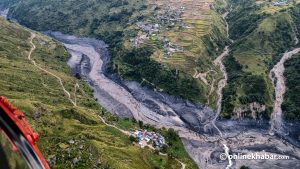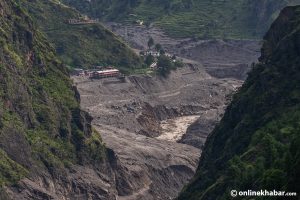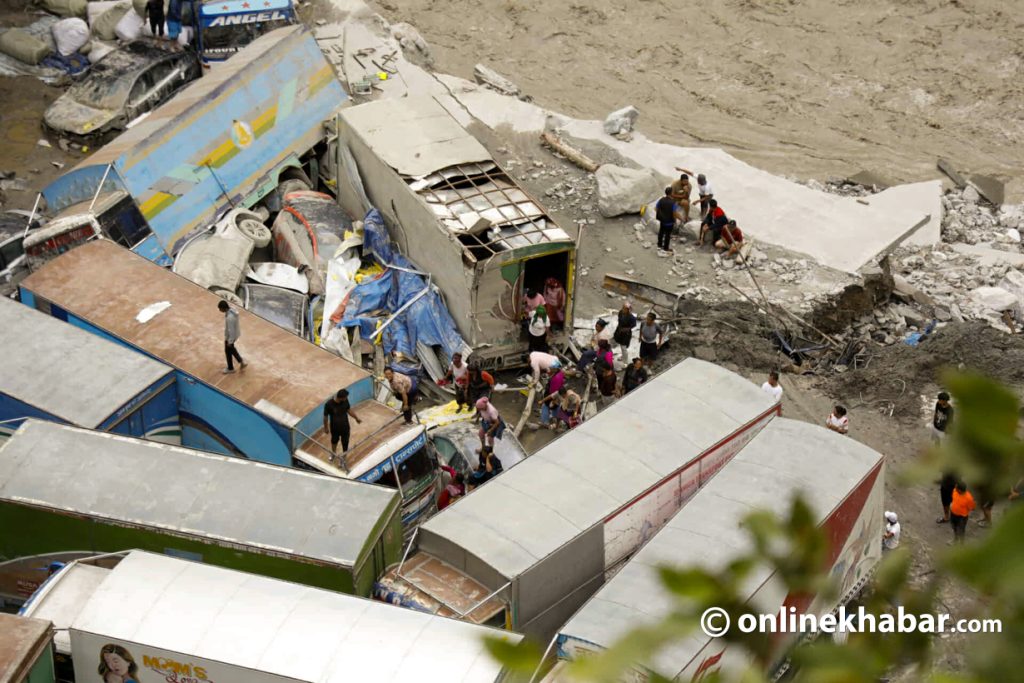

At 9:10 a.m. on August 26, head teacher Rajendra Dawadi received frantic phone calls about a flood heading downstream toward Tribhuvan Trishuli Secondary School. He ordered his roughly 900 students to run for higher ground.
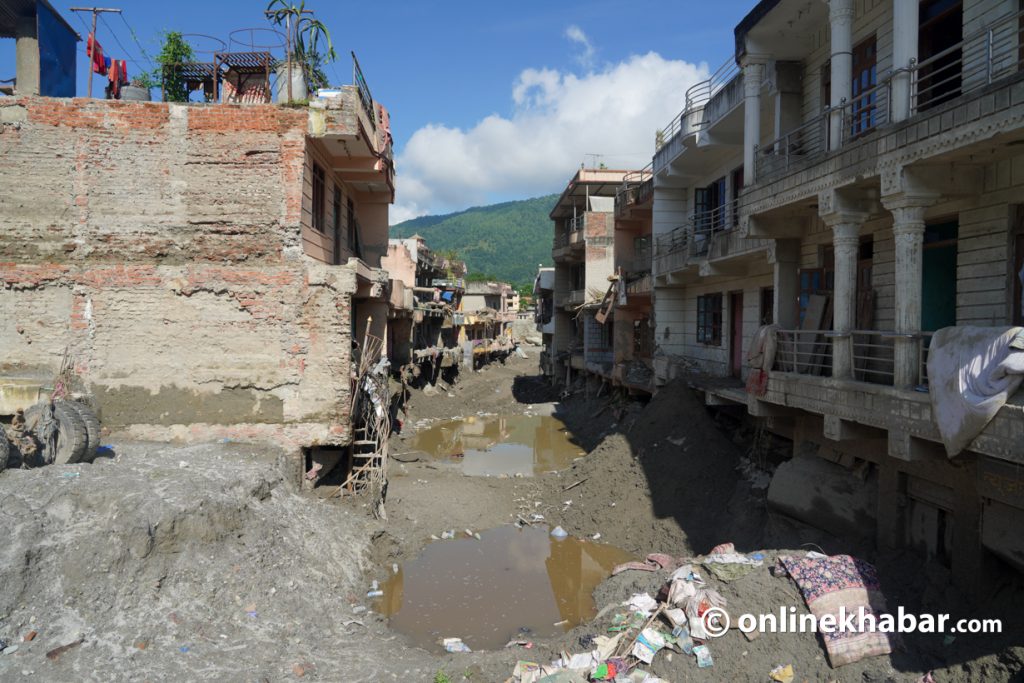
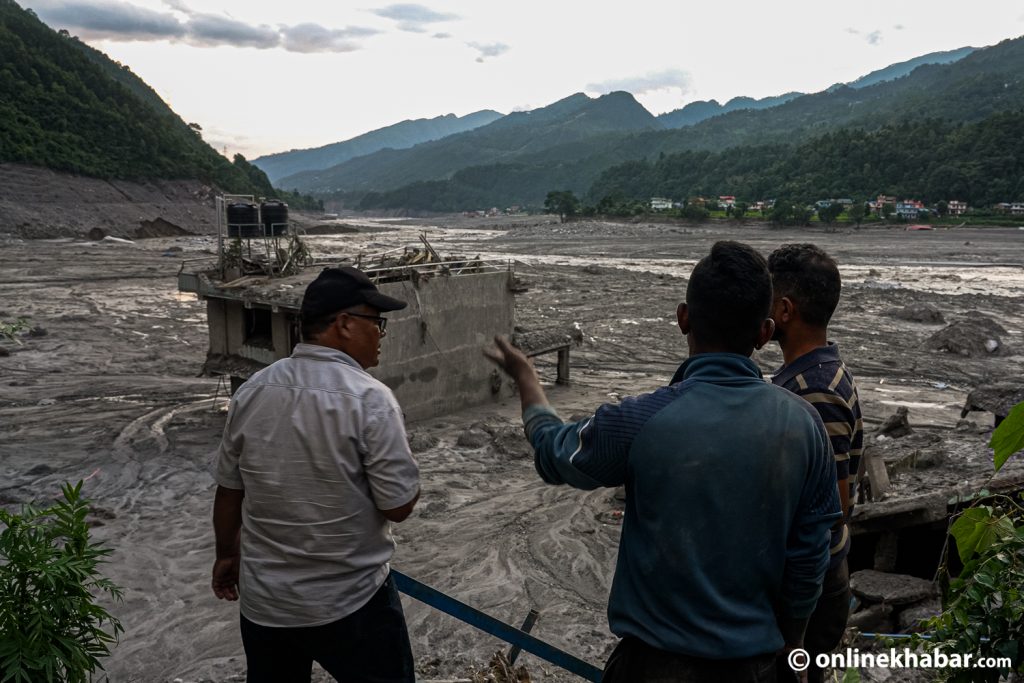
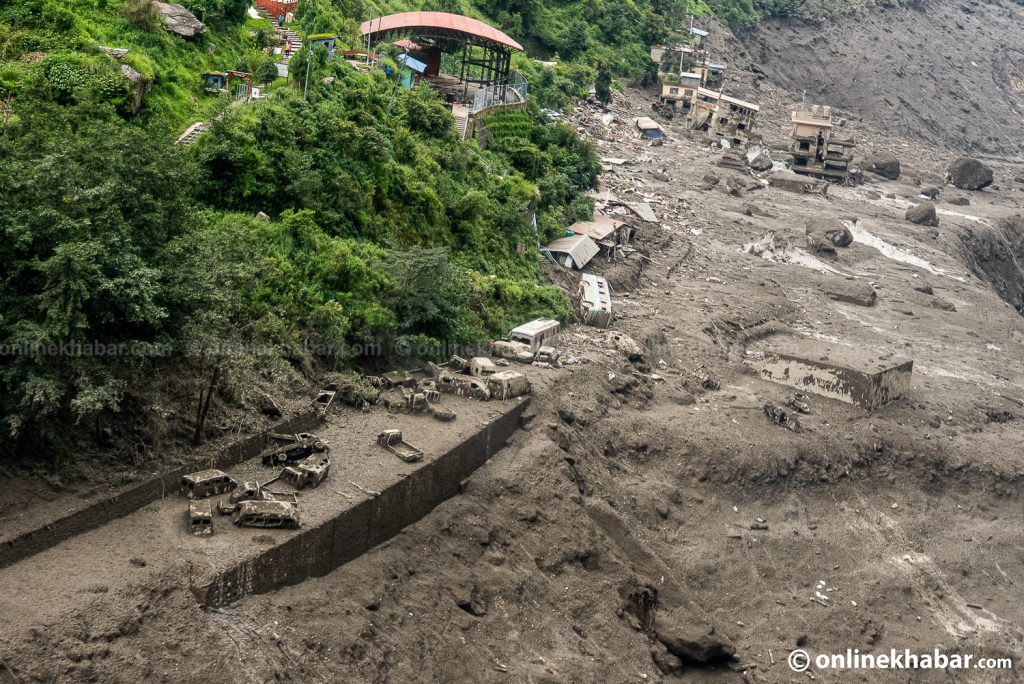
Ten minutes later, the flood hit the evacuated school. When flood waters receded, the whole compound was buried under debris, with only a fragment of the school’s roofline left showing.
There were two “systems” that warned people about the impending danger that day: one built by the state relying on sensors and SMS messages, the other relying on community-based ties. Only the second worked reliably, and in the case of Dawadi and many other survivors, it even arrived first.
But not everyone was as lucky. According to the National Disaster Risk Reduction and Management Authority (NDRRMA), as of September 3, a total of 1,252 people have died, with 4,216 more missing and roughly 1.6 million people affected across five districts in Nepal.
Communication researcher Bhuwan KC observed that while one-half of the corridor (upstream) had no information at all, the other had information, but that information couldn’t convey urgency and scale.
In areas nearest to the border, on both the Nepal and China sides, everything happened in just seven minutes. The sensors were knocked out immediately. But farther down, in Trishuli Bazaar, Betrawati and toward Muglin and Devghat, people received an SMS or a loudspeaker announcement from the state mechanism. But an analysis of social media videos from the day shows, the information conveyed failed to specifically and urgently deliver the message that this was not a usual flood. In some areas downstream, the SMS was also not timely. “The SMS and the flood came together,” said Chandra Bhatta, a resident of Nuwakot who didn’t receive the message sent at 9:35 a.m. until 9:54 a.m.
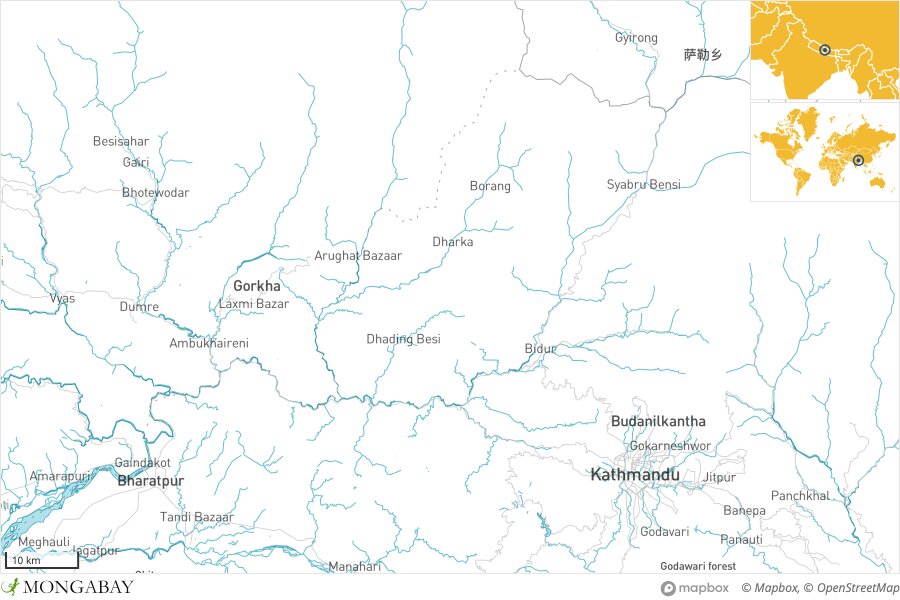
The Bhotekoshi/Trishuli river flood started near Gyirong in China and ravaged Syabrubesi, Bidur and other areas nearby before reaching the flood plains of Chitwan (Bharatpur).
Nepal’s official flood warning system relies on threshold-based river sensors: When water crosses a preset danger level, it triggers an alert, said Binod Parajuli, an official at the Department of Hydrology and Meteorology’s flood forecasting division. The system, including the message templates, was designed for the gradual monsoon flooding that Nepal’s rivers usually produce, Parajuli said. DHM itself learned about the flood after receiving a call from a local official.
A message with nothing to act on

Utilizing social connections and decentralized community-level communications during disaster, however, is not new to Nepal. One of DHM’s first flood early warning systems, built in 2002 on the East Rapti River in Chitwan, began as a volunteer watching a river. The volunteer seated on an elevated (machan) platform tracked water levels and sent a runner door to door when they saw water levels rise.
This was a named and trusted person telling fellow villagers the water was coming. This wasn’t an unnamed DHM official sending a message from far away. The calls that head teacher Dawadi received also shared these attributes.
On Aug. 26, the day of the flood, DHM said its first mass alert was at 9:15-9:16 a.m., reaching 679,295 residents across Rasuwa, Nuwakot, Dhading and Chitwan. Mongabay couldn’t independently verify the timing of the first SMS nor the exact number of recipients as each of the five residents Mongabay talked to said they received the same message thrice.
Prime Minister Balendra Shah told Parliament on Wednesday that the first batch of SMS messages was sent out at 9:35 a.m. An alert sent at 9:35 a.m. and received in Bidur — the Nuwakot district headquarters on the Trishuli’s banks — read in full: “A large flood has entered the Bhotekoshi River in Rasuwa from the Tibet side. Until further notice, residents along the banks of the Trishuli River (up to Muglin) are requested to remain in a safe location with high alert.”
It carried none of the attributes that made both Dawadi’s calls and Chitwan’s alerts work: a named, trusted person describing exactly what they saw.
But the content was the same generic language used for routine monsoon advisories: Move to safe ground, with no street-level instruction, no sense of how much time people had, no indication of scale.
“Because official SMS warnings were generic, they failed to communicate individual vulnerability,” said Chandani Bhandari, a University of Geneva researcher. “Even when people receive the information, they often think, ‘Malai ta kei hunna,’ [Nothing will happen to me].”
She also added that the SMS warnings lacked exact locations, severity, context and actionable instructions. “People need to know exactly how severe the risk is to their specific location and where the evacuation shelters are,” she told Mongabay. Similarly, the alerts only went out in Nepali, on a corridor that includes a major tourist trekking route. Foreign visitors not fluent in Nepali who received the message had no way to read it.
The SMS issue is not just about the recent floods; it has been a systemic attribute, a recent study suggests. A 2026 scoping review of 38 peer-reviewed studies over four decades of Nepali risk-communication research, led by Bhandari, found that DHM’s SMS alerts were repeatedly found to lack actionable guidance.
No one with the authority to say ‘leave now’

Beneath the technical and linguistic challenges lies a deeper structural problem. DHM’s legal mandate covers forecasting and disseminating warnings, and not ordering evacuation, Parajuli said. “Even we didn’t know the extent of the floods in the early stages when sending the SMSs,” Parajuli told Mongabay. “But even if we had known, we don’t have the authority to order evacuation,” he added.
The authority to “relocate” people from unsafe areas rests with the district, provincial and central-level disaster management committees. But the law only imagines the use of this power for resettling communities off riverbanks and landslide-prone slopes before disaster strikes, not for issuing a real-time evacuation order. Nothing in the law requires a flood forecast to automatically trigger such an order; the link between “the water is rising” and “everyone must leave now” is discretionary, not mandatory, and on Aug. 26, no agency appears to have exercised it in real time.
A system that can alert but cannot translate it to action leaves the decision with the person receiving the message. Head teacher Dawadi had to make that call on his own by heeding others’ urgent messages, as no institution stepped in to decide for him.
This gap was also documented in detail less than five years ago. A 2022 study by researchers Dinanath Bhandari and Ajaya Dixit examining a 2021 rainfall disaster found that although DHM forecasted the event accurately,120 people died, as its warnings didn’t translate into specific advice for telling people what to actually do. The study called for “legally binding directives and standard operating procedures” so forecasts automatically trigger a defined chain of action. But that wasn’t observed during the recent floods.
An ignored model
None of this surprises people who’ve spent years building community-based flood warnings in Nepal. Dinanath Bhandari, who has worked on upstream-downstream community linkages since early efforts in the field, said such linkages and social relationships have consistently proven far more effective — more trusted, more acted upon — than formal messages from authorities.
But as high-tech systems and government agencies took over the space, community-based approaches pushed back, treated as backup rather than the backbone they’d proven themselves to be.
The marginalization wasn’t just passive; at times it was visible. Dinanath Bhandari recalled one former NDRRMA executive criticizing manual sirens, the kind communities themselves can operate, as a step backward. The Bhotekoshi-Trishuli flood shows that the “backward” system relying on human-to-human relationships worked better than tech-powered ones.
The boy who cried wolf
Compounding this is a trust problem years in the making. In Rasuwa and Nuwakot, and even in Kathmandu, flood-warning SMS messages arrive routinely through monsoon season, and just as routinely, nothing happens.
Repeated low-stakes alerts with no visible consequences have worn down the sense that any given message is urgent, said Chandani Bhandari. She added that a population trained to treat flood SMS alerts as background noise can’t instantly recognize one single message that matters. But a call from a friend upstream doesn’t carry such history. “In addition to that, Nepalis in general trust their family, friends and neighbors more than government officials,” she said.
Fixes already on the shelf
A few months before the flood, a GSMA/ITU study examined cell broadcast technology for Nepal. Although the system uses mobile networks, it is different from SMS, as it can alert every phone in a defined area, independent of a subscriber database. It can do so in seconds, and in multiple languages, at once. The study found that the technology could reach a targeted zone in roughly 10 seconds even under network congestion, named NDRRMA as lead agency and estimated setup costs at $1.75-$3 million. It had not been procured or built by the time the flood arrived.
Cell broadcast can’t fix the problem if the messaging doesn’t change, Chandani Bhandari said. “Warnings should ideally contain exact locations, severity, context and actionable instructions. People need to know exactly how severe the risk is to their specific location and where the evacuation shelters are,” she told Mongabay. Cell broadcast also wouldn’t replace the trusted urgency of a call from someone who can see the water.
But it addresses two of the clearest failures of August 26: a message that couldn’t reach non-Nepali speakers and a delivery method vulnerable to the same network strain a mass flood produces. However, the study’s recommendations haven’t been implemented.
A second fix has existed even longer and doesn’t need procuring. It needs reinvestment. Model’s such as Chitwan’s East Rapti needs to be adopted more widely to function as a wider community-based network: trained volunteers who monitor water levels, relay readings by radio or phone up and down the watershed and sound warnings, said Dinanath Bhandari.
It works on the principle that saved Dawadi’s school: A trusted person telling you the water is coming, rather than a threshold tripping a form-letter text.
What saved 900 children in Nuwakot was not a system in the formal sense. It was informal, redundant and human, yet fast: Four people independently reaching the same conclusion and acting immediately, and a head teacher willing to trust them over the absence of official word.
The incident serves as a case study for those designing emergency communications, Chandani Bhandari said. “The lesson here is that we need societal linkages and community participation for any emergency communication to succeed,” she said.
“We need to encourage more people like the friends and relatives who called up the school and more people like head teacher Dawadi, who acted decisively,” she added. This, according to her, could be done at the municipal level by allowing the community to choose people to play coordinating roles during disasters.
This article is republished from Mongabay under a Creative Commons license. Read the original article.