Kathmandu, October 2
Nepali Congress will not form panels for its upcoming 15th General Convention, and delegates will be free to vote for candidates of their choice, party Vice President Bishwa Prakash Sharma has said.
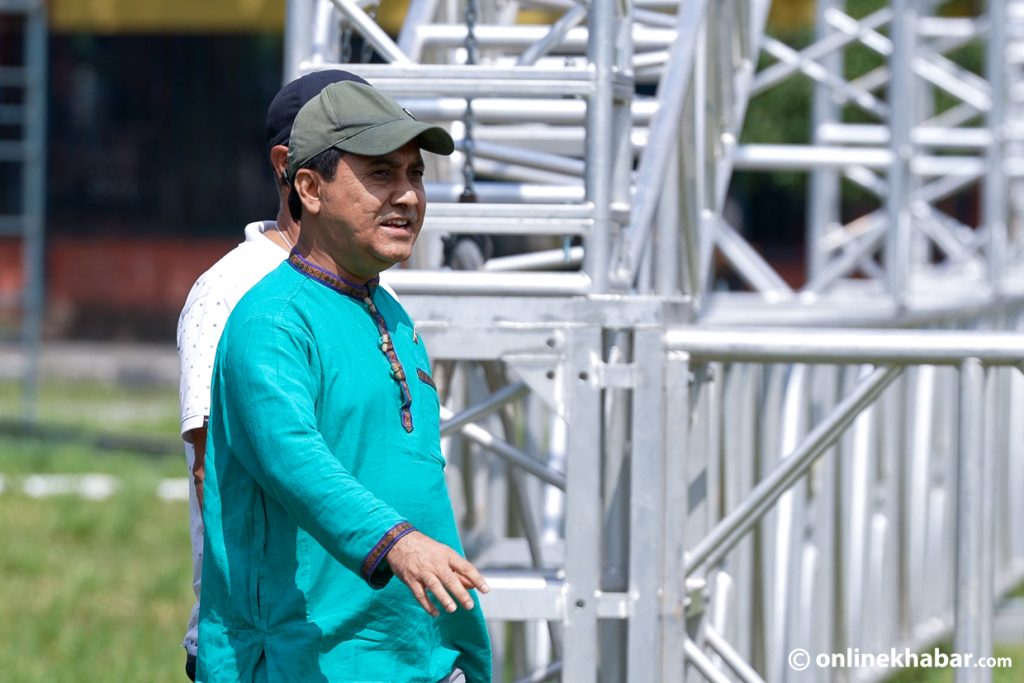
Speaking to Onlinekhabar at the convention venue at Khulamanch, Sharma said the convention would seek to institutionalise the changes initiated by the party’s special general convention held last December.
“The difference this time is that there will not be the situation of saying this is one group and that is another group,” Sharma said. “There is no control over who gets to become a candidate through a group ticket. There will be no panels.”
He said all candidates would be treated equally and delegates would be allowed to vote according to their own judgment.
“We will not discourage anyone from contesting for any position,” he said. “All our colleagues are respected. Everyone is equal. Delegates will find it easier to vote independently and according to their own judgment.”
More than 7,000 delegates are expected to participate in the convention, which is scheduled to be held at Kathmandu’s Khulamanch.
Sharma said the convention was being organised at a time when the Nepali Congress was undergoing a transition, with the party seeking both ideological and organisational change.
He compared the special convention to a “force landing” and said the 15th General Convention would take the party toward a “safe landing”.
“The special general convention was a kind of force landing. The 15th General Convention will take the Nepali Congress towards a safe landing,” he said.
According to Sharma, the convention will also examine the party’s ideological position and identify areas where it needs to change.
He said the party should acknowledge its mistakes while clearly communicating the positive contributions it has made to the country.
“The convention will discuss how the ideas and principles we have carried from the past should be modified according to the present context,” Sharma said.
Party President Gagan Kumar Thapa is expected to present a document containing ideological and theoretical issues, including how the country should move forward over the next decade.
Sharma said his own document would examine the erosion of democratic culture and the need for reforms suited to the changing times. Other documents, including those from General Secretary and Deputy Speaker-level party leadership, will also be presented.
Sharma said the convention would also reflect changes in the composition of the party, including greater representation of younger members and groups previously not adequately recognised by the party statute.
The party has created a separate representation category for members below the age of 35, with around 600 delegates from that age group expected to attend the convention, according to Sharma.
He said more than 35,000 members below the age of 35 had also reached party committees from the ward level to the central level under the new provisions.
“Politics should be based on agendas, not age,” Sharma said. “That does not mean an older person becomes irrelevant simply because of age. What matters is how many times they have led, whether they still have creativity and whether their agenda remains relevant.”
He said the Nepali Congress was attempting to present a model in which experienced and younger leaders could work together.
The convention will also use digital systems for distributing documents and recording discussions, Sharma said.
Documents will be made available digitally, while speeches will be audio- and video-recorded. A separate team will take notes and incorporate suggestions made during discussions before the documents are finalised.
Sharma said three halls had been prepared at Khulamanch, each accommodating more than 2,500 delegates. The arrangement is intended to allow around 150 delegates to speak during a day while ensuring that documents presented in one hall are broadcast to the others.
He said the stage had been positioned facing east so that sound would not disturb patients at nearby hospitals.
Sharma acknowledged that political conventions often focus heavily on leadership contests and candidate support rather than substantive discussion of documents.
“It would be unrealistic to say that we will be completely free from that,” he said. “But our entire effort is to make the convention better.”
The Nepali Congress has also decided to limit the use of elaborate promotional displays across Kathmandu during the convention.
Unlike previous conventions, there will be no large gates, banners and decorations across areas such as Maharajgunj, Lagankhel, Jorpati, Koteshwar, Nagdhunga and Bhaktapur, Sharma said.
He said the decision was influenced by the recent disasters in the country, in which many people lost their lives and thousands remain missing.
“There is no need to make the entire city colourful at a time when we are holding a convention after a major disaster,” he said.
Promotional activities will instead give greater priority to digital platforms, while normal decorations will be allowed within the convention venue.

The Nepali Congress is also discussing the use of electronic voting machines for the leadership election.
Sharma said electronic voting would be used if the system could process more than 7,000 votes within a single day. If that is not possible, the party would have to use a manual voting system.
He rejected concerns that manual voting and counting would significantly delay the conclusion of the convention.
“The counting will not take a month,” Sharma said. “The Nepali Congress’ vote counting will not prevent people from celebrating the festivals.”
Sharma also recalled the historical significance of Khulamanch for the Nepali Congress, referring to a speech delivered there by party founder BP Koirala in 2036 BS, when Koirala was suffering from throat cancer and had undergone surgery.
He said the convention should not be seen only as an internal Nepali Congress event but as an opportunity to generate hope across the country.
“We have come here to awaken a new hope across the country, not just for the Nepali Congress,” Sharma said. “The country should move forward on the foundation of that hope and confidence.”