

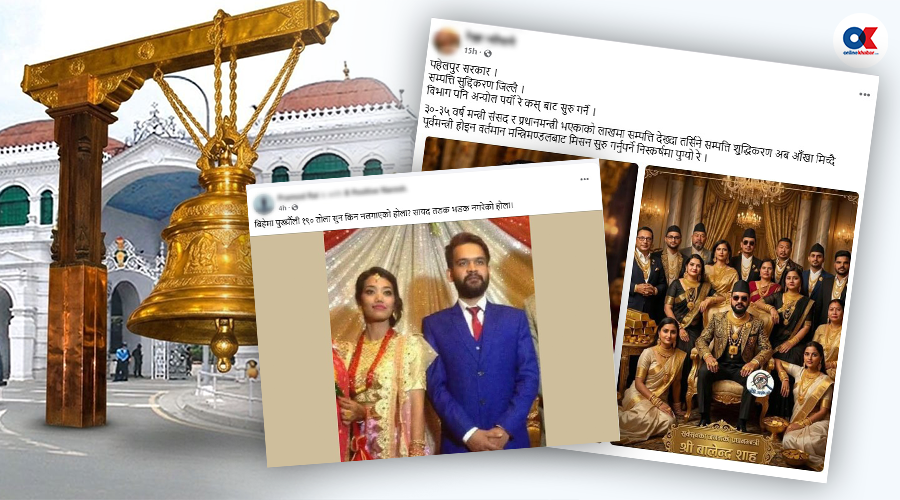
Finance Minister Swarnim Wagle had written a satirical post on social media on May 25, 2018, that reads “Swarnim Mantrimandal,” which means Golden Cabinet. The post included a graphic showing the amount of gold declared in the asset disclosures of ministers in the then KP Sharma Oli-led government. The entire graphic used a yellow colour theme, reinforcing the satire.
That same post by Wagle has now gone viral again on social media. The reason: the asset disclosures of ministers in the current government, where Wagle is the finance minister, also show large amounts of gold.
The way gold figures appear in the asset declarations of the current Prime Minister and ministers has triggered widespread commentary and trolling online. A common question being raised is: those who once questioned the wealth of previous rulers, how do they now possess so much themselves?
And why wouldn’t people ask? Eight years ago, when Wagle was questioning the “Golden Cabinet,” then Finance Minister Yubaraj Khatiwada had declared just 10 tolas of gold. In contrast, according to current disclosures, Wagle himself now owns 45 tolas of gold. This has led many to question why Wagle, who once mocked others for their gold holdings, should not now be questioned in the same way.
Before diving into the debates on social media, let’s compare the asset disclosures of then and now.
According to public records, the current Prime Minister, Balendra Shah (Balen), owns 190 tolas of gold, whereas former Prime Minister KP Sharma Oli had declared 18 tolas. Home Minister Sudan Gurung currently holds 89 tolas, while former Home Minister Ram Bahadur Thapa had just 6 tolas.
Similarly, current Foreign Minister Shishir Khanal has 22 tolas of gold, compared to only 2 tolas declared by former Foreign Minister Pradeep Gyawali.
In the case of the Energy Ministry, there is parity; former Energy Minister Barshaman Pun and current minister Biraj Bhakta Shrestha both have 15 tolas of gold.
Other current ministers’ disclosures include: Physical Infrastructure Minister Sunil Lamsal (30 tolas), Law Minister Sobita Gautam (15), Sita Wadi (18), Pratibha Rawal (25), Nisha Mehta (30), Sasmit Pokharel (25), Khadkaraj Paudel (11), Bikram Timilsina (19.5), and Gita Chaudhary (9).
Among them, Industry Minister Gauri Kumari Yadav ranks second after Prime Minister Shah in terms of gold holdings, with 180 tolas. She is followed by Sudan Gurung and newly appointed Labour Minister Ramji Yadav, who holds 80 tolas.
Back in 2018, when Wagle made his “Golden Cabinet” remark, the highest gold holding was by then Culture, Tourism and Civil Aviation Minister Dhan Bahadur Budha, with 150 tolas. He was followed by the late Rabindra Prasad Adhikari (60), Raghuvir Mahaseth (51), Jagat Bishwakarma (50), and Sher Bahadur Tamang (30). Other cabinet members had less than 18 tolas.
Thus, those who once questioned others’ wealth are now themselves in power, and their own assets have become the centre of attention. The discussion, particularly around gold, has turned social media “yellow” with debate.
Many comments have resurfaced under Wagle’s old post. One user, Deep Bista, wrote: “Swarnim Mantrimandal, the earth is around,” and even recreated similar graphics showing current ministers’ gold holdings.
There is also surprise at how young ministers, many in their early 40s, have accumulated such wealth. Dr Prem Phyak commented that while having wealth is not inherently wrong, the key concern is how it was earned and whether political privilege played a role.
Similarly, writer Kedar Sharma compared the numbers from 2018 and now. According to him, the average gold per minister has increased from 25.16 tolas in 2018 to 41.84 tolas now. The total gold held by the cabinet has also risen from 528.5 to 669.5 tolas.
“The most interesting part,” Sharma writes, “is that these ministers, with an average age of 40, achieved this progress during the same period they described as a time when the country was ‘ruined’ to win public votes.”
He also raised questions referencing campaign promises made by the Rastriya Swatantra Party (RSP), suggesting contradictions between rhetoric and reality.
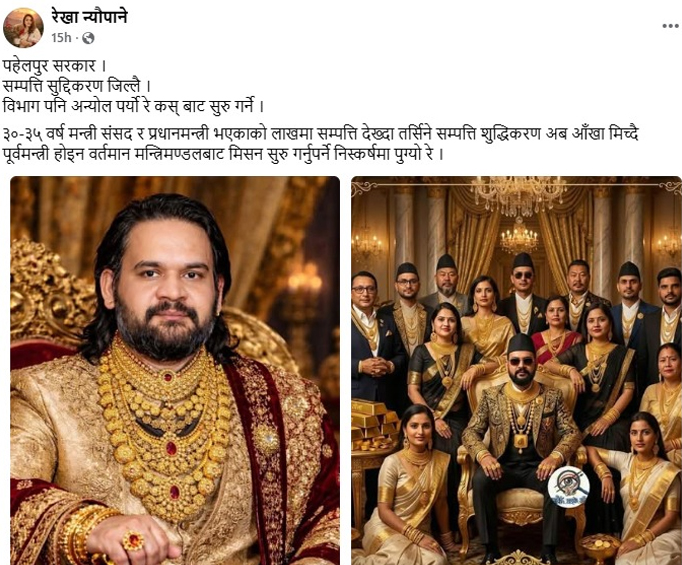
Netizens have been posting satirical images, including one depicting the Prime Minister and ministers covered in gold, calling it a “yellow government.” Rekha Neupane sarcastically suggested that investigations into wealth accumulation should begin with the current government.
Journalist Nabin Rai noted that many leaders of the Gen Z movement, who helped bring political change, still struggle with basic expenses, while the leaders who benefited from that movement appear financially secure with large gold reserves.
Rai clarified he has no bias against wealth accumulation, stating that earning wealth legally is not a crime. However, he questioned whether those who are already financially secure can truly empathise with ordinary citizens struggling for daily survival.
Meanwhile, a video of former RSP leader and ex-MP Binita Kathayat has also gone viral. In the video, she argued that economically stable individuals should be encouraged in politics, claiming that those from poorer backgrounds are more likely to become corrupt, remarks that have drawn criticism and renewed trolling.
Some RSP supporters counter that earlier politicians accumulated wealth after entering politics, while current leaders were already wealthy, implying less likelihood of corruption.
Even Home Minister Sudan Gurung responded to criticism, stating he had earned his wealth without corruption before joining the government. “Being born poor is not your fault, but dying poor is,” he wrote in a social media post, adding that earning without corruption is not a sin, but earning through corruption while in power is.
He later deleted the post.
As debates continue, supporters argue that wealthy leaders will ensure cleaner governance and faster development, while critics say the country risks returning to elite capture.