Kathmandu, September 10
The devastating flood and debris flow in the Lhende Khola area along Nepal’s border with Tibet was triggered by a massive landslide rather than an earthquake, according to an analysis of seismic data by an international team of scientists.
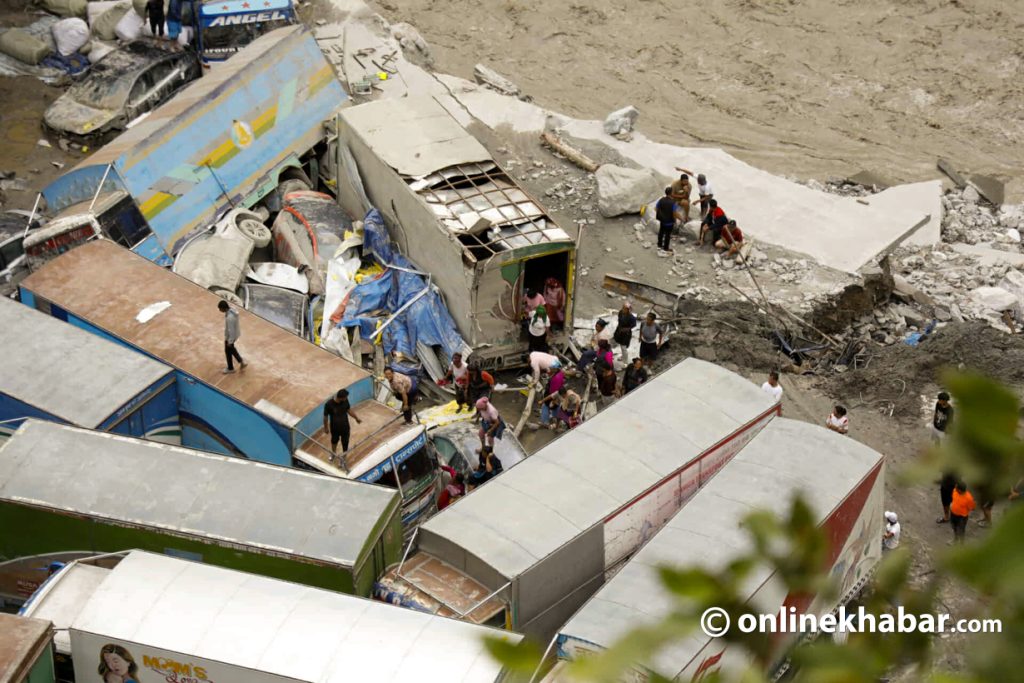
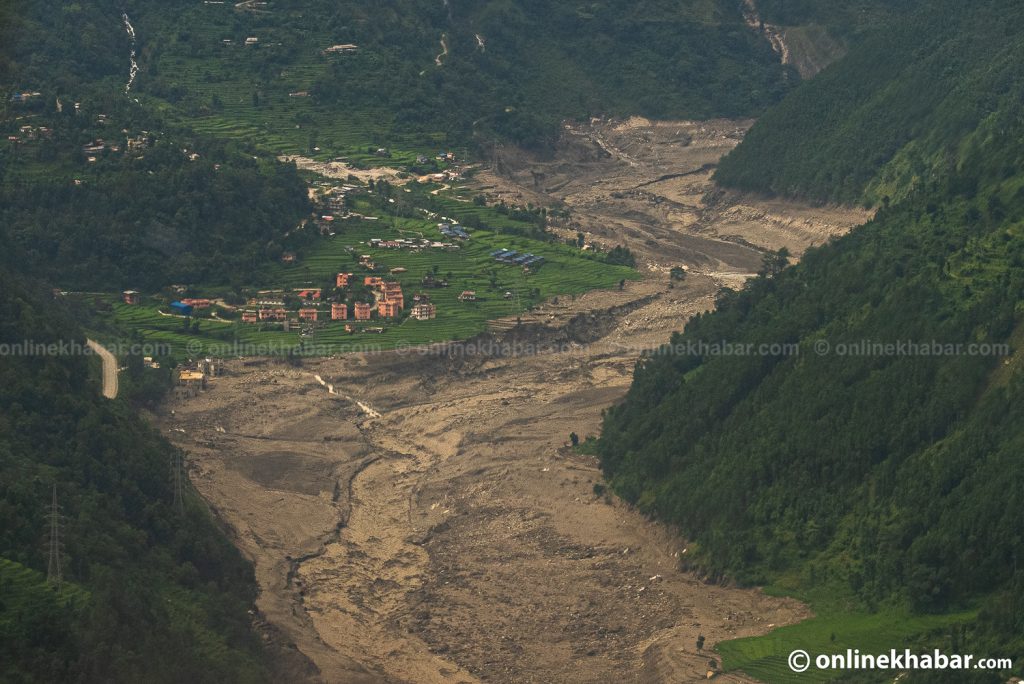
The disaster has killed more than 1,300 people and left many others missing. Major towns and hydropower projects along the affected river corridors were also destroyed.
In the immediate aftermath, the United States Geological Survey (USGS) and other agencies had suggested that a 4.4-magnitude earthquake may have caused rocks and ice to collapse, triggering the flood. Another possibility was that a glacial lake or dam had burst.
But an analysis of seismic data by an international team including geomorphologist Dr Kristen Cook of Grenoble Alpes University in France and seismologist Göran Ekström of Columbia University has challenged those early explanations.
Data recorded at a seismic station north of Kathmandu and by the Global Seismographic Network showed not the sharp, high-frequency shaking normally associated with an earthquake, but prolonged, low-frequency waves.
The pattern indicated a massive landslide.
Scientists estimate that the landslide generated seismic energy equivalent to a magnitude 5.7 earthquake, making it one of the largest landslides recorded anywhere in the world in the past decade or two.
What remains less clear is how such a large volume of water became part of the flood.
A glacial lake outburst flood, or GLOF, was initially suspected, but scientists have found no evidence of one.
Early satellite images from Planet Labs showed what appeared to be a glacier collapse at an altitude of around 5,200 metres, leading researchers to initially consider a glacial collapse as the likely trigger.
But calculations by Ekström and other scientists showed that the glacier alone was not massive enough to generate seismic waves equivalent to a magnitude 5 earthquake.
Clearer imagery from the Indian Space Research Organisation (ISRO) and NASA-USGS’s Landsat-9 satellite later showed that a large rocky mountain had collapsed. The glacier was swept down with the landslide.
Dr Basanta Raj Adhikari, director of Tribhuvan University’s Centre for Disaster Studies, said the cause of the disaster was not immediately clear during the first three hours after the flood.
Subsequent drone footage and field investigations, however, confirmed that the event had been triggered by a landslide, he said.
According to Adhikari’s calculations, the energy generated by the landslide was greater than that released by the atomic bomb dropped on Hiroshima.
Scientists describe the disaster as a “cascading hazard”—a chain of disasters in which one event triggers another.
In this case, the landslide, debris flow and flood became part of a single destructive sequence.
Cook said similar cascading events occurred in India’s Chamoli disaster in 2021 and in Nepal in 2012, 2015 and 2017. But she estimated that the Lhende Khola event was about 10 times larger than those incidents.
Scientists are still trying to determine exactly how the flood acquired such a large volume of water.
One possibility is that the force of the landslide carried rocks, ice and debris into the river at such speed that it incorporated water from the river and old ice deposits in the lower part of the valley.
The disaster is also raising broader concerns about the stability of high-altitude mountain terrain.
Geographers including Alton Byers of the University of Colorado Boulder say rising global temperatures are causing permafrost—the permanently frozen ground that helps bind rocks and ice together in high mountain areas—to thaw.
As the permafrost weakens, mountain slopes can become increasingly unstable, potentially increasing the risk of large landslides.
For now, authorities are focused on rescue and relief operations in the affected areas, while attention is also turning to the need for more effective early-warning systems for communities downstream.
The Lhende disaster, scientists say, is a reminder that in the high Himalayas, a single destabilised mountainside can set off a chain of hazards extending far beyond the point where it collapses.