
Kathmandu, September 27
Continuous rainfall since Wednesday night, followed by floods and landslides, has disrupted Nepal’s supply network, with Kathmandu Valley facing growing concerns over cooking gas, vegetables and other daily essentials.
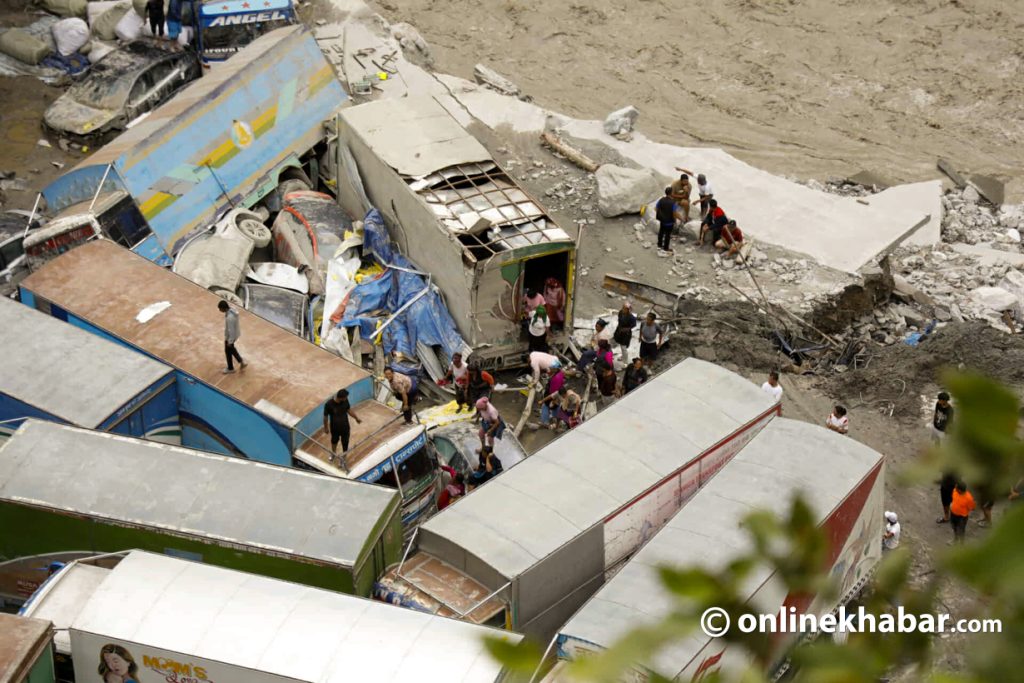
The Prithvi Highway and the Nagdhunga-Muglin road section, considered key lifelines connecting the federal capital with the Tarai, have been obstructed at multiple locations.
According to the Nagdhunga-Muglin Road Project, landslides occurred at more than 10 locations on Sunday. Large landslides at Krishnabhir, Jamireghat, Chaukibhir, Ghoptebhir and Simaldhara in Dhading and Chitwan have completely blocked the road in both directions.
Road sections at Shitalbazar, Gomti Khola, Hugdi Khola-Jawang Khola, Fishling, Chumlingtar and Dharapani are operating only on a one-way basis because of landslides.
The Department of Roads says it is prioritising the reopening of key lifeline routes and is working to clear the blockages across the country.
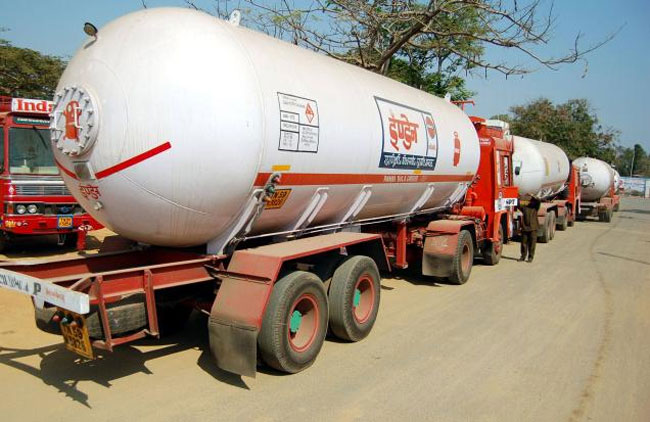
The disruption has prevented gas bullets and other freight trucks carrying supplies from India from entering Kathmandu Valley. Nepal Oil Corporation says no new LPG bullet has entered the Valley since rainfall began on Wednesday.
The situation has revived concerns over a possible LPG shortage in Kathmandu. A similar shortage occurred around three weeks ago after a landslide at Krishnabhir blocked the main highway connecting the Valley.
Although supplies had begun returning to normal after the highway reopened, the latest disruption has once again affected the movement of LPG and other essential goods.
Around 150,000 gas cylinders stuck on the road
Nepal Oil Corporation has urged consumers not to panic, saying a significant volume of LPG is already on its way to Kathmandu and can be brought into the market once the roads reopen.
NOC Executive Director Nagendra Sah said around 125 LPG bullets loaded for 16 gas brands operating in Kathmandu Valley are currently stranded at different locations.
The bullets have already cleared customs at Birgunj and are being held at safe locations in coordination with local administrations, including Ramnagar in Chitwan and Hetauda.
“About 125 gas bullets are currently stuck on the road,” Sah said. “They have already cleared customs at Birgunj. Some are at Ramnagar in Chitwan, some in Hetauda and others at safe locations.”
A gas bullet carries enough LPG to fill an average of 1,250 cylinders. Based on that figure, the stranded consignments contain enough gas to fill roughly 150,000 cylinders for Kathmandu Valley.
Sah said the corporation could quickly increase market supplies once the roads reopen.
“Once the road opens, we can send 50,000 to 60,000 cylinders to the market each day for three or four consecutive days,” he said. “That would help us normalise the market.”
He said there was no difficulty in bringing LPG from India, with gas already loaded from locations including Barauni, Paradip and Haldia and brought close to Chitwan and Hetauda.
“The main issue now is clearing the landslides at Krishnabhir and other locations in Dhading,” Sah said.
According to Sah, gas industries also released around 17,000 to 18,000 cylinders from their existing stocks on Sunday.
He said there could be some short-term inconvenience and it could take time to meet 100 percent of demand, but the corporation was working to prevent a repeat of the severe shortages seen previously.
More than 63,000 cylinders supplied in three days

Although no new gas bullets have entered Kathmandu since Wednesday, NOC and gas companies have continued supplying LPG from their existing stocks.
According to NOC data, 63,256 LPG cylinders were distributed in Kathmandu Valley and surrounding districts over the three days from Friday to Sunday.
The highest daily distribution was recorded on Friday, when 37,986 cylinders were sent to the market through various dealers.
Sagar Gas supplied 6,234 cylinders on Friday, followed by Nepal Gas with 4,640. STC Gas supplied 3,138 cylinders, Everest Gas 2,645, Shriram Gas 2,520, Sitashree Gas 2,513, Shree Gas 2,409 and Himal Gas 2,345.
Other companies also continued distribution, including HP Gas, Sai Baba, Shrimaya, Om, Sugam and Bhanu.
Distribution was lower on Saturday because of the public holiday, with 6,399 cylinders sent to the market.
On Sunday, 18,871 cylinders were distributed through 320 dealers and shops operated by 10 gas companies across Kathmandu, Lalitpur, Bhaktapur and Kavre.
Sagar Gas recorded the highest distribution, supplying 4,576 cylinders through 102 dealers. Nepal Gas distributed 3,360 cylinders through 34 dealers, while STC Gas supplied 2,832 through 38 dealers.
No immediate problem with petrol, diesel and aviation fuel
NOC says supplies of petrol, diesel and aviation fuel are not currently facing the same disruption.
The corporation has enough petrol and diesel stocks at Thankot to meet demand for around seven to 10 days.
Pradeep Yadav, chief of NOC’s aviation fuel office in Sinamangal, said there was also enough aviation fuel for domestic and international flights for around 10 days.
“We will not face any problem for the next 10 days,” Yadav said. “If the main road remains blocked for a longer period, we can use alternative routes to prevent shortages.”
Why LPG faces a bigger supply challenge
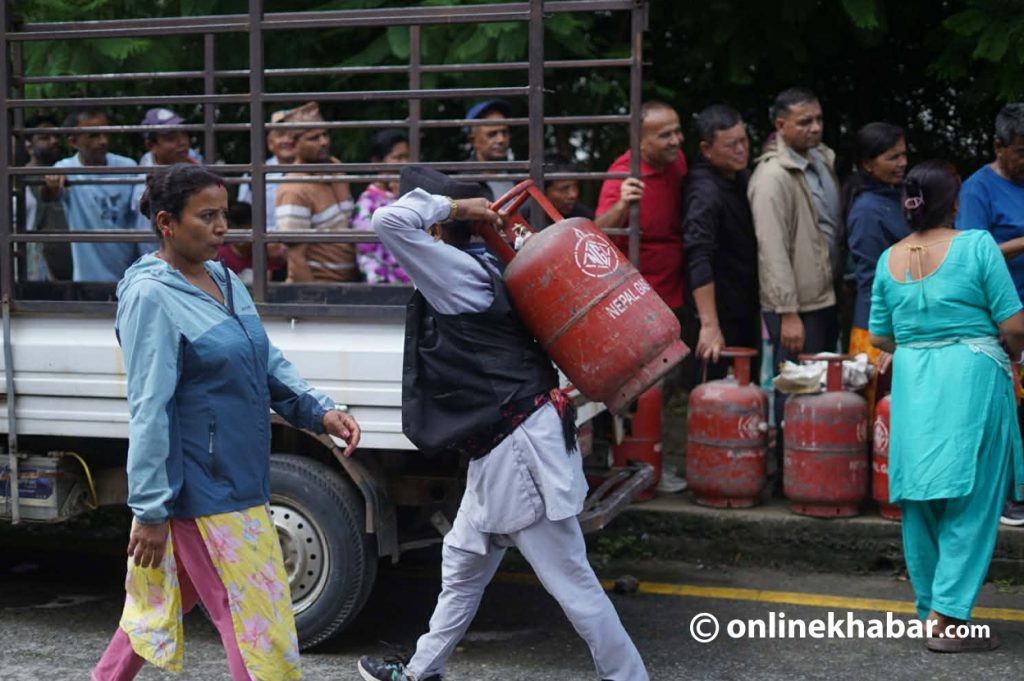
Long-term road blockages generally create a greater challenge for LPG than for petrol and diesel because of the different ways the fuels are transported.
Petrol and diesel imported through the pipeline are stored at the Amlekhgunj depot. From there, smaller tankers can transport fuel to Kathmandu using alternative routes, including the BP Highway.
LPG, however, requires large specialised bullets for transport. These vehicles cannot easily use narrow and winding alternative roads, making it difficult to bring gas into Kathmandu when the main highways are blocked.
During previous prolonged road closures, gas companies have had to collect empty cylinders from dealers in Kathmandu, transport them to gas plants in the Tarai using ordinary cargo trucks, fill them and then bring the cylinders back through alternative routes.
The process is time-consuming, cumbersome and significantly more expensive.
If the main highways remain closed for an extended period, gas companies could again be forced to resort to this costly alternative.
With the Muglin-Nagdhunga road currently blocked, the Valley Traffic Police Office says the Tribhuvan Highway has been opened on a limited basis to facilitate the movement of essential food, vegetables and fuel.
However, the route is narrow and considered risky, making it unsuitable for large freight vehicles and LPG bullets.