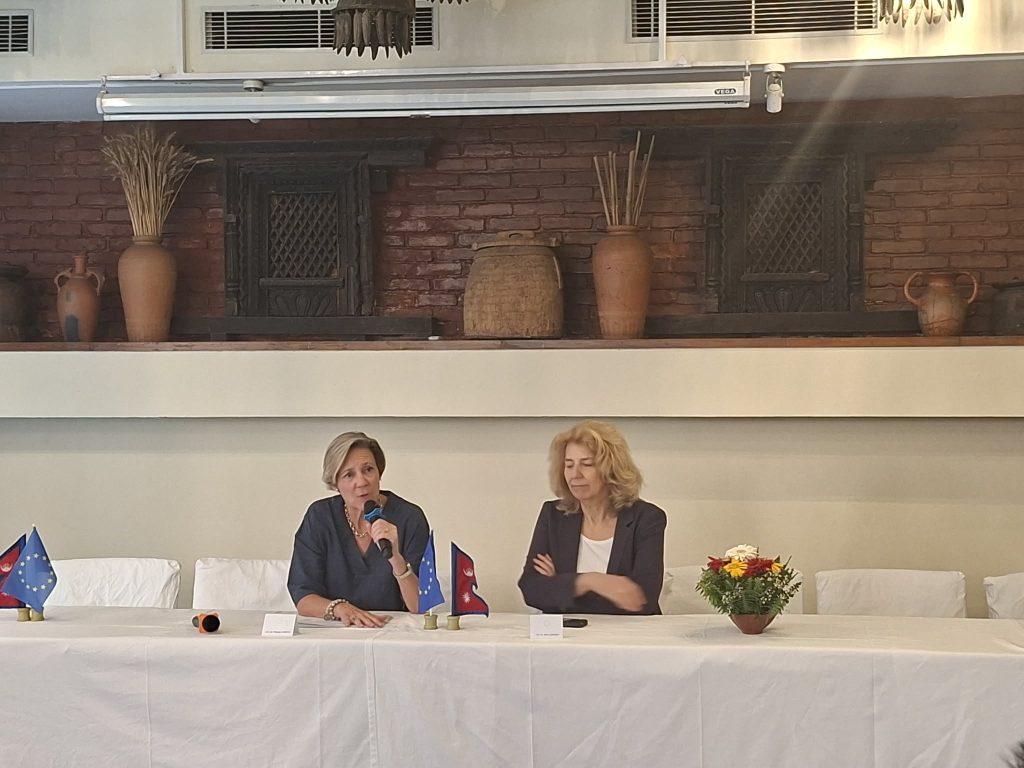
Kathmandu, May 26
European Union Ambassador to Nepal, Véronique Lorenzo, has said that the European Union and Nepal share the same objective of restoring confidence in Nepal’s aviation sector, stressing that progress on aviation safety reforms is necessary for the country to be removed from the EU air safety list.
Speaking during a press meet held on Tuesday on the occasion of the visit of EU Member States’ Heads of Missions to Nepal, Ambassador Lorenzo said the issue of Nepal’s inclusion in the EU air safety list has been repeatedly raised by Nepal’s new government.
“I have never been asked so many times about the air safety list as with the new government,” she said. “Every single minister, in every meeting we have, raises this issue, and I think this is great because it means there will be progress.”
Nepali airlines have been banned from European airspace since 2013 over safety concerns. Responding to a question on why Nepal remains on the list despite operating mostly European-made aircraft and following international aviation standards, Lorenzo said the EU’s concern is not about the origin of aircraft alone, but about the overall safety oversight mechanism.
“In terms of standards, yes, most of the planes here are European, ATR and Airbus are European manufacturers,” she said. “But it is not because aircraft are built to European standards, or because pilots receive some training in Europe, that both the civil aviation authority and the airlines automatically comply with all safety provisions.”
Lorenzo clarified that the European Union has never specifically demanded a legislative split between Nepal’s aviation regulator and service provider. Instead, she said, the EU has consistently stressed the need for independent oversight to avoid conflicts of interest.
“The European Union has never asked for a legislative change to split service provision from regulation,” she said. “What it has insisted upon is the independence of each function to avoid conflicts of interest.”
She noted that an assessment carried out in 2023 found that Nepal had not made sufficient progress to be removed from the safety list. According to her, the assessment recommendations led to a corrective action plan prepared by Nepal’s civil aviation authorities, but implementation has remained slow.
“Over the last two and a half years, there has been hardly any progress under this corrective action plan, and this is what needs to be addressed,” Lorenzo said.
She added that the reforms required are broader than pilot licensing alone and include continuous training, certification systems, and stronger oversight functions within civil aviation authorities.
“For all these years since 2013, we have been providing technical assistance to help Nepal make these changes and ensure that airlines comply with these minimum security and safety standards,” she said.
Lorenzo expressed hope that closer cooperation with Nepal’s newly appointed Director General of Civil Aviation would help move the reform process forward.
“We hope that now, with the new DG just appointed, we will be able to work more closely together and really make progress on this corrective action plan,” she said. “And in time, when the necessary work is done, be able to present Nepal again for removal from the air safety list.”
She also emphasised that the continuation of the ban is not in the EU’s interest either, saying both sides want to rebuild international confidence in Nepal’s aviation sector.
“We are not pleased about this situation at all, and we share the single objective of restoring confidence in Nepal’s aviation industry,” Lorenzo said. “That is crucial, of course, for the further development of tourism.”