

I am writing this after taking a short break from the campaign to support the government in this disaster.
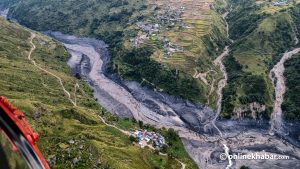
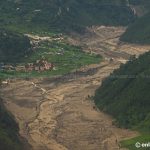
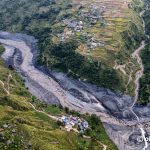
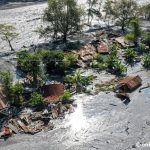
What began in Rasuwa is not the kind of ordinary landslide or flood Nepal sees every year. It is something much bigger—a Himalayan tsunami that has shaken an entire region.
The disaster struck last Wednesday and may have caused more loss of life and property than the 2015 earthquake. It has also delivered a lesson that could take us decades to recover from.
We have repeatedly called it the “Rasuwa flood”. But that description does not quite capture what happened.
In a normal flood, water levels rise gradually in rivers and other water sources. People living along the banks have at least some time to move to safety. That was not what happened in the Bhotekoshi-Trishuli region.
There had been no significant rainfall. The ground was not even wet. It was a bright sunny morning.
Suddenly, a violent snowstorm hit the Rasuwa-Tibet border area, producing something that looked more like an ocean storm than a conventional Himalayan flood.
Perhaps “Himalayan tsunami” is the more appropriate description.
And the threat has not gone away.
Nepal, China, India, Pakistan, Bhutan, Myanmar and other countries could face snowstorms and disasters of an even greater scale in the future.
There have been some encouraging signs in the response.
Prime Minister Balen Shah’s immediate messages on social media, followed by his visit to Bidur in Nuwakot, are worth noting. As far as I know, the visit was not part of a pre-planned programme. He simply travelled by road, without much fanfare, to one of the affected areas. That, in itself, is positive.
Nepali Congress president Gagan Thapa and other political leaders have pledged their support for the government’s efforts. The CPN-UML submitted an eight-point list of measures the government should take immediately on Sunday.
Across the country, government agencies, private organisations and communities have also been mobilising according to their capacity.
That is how it should be.
In a natural or human-made disaster, the responsibility of citizens and communities is not simply to support the government. It is to support the state. The government is, after all, one part of the larger state.
And supporting the government does not mean ignoring its failures.
The state did deserve credit for some of its initial response.
As soon as news of the Rasuwa disaster emerged on Wednesday, security personnel began making announcements through loudspeakers. The Cabinet called an emergency meeting. The House of Representatives took some time to get going, but Speaker DP Aryal eventually stopped other proceedings and gave the disaster the attention it demanded.
Foreign Minister Shishir Khanal immediately began coordinating with the international community.
The Nepal Army, which has developed considerable expertise in disaster response, launched emergency rescue operations. Nepal Police and the Armed Police Force were also deployed quickly.
These were the right first steps. They were also the steps one would naturally expect from the state.
But while the scale of this disaster could never have been completely avoided, the loss of life and property could have been reduced significantly.
We failed to do that.
Some of the reasons go back years—to our poor state of preparedness and our weak disaster-response capacity. Others have to do with the government’s own failures of coordination.

Before getting into the argument, look at the numbers.
Government figures show that by 6pm on Sunday, 781 people had been reported dead. Another 2,502 people were out of contact. The death toll is still rising.
The security forces have reported rescuing 9,435 people, while 267 people have been injured.
These are not just numbers. Behind each one is a family waiting for news.
Our Prime Minister and Home Minister may not be expected to operate exactly like Chinese Premier Li Qiang. But their urgency must show up in the results. Otherwise, all the running around risks becoming little more than another exercise in self-promotion and image-building.
The Army, Nepal Police and Armed Police Force deserve praise for their work in the immediate rescue and response.
But the Home Minister has a different responsibility.
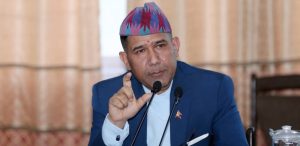
If Home Minister Sudan Gurung had remained focused on the central chain of command instead of personally entering tunnels, his efforts might have appeared less like a race for visibility and more like a coordinated rescue operation.
Those with expertise in emergency rescue should be given the responsibility for operational command, while political leadership should remain focused on coordinating and clearing obstacles from the centre.
There is another major issue.
More than a dozen countries—including India, China, South Korea and the United Kingdom—have sought permission to send specialist emergency rescue teams. Yet the government has taken time to make decisions.
There have been discussions about the Army’s concerns and geopolitical interests.
But this is not the time to lose sight of the central issue.
This is about saving lives.
Information received so far suggests that construction companies from South Korea and other countries have also sought permission to rescue employees trapped inside tunnels in their project areas. They are reportedly frustrated by the delay in getting a decision.
Finance Minister Swarnim Wagle’s remarks during his visit to Trishuli also shed light on the confusion and delay within the government.
If we manage to save as many people as possible, we will demonstrate not just the strength of the state but also what it means to be a country that stands by its citizens. Yet, so far, there has been little sense of that urgency.
This raises an uncomfortable question: does criticising the government during a disaster amount to being against the government?
Apparently, even well-intentioned advice is increasingly being treated that way.
Rastriya Swatantra Party chair Rabi Lamichhane and the party’s parliamentary whip Krantishikha Dhital issued an advisory to their lawmakers about what they should and should not do during the disaster. Yet Sagar Dhakal, Jwala Sangroula and Ashika Tamang, among others, do not appear to have followed it.
Tamang’s conduct in Dhading has also exposed the communication gap between the federal and local governments. In the race to make our videos go viral, we must make sure people’s lives do not become collateral damage.
Should politicians go to affected areas?

Of course they should. But there has to be some common sense about when to go, who should go and what they should do once they get there.
Ministers from affected districts such as Rasuwa, Nuwakot and Dhading, federal lawmakers, provincial and local representatives, and local political party units all have an important role to play.
So do elected representatives with relevant expertise, such as Shriram Neupane and Dhananjaya Regmi.
RSP lawmaker Shriram Neupane, for instance, is himself a tunnel expert and is currently involved in rescue efforts at the Upper Trishuli 3A project.
Other lawmakers, including Ganesh Karki, have urged politicians to stay home and support the response rather than crowd affected areas.
Yet the number of what can only be called “disaster tourists” does not appear to be falling.
There is a useful comparison right across the border.
Chinese Premier Li Qiang himself travelled as far as the area near Nepal’s border and took an active role in the response.
More importantly, there is evidence that his visit was not simply about appearances. The immediate priority given to rescue operations and the rebuilding of roads, electricity infrastructure and bridges is there for everyone to see.
A minister can certainly enter a tunnel and physically participate in a rescue. But people judge governments by results during a crisis.
The government may not have the luxury of comparing the Chinese premier’s style with that of our Home Minister. But the RSP and its supporters should be able to tell the government something very simple:
There is a difference between building an image and delivering results.
I keep coming back to one question.
Can a country like Nepal, with its limited capacity, really confront a disaster of this scale on its own?
Clearly not.
The burden created by climate change is also something this small Himalayan country cannot carry alone.
What we need is political will, a clear understanding of the scale of the crisis, and strong national and international lobbying and coordination.
Is our government capable of doing that?
And if it is not fully capable on its own, can it confidently approach countries and organisations that have the skills, resources and equipment we do not?
This federal government is led by young people. It should be capable of doing precisely that.
That is why we can—and should—expect more from it.
We should expect the government and its representatives not to turn this disaster into an opportunity to build their own image.
Home Minister Sudan Gurung may genuinely be giving everything he has to the response. There is no reason to doubt his commitment. But commitment alone is not enough.
Following him with cameras as he enters tunnels does not guarantee the rescue or safety of the engineers, employees and workers trapped inside them.
Engineers and workers are trapped inside tunnels at the Upper Trishuli 3A, Langtang, Upper Trishuli 1 and Chilime hydropower projects. Five days have passed, and we still have not been able to establish and publicly communicate their actual condition.
Imagine what their families must be going through.
At a moment like this, shouldn’t the Home Minister be running the central command properly? Shouldn’t he be taking the lead in immediately mobilising more than Rs5 billion in assistance?

When floods and landslides hit the mountains, a minister’s job is not to bang his head against a tunnel wall. It is to use the head—and the brain inside it—to run the central command.
That is why, despite wanting to support the government day and night, this is a point where we have to say something the minister may not want to hear.
If questioning the government’s approach and suggesting better, more practical ways of doing things is considered a failure to support it, then so be it.
We have to be willing to say it.
Because the priority now is simple: minimise the number of people who die, recover those swept away by the floods, find those missing inside tunnels, rescue foreign tourists and protect livestock and other animals.
Above all, we need to rescue as many people as possible, as quickly as possible.
Prime Minister Balen has spoken about protecting the life of every citizen. That commitment now needs to be felt on the ground.
There is no time to waste.
The Home Minister, other ministers and every arm of the state need to understand that. Every hour of delay means another life-saving opportunity is lost.
What is happening on the ground?
Information provided to the Onlinekhabar newsroom by reporting teams deployed to the affected areas at different stages paints a grim picture.
Some areas where people are trapped have no clean drinking water. Communication has been cut off and shelter and electricity are gone.
High-capacity helicopters such as the Mi-17 cannot easily land in many places. Rescue units that should be reaching victims are more heavily concentrated in the Nuwakot area.
The one-door system for relief distribution has also failed to ensure that assistance reaches people evenly.
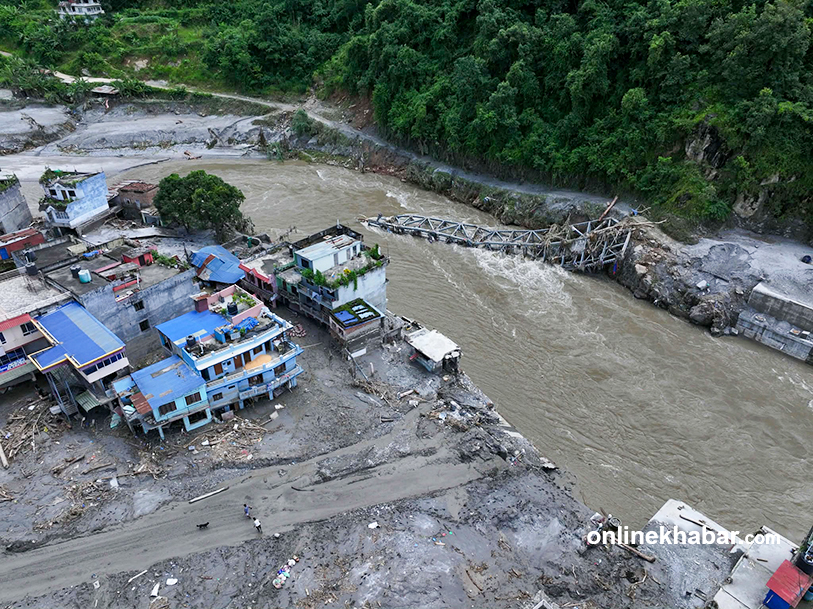
Most bridges have been washed away.
Emergency Bailey bridges could make a significant difference in some locations, but the initiative has so far been limited. No one expects bridges to be built everywhere immediately. But even where vehicles cannot pass, people need walking routes and pedestrian bridges. At least some of them are urgently needed.
Who is supposed to lead and coordinate all of this?
The Ministry of Home Affairs and the units under it. That is where the leadership responsibility lies. Home Minister needs to lead.
There are plenty of ways for him to demonstrate that he remains connected with people on the ground. He can provide regular briefings. He can visit selected locations and offer reassurance.
But how much he sweats or how many calories he burns is completely irrelevant. His urgency and his ability to make decisions must be measured by the results.
Perhaps our Prime Minister and Home Minister cannot match the Chinese premier. They do not need to.
But their determination must be visible in what they achieve. Otherwise, all this movement will become another exercise in self-promotion and image-building.
This is bigger than politics
Nothing is more important than a citizen’s right to live. Certainly not the projection of any individual as a future prime minister.
Yet we are still seeing the danger that the Himalayan tsunami that began in Rasuwa—one of the most devastating disasters the country has faced—could become an opportunity to spend state resources building the glory of an individual.
Let us say it plainly.
Those who built and now lead this government must have the courage to remind Home Minister Sudan Gurung if he is using the disaster to burnish his image.
The rescue of people trapped in a disaster is not nearly as romantic as it may look from Singha Durbar.
It is difficult and it is painful. And the danger has not passed. More risks may yet emerge.
So what have we done with the time we have had?
Finding people swept away by floods is obviously not easy. But even a proper look at social media shows the desperate pleas coming from their families.
Climate change is no longer something to be discussed only in five-star hotels.
Glaciers melting and Himalayan ranges turning black are no longer issues limited to mountaineering expeditions and mountain flights.
For the poorest people living in these areas—and for indigenous and minority communities—the consequences are immediate. Their homes are being destroyed. Their children’s schools are being lost. Health posts, farmland and livelihoods are at risk. And yet, at a time like this, a section of the privileged appears more interested in promoting itself.
There is another side to Nepal, too.
A photograph posted on Facebook by Sonukumar Das and shared by RSP lawmaker Manish Jha offers a glimpse of it.
In Rautahat, 26 students collected Rs 470 for the Prime Minister’s Disaster Relief Fund by setting aside Rs1 0 to Rs 20 from their daily snack money. That small act says something important about Nepali society.
It is the same society that can put out the communal fire recently being stoked through Kaptanganj and Golbazar with tolerance and humanity.
There is something deeply pure about that gesture. The sentiment behind the money matters far more than how many zeros the amount has. Thank you, friends from Rautahat.
That same spirit is needed from citizens across the country. But this crisis also forces us to ask another uncomfortable question:
Are we genuinely sensitive towards other people and communities, or do we simply perform sensitivity on Facebook? We must make sure that crises like this do not become another form of preparation for the next election.
Let the government work
In March, a strong government was formed with a huge majority. But a strong government is not defined only by the number of votes it wins. It must also be able to make its citizens feel that the state is strong and that it will not abandon them.
So let the government work.
The blue jackets carrying “RAT” and the red-and-white promotional materials we have been seeing across Nepal are becoming a distraction. They are getting in the way of the work that needs to be done. And they risk repeating the same mistakes we have seen from governments in the past.
A political culture that thinks about the next election even during rescue and relief operations cannot be the politics of a modern, civilised state.
The voters are the very people suffering today. Winning their votes once is not enough. They have to be won over again and again.
For now, there is only one thing that matters; Let us all work together to help the government do its job—and do it well, effectively and with results.