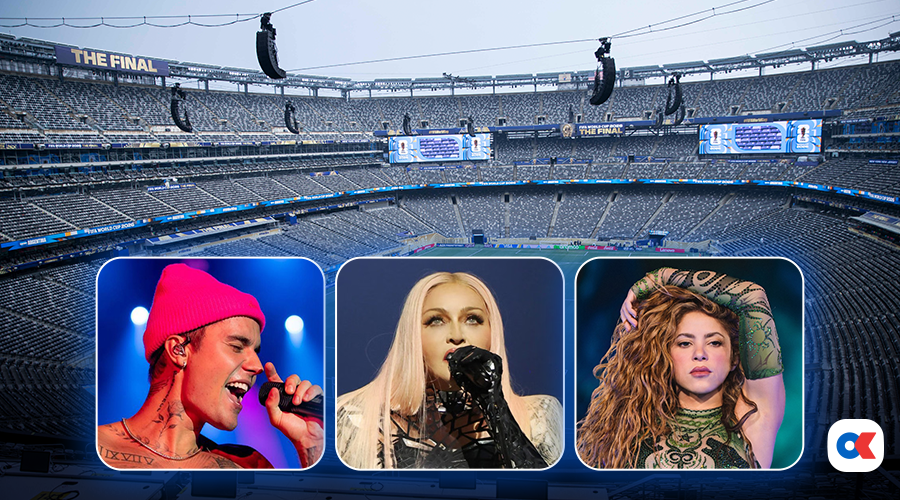
If the match between Spain and Argentina is the World Cup final, then the “halftime show” is the symbolic final of world pop music. As Lionel Messi and Lamine Yamal face off for the title at MetLife Stadium in New York, the heavyweight of world music, Madonna, Shakira, BTS, and Justin Bieber will give their performance in a nearly 30-minute halftime show.
This unprecedented convergence of football and music is creating a unique chemistry between sports fans and music lovers alike. At a time when geopolitics is causing upheaval across the world, the World Cup final and its halftime show could become a formula that unites divided minds.
FIFA President Gianni Infantino made this message clear at a pre-final press event, delivering remarks in front of President Donald Trump himself, a moment carrying diplomatic weight, given that the FIFA chief’s message of global unity was delivered directly before Trump.
The halftime show will be performed in front of Trump. Notably, Trump, who is often seen as unfriendly toward Hollywood and celebrities, will witness this musical performance, and other figures from the global entertainment world are also expected to be present at the same time.
FIFA’s choice of performers for the show appears deliberate. By bringing pop stars from different continents onto a single stage, FIFA seems to be aiming to send a message of global unity and cooperation, an unprecedented gathering across continents, generations, languages, and musical cultures.
Madonna is one of the most influential names in global pop culture. Shakira has built a strong connection between Latin music and football celebrations. Justin Bieber is among the most popular pop stars of the digital era. BTS has brought K-pop into the global mainstream, while Burna Boy represents the growing international influence of African music.
First time in World Cup
This will be the first-ever halftime show at a World Cup, a format similar to America’s Super Bowl. Alongside the headliners, Nigerian singer Burna Boy, Venezuelan music director Gustavo Dudamel, and Coldplay, along with the PS22 Chorus, will also perform, with the show coordinated by Coldplay’s Chris Martin.
According to FIFA, the televised musical segment will run 11 minutes, though international media reports suggest the halftime break, including time for stage setup and removal, could stretch to around 25 minutes.
Since a football match’s halftime is normally capped at 15 minutes, there has been debate over whether this extended break could affect players’ readiness and the game’s rhythm. FIFA, however, has stated there will be no compromise on the fairness of the game or players’ welfare.
The halftime show is being organised in support of the FIFA/Global Citizen Education Fund, which aims to raise $100 million to provide quality education and football opportunities to children around the world. More than $50 million has already been raised, with one dollar from every World Cup ticket contributed to the fund.
Support and Criticism
The gathering of famous pop stars representing different geographies, cultures, languages, and generations on one stage isn’t limited to entertainment value alone; it sends a message that football and music can rise above political and cultural boundaries to unite the world.
The participation of Madonna, Shakira, BTS, Justin Bieber, and Burna Boy reflects an effort to bring together audiences from North America, Latin America, Asia, Europe, and Africa in a single global event. Since the performance is tied to raising funds for children’s education, it also represents an effort to convert fame into social impact.
Meanwhile, debate continues over whether the World Cup is increasingly being turned into an American-style entertainment and commercial “mega-event.” There is criticism of the halftime show, though it amounts more to ongoing debate among football fans, analysts, and media than any organised boycott.
Critics worry that extending the halftime break to 25 minutes could pose health risks to players, their bodies cooling down during a long period of inactivity, increasing the risk of injury in the second half. Under International Football Association Board rules, halftime cannot exceed 15 minutes, and any change requires the referee’s approval, raising questions about how the proposed extended break would be reconciled with the rules.
There are also concerns about disrupting the game’s rhythm, with critics arguing that a musical performance could affect players’ concentration and the game’s natural flow. Some have complained that football is being “Americanized,” while some supporters have accused FIFA of following the Super Bowl model and turning football into more of an entertainment and advertising spectacle than a sport.
Supporters, however, see this as an opportunity to connect with new audiences. They believe the participation of globally famous artists could draw younger and new viewers, even those with limited interest in football, closer to the World Cup. The argument goes that music makes the final feel like a bigger cultural occasion than an ordinary match, and that as audience expectations for major sporting events grow, the world of sports needs to experiment with new formats too.
Supporters argue that bringing together artists from different regions- Madonna, Shakira, BTS, Justin Bieber, and Burna Boy, will further broaden the World Cup’s international character. Organisers, meanwhile, insist there will be no compromise on the fairness of the game or players’ health.
Ultimately, the debate centres on one question: will the music make the World Cup final even more special, or will it overshadow football’s core appeal and the players’ wellbeing? A practical answer will likely become clearer only after the event and match are over.
Given its popularity, cultural influence, and potential global audience, the halftime show could become one of the largest musical gatherings ever held. Since the World Cup final itself is among the most-watched sporting events in the world, its stage will be far larger than any ordinary concert.