
Kathmandu, August 20
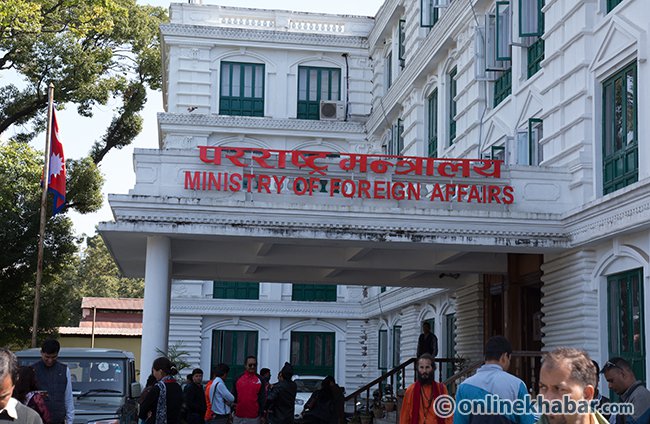
The government is preparing to allow private-sector entities to collect biometric data from Nepali citizens living abroad as part of the passport application process.
The provision has been proposed in the Passport (First Amendment) Bill, 2026, registered in the House of Representatives by Foreign Minister Shishir Khanal on July 30.
Under the proposed amendment, the Ministry of Foreign Affairs would be able to arrange for private companies or other institutions to collect passport applications along with biometric data from Nepalis abroad.
Currently, biometric collection is handled exclusively through government agencies and Nepali diplomatic missions. Nepali citizens applying for passports abroad must generally appear in person at the relevant embassy or consulate to provide their biometric data.
Concerns over sensitive data
The proposed provision has raised concerns among lawmakers over the security and potential misuse of sensitive personal data.
Rastriya Swatantra Party lawmaker Rima Bishwakarma questioned whether the bill provides adequate safeguards against the misuse of biometric data.
She said the bill lacks clear standards for preventing the misuse of sensitive personal data and stressed the need for explicit legal provisions on data security, use, protection and accountability.
Nepali Congress whip Nishkal Rai also raised concerns about who would control citizens’ data if private companies were allowed to collect it.
He questioned what would happen in cases of data misuse, leaks, subcontractor access, transfers to foreign jurisdictions, incorrect identity matching or failure to destroy data when required.
Rai argued that the bill should establish a clear chain of accountability rather than leaving major decisions concerning citizens’ sensitive information to the executive.
Government cites difficulties faced by Nepalis abroad
Foreign Minister Khanal defended the proposed provision, saying it is intended to make passport services more accessible to Nepalis living far from diplomatic missions.
He said Nepal has embassies in only limited locations while Nepalis are increasingly dispersed across different countries. Requiring citizens to travel long distances simply to provide biometric data can impose significant costs and inconvenience.
Khanal cited Australia as an example, noting that Nepal’s embassy is in Canberra while a large Nepali population lives in Sydney. Travelling from Sydney to Canberra for passport-related services can cost hundreds of dollars in airfare alone, in addition to accommodation expenses.
He said similar challenges exist in Europe, where Nepal does not have diplomatic missions in many countries.
“That’s why we have introduced the concept of third-party provision to see whether the service can be made easier,” Khanal said, adding that the ministry is studying possible arrangements with established institutions that already handle similar services internationally.
Bill moves forward
The bill underwent a preliminary discussion in the House of Representatives on August 18. Parliament subsequently approved a proposal to consider the bill, opening a 72-hour window for lawmakers to submit amendments.
The provision allowing private-sector collection of biometric data is expected to receive further scrutiny during clause-by-clause discussions.
The key issue will be whether the government can expand access to passport services without compromising the security and control of citizens’ biometric data.