
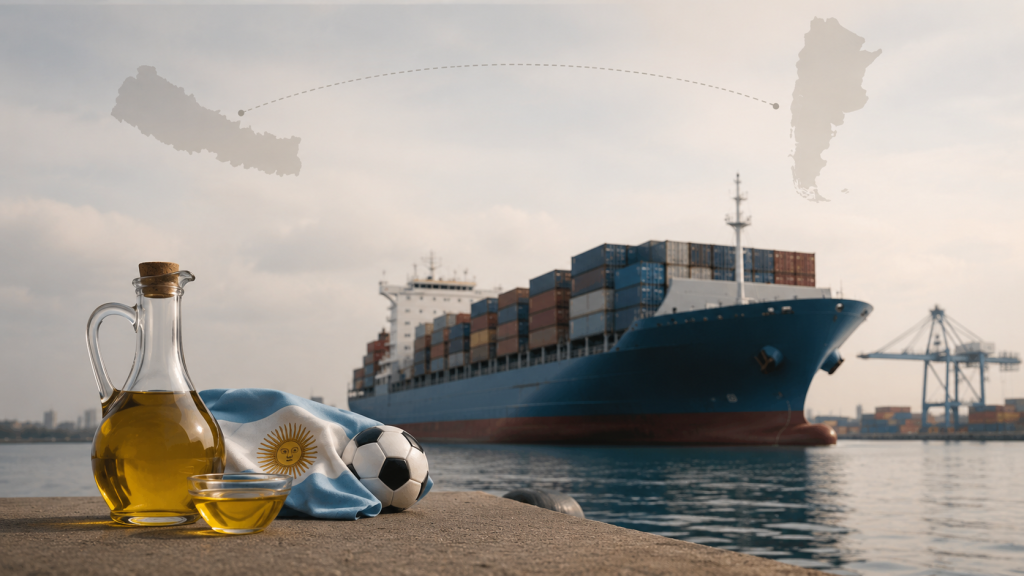
With the FIFA World Cup 2026 in the air, Argentina is again on the minds of people in their homes, cafes and social media feeds across Nepal. The South American country has a strong emotional resonance for the Nepalis, as it has been providing them with memorable moments for decades in the World Cup.
Yet, Argentina’s significance for Nepal is more complex than just football. It’s a tale of a distant conflict, Nepali soldiers who served on the other side of the world and a billion-rupee trade that is almost entirely dependent on edible oil.
A war Nepal was quietly part of
Today, few Nepalis can recall a war fought in the South Atlantic in 1982 between Britain and Argentina over islands, which is known as the Falklands War. Nepal was not involved in the war, but the war has an unusual connection with Nepal: Gurkha soldiers from Nepal served in the British Army as part of their campaign to retake the islands.
The 1st Battalion, 7th Duke of Edinburgh’s Own Gurkha Rifles was attached to the British 5th Infantry Brigade and fought in the area of Mount William near Port Stanley. During the war, some Argentine troops were anxious about the reputation of the Gurkhas, and this was exacerbated by rumours and media coverage. In fact, some Argentinean voices even called them “mercenaries”, a term that was not accepted by Gurkha veterans and historians.
The Falklands War was never a war between Nepal and Argentina. But Gurkha troops from Nepal were deployed thousands of kilometres from their home country to fight against the Argentineans — a lesser-known part of the complex history between the two nations.
A surprising position in Nepal’s trade data
This historical footnote makes the current economic situation even more remarkable.
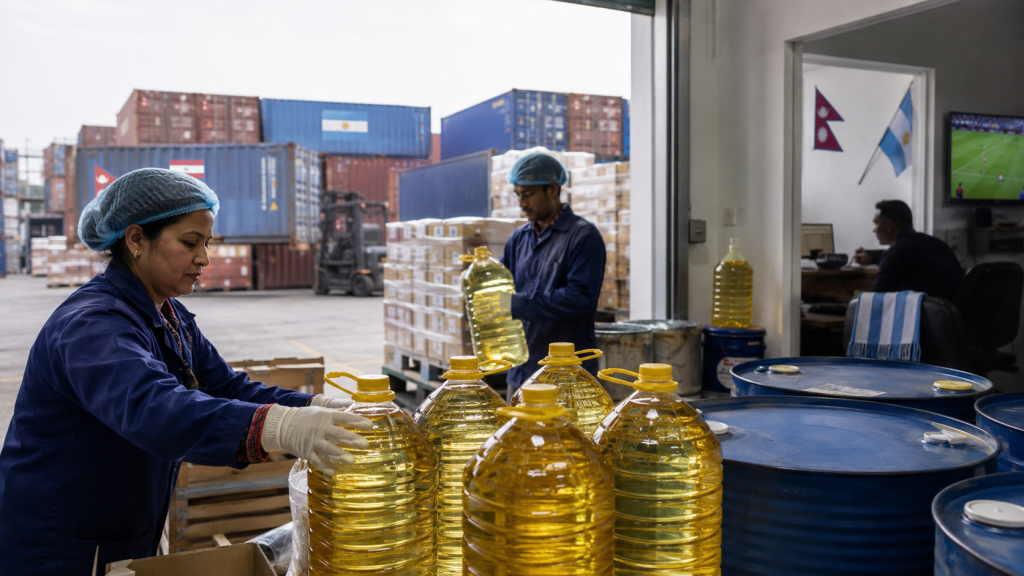
The Department of Customs in Nepal has released the statistics of foreign trade during the first 11 months of the fiscal year 2082/83 (Shrawan-Jestha), which reveals that Argentina is Nepal’s third largest import source country after India and China. In this time, Nepal imported goods worth around Rs 105.08 billion from Argentina.
To put this in perspective, India was still the leading import partner of Nepal at Rs 1092.02 billion. The second largest is China with Rs 382.25 billion. Argentina’s figure of Rs 105.08 billion placed it well ahead of the United Arab Emirates at Rs 50.99 billion and the United States at Rs 29.10 billion. The result was a remarkable one for a nation located thousands of kilometres away, with no resident embassy in Nepal and no major cultural or migration corridor comparable to Nepal’s ties with India, China or the Gulf.
What Nepal actually buys from Argentina
The trade relationship, however, is highly concentrated. The imports from Argentina to Nepal are highly skewed towards a single product group, namely crude edible oils.
The import bill for crude soybean oil was the largest at Rs 90.12 billion, while crude sunflower oil added another Rs 14.79 billion. These two commodities account for nearly 99.8 per cent of Nepal’s imports from Argentina, leaving little space for anything else.
This concentration brings the structural aspect of the relationship to light. Nepal does not source a diverse range of consumer or industrial goods from Argentina. Instead, it depends on the country as a key point in its chain of edible oils, importing raw oils for processing in the country, refining and consumption.
Three different Argentinas
And so there are not one Argentina in Nepal’s narrative but three, to all appearances quite unrelated: the Argentina of football – beloved, passionate, emblazoned in blue and white, identified by its Messis and Maradonas, decades of Cup finals – and the Argentina of the Falklands War, in whose colonial-era land in the South Atlantic an Argentine conscript fought on a British side against a Gurkha whom he may never have noticed and whom he may never meet even now; and then there is Argentina the vast agrarian economy whose products in large volumes trickle into the accounting pages of Nepal’s Directorate of Customs with the designation ‘crude edible oil.’
Most Nepalis understand very little about these three Argentinas. The football in Argentina is the noisiest. The trade with Argentina means more in cash than anything else. The war in Argentina might be the most dormant in the memory of most of this country.
Nepal’s broader trade picture
The Argentina numbers fit in a broader pattern of structural trade imbalance. Imports grew to Rs 1,894.10 billion, exports just to Rs 277.97 billion — yielding a trade deficit of Rs 1,616.13 billion just in the first 11 months of FY 2082/83. Of this trade imbalance, Argentina’s Rs 105 billion component just shows how even a remote, distinct, and seemingly disconnected nation can be catapulted to the top three spot in a country’s list of import partners by a single item.
Key figures at a glance
| Indicator | Value |
| Argentina’s rank among import partners | 3rd |
| Nepal’s imports from Argentina | Rs 105.08 billion |
| — of which: crude soybean oil | Rs 90.12 billion |
| — of which: crude sunflower oil | Rs 14.79 billion |
| Share of oils in Argentina’s imports | ~99.8% |
| Nepal’s total imports | Rs 1,894.10 billion |
| Nepal’s total exports | Rs 277.97 billion |
| Trade deficit | Rs 1,616.13 billion |
Data source: Nepal Foreign Trade Statistics, Department of Customs, Government of Nepal. First 11 months of FY 2082/83 (Shrawan–Jestha). Figures are preliminary and subject to revision upon publication of annual trade statistics.