The release on YouTube of three politically themed films just days before the election is unlikely to be a coincidence. Each is closely tied to the current scenario, such as high public dissatisfaction, voters seeking change, and digital platforms increasingly amplifying civic voices.
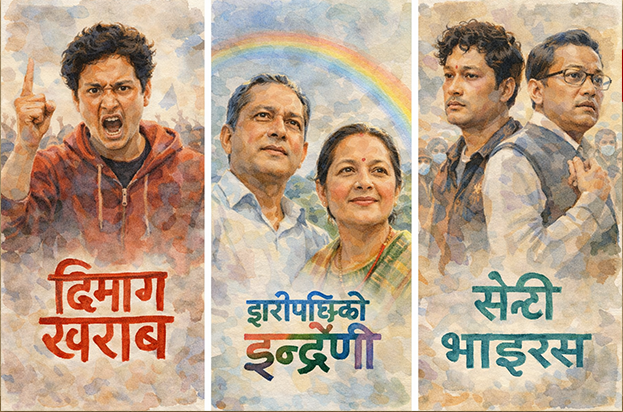
Dimag Kharab channels anger, Jhari Pachhiko Indreni evokes hope and Senti Virus explores emotion.
At the centre of all three are stories of frustration, rebellion and expectation, sentiments that may well mirror the electorate’s state of mind. Their staggered release online on the eve of voting lends their timing, purpose and potential impact added significance.
All three films revolve around political discontent, questions about the system, social despair and the search for alternative leadership. Their producers describe them as artistic reflections of contemporary realities. Yet the electoral context appears to place them beyond the realm of mere entertainment.
Strategy or necessity?
Each of the films had previously been released in theatres and is now drawing substantial viewership on YouTube. According to Arjun Ghimire, known as “Pande,” the director of Jhari Pachhiko Indreni, the timing of the online release is perfect.
Ghimire has said the intention was to raise civic awareness through the film. Its popular track “Aam Nepali Buba” was prepared by Balendra Shah, a candidate from the Rastriya Swatantra Party. Notably, the film was uploaded to YouTube through Shah’s own channel.
“We are trying to inform and sensitise citizens through this film,” Ghimire says to Onlinekhabar. “The present moment is highly suitable for that.”
The film arrived on YouTube only a few months after its theatrical release.
The producers of all three films argue that digital platforms allow them to reach audiences beyond geographic boundaries, including Nepalis living abroad.
This year’s election debate, campaigning and public discourse have largely unfolded on social media. Political content spreads rapidly online. Scenes, dialogues and messages from films released on YouTube can easily circulate as short clips on Facebook, TikTok and X. In that sense, these films do not remain confined to cinema; they become part of the broader electoral conversation.
Three films, three moods
Dimag Kharab tells the story of a disillusioned youth. It centres on corruption, centralised power and distrust of political leadership. Its characters are weary of repeated promises and incomplete reforms. The film presents youthful anger and the message that “the old ways are no longer acceptable.”
In recent years, growing political frustration among urban youth has paralleled the film’s narrative, making its message especially resonant in the current electoral climate.
Jhari Pachhiko Indreni tells a story of possibility after despair. Using symbolism, it portrays political instability and social hopelessness as “rain,” while the “rainbow” that follows suggests hope and reconstruction. Though the film does not name any political party directly, it emphasises the need for new thinking and transparent leadership. Its emotionally charged message that change is possible may be particularly potent during an election.
Senti Virus blends politics and emotion. Set around a local election in Kavre District, the film explores how public sentiment intensifies during campaign season. It examines how social media, rumours, emotional appeals and crowd psychology shape voter perceptions.
Media scholars note that in elections conducted amid the rise of social media, emotion can often outweigh facts. The film appears to present that tendency in artistic form.
Cultural intervention
Political themes in Nepali cinema are not new. But the simultaneous arrival of three such films on YouTube just before an election is noteworthy. Another political film, Bigul, was released in theatres but withdrawn within a week. Its producers had promoted it as essential viewing ahead of the election. Similarly, the director of Shree Bukuro described it as a film worth watching before casting a vote, even if only to cultivate a calm state of mind.
During election season, citizens are especially politically sensitive. Popular culture released at such a time is often interpreted through a political lens.
The current political environment is marked by discontent with traditional parties, the rise of independent candidates and the growing influence of digital campaigning. The messages of all three films appear closely aligned with this psychological landscape.
Since their release on YouTube, the films have drawn significant viewer engagement. In comment sections, some audiences have praised them as realistic portrayals of society. Others have criticised their timing in relation to the election.
Clips and dialogues from the films are circulating widely on social media, further weaving them into the fabric of the election debate.
The power of “soft influence”
It is unlikely that any single film will directly change votes. Yet their “soft power,” their capacity to shape narratives and emotions, may be consequential. Online debate and emotional resonance can contribute to the formation of longer-term public perceptions.
All three films foreground anger, hope and emotion, phenomena that are intimately connected to the present electoral psychology.
The pre-election YouTube releases of Dimag Kharab, Jhari Pachhiko Indreni and Senti Virus naturally raise questions about timing and context. They have emerged at a moment defined by the expansion of digital media, the rise of alternative political forces and the heightened expression of public sentiment.
Whether they will have an immediate effect on voters’ decisions remains uncertain. But one thing is clear, the modern election campaign is no longer confined to rallies, speeches and posters. It now unfolds on digital screens as well, a shift these cinemas vividly illustrate.