
The National Human Rights Commission has recommended that those responsible for the incidents of September 8 and 9 last year be prosecuted and further investigated. During the Gen-Z movement, a total of 76 people lost their lives, including students, police officers, protesters, and detainees.
A committee formed under the coordination of Commission member Lili Hajur Basnyat Thapa concluded that former Prime Minister KP Sharma Oli, former Home Minister Ramesh Lekhak, and former Minister of Information and Communication Prithvi Subba Gurung had committed human rights violations.
Since no existing law provides for punishing these individuals specifically for human rights violations, the Commission has recommended enacting a retroactive law (one that can punish crimes committed before the law’s enactment) to take action against them for crimes against humanity and human rights.
The Commission’s recommendations, submitted to the Prime Minister’s Office on May 27, also call for further investigation into interim government Prime Minister Sushila Karki and outgoing Home Minister Sudhan Gurung, among others.
Furthermore, Rastriya Swatantra Party (RSP) chairperson Rabi Lamichhane has been specifically identified as having been involved in releasing detainees from prison during the Gen-Z movement. RSP lawmakers Manish Jha and Hari Dhakal, and Nakkhu Prison administrator Satya Raj Joshi, among others, have been recommended for investigation.
The then Inspector General of Police, Dan Bahadur Karki, Armed Police Force IGP Narayan Datta Paudel, DIG Om Bikram Rana, SSP Bishwa Adhikari, APF SP Jeevan KC, National Investigation Department Director Krishna Khanal, and Kathmandu Chief District Officer Chhabi Lal Rijal have been recommended for departmental action for suppressing the Gen-Z movement.
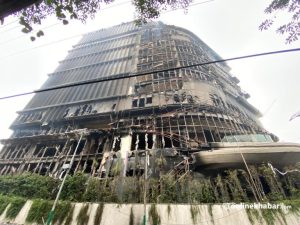
The Commission also identified weaknesses on the part of the Nepal Army in connection with the vandalism and arson at Singha Durbar, the Supreme Court, and the Presidential Palace during the September unrest, though no formal disciplinary action has been recommended against the Army.
The Commission has not yet made the full report public. It has been stated that the decisions released are based on a report spanning approximately one thousand pages.
Former Human Rights Commission member Gauri Shankar Lal Das says that recommendations made by any constitutional commission are binding.
“In countries with strong democracies, it is customary for promotions to be granted only after the Human Rights Commission certifies that an individual has not committed violations,” he says. Here, even 10 percent of the Commission’s recommendations are not implemented.”
Under the Commission of Inquiry Act, 2026 (B.S.), a commission can be formed if it is deemed necessary to investigate any matter of public importance. Such commissions have the authority to collect facts and details related to incidents.
Although commissions formed under this Act can investigate and offer their opinion, the final decision-making authority remains with the government. Typically, such commissions recommend that the government conduct further investigation and take action according to the law.
A tale of two mandates
Former Commission member Mohana Ansari explains that the mandate of a constitutional commission differs from that of commissions formed under ordinary law.
Although a constitutional commission’s recommendations are binding, Ansari expresses frustration that she has not seen the Human Rights Commission’s reports actually implemented.
“The recommendations made during our tenure were also not implemented. When such recommendations are followed, it elevates the state’s standing internationally as well,” she says.
A cautionary example: The Kumar Lama case
Consider what happens when recommendations go unimplemented. During the decade-long Maoist armed conflict, the Commission had recommended departmental action against Nepal Army Colonel Kumar Lama for allegedly torturing Janak Bahadur Raut at Gorusing Barracks, along with compensation for the victim.
The government took no action. Lama was later arrested in the United Kingdom in 2012 while on leave from his deployment in South Sudan. By then, he had already been promoted to the rank of Colonel.
In 2014, at a meeting of Parliament’s Social Justice and Human Rights Committee, then-members, including current President Ram Chandra Paudel, demanded that Lama be brought back to Nepal and investigated under Nepali law.
“If the Commission’s report had been implemented, the state machinery would not have had to be so extensively mobilised to free him, and he himself would not have had to face such humiliation abroad,” says one Commission member.
The Rangeli incident
In January 2016, three people were killed by police bullets during a clash between CPN-UML and United Democratic Madhesi Front workers in Rangeli, Morang. The Commission concluded that the deaths were caused by security officials’ failure to exercise caution.
The Commission recommended action against those responsible and adequate relief and compensation for the victims’ families. At that time, the officials named in the action recommendation approached the Commission seeking a review of the decision.
“There is no provision for reviewing or correcting a Human Rights Commission recommendation,” says former member Ansari.
Constitutional authority
Article 249 of the Constitution grants the Commission the authority to recommend that cases be filed in court against individuals or institutions that violate human rights.
The Commission can also recommend departmental action and punishment against human rights violators to the relevant authorities.
Even the Supreme Court has issued orders directing that Commission recommendations be implemented without conditions.
Civil society perspective
Human rights activist Charan Prasai says that despite various shortcomings in the Commission’s recommendations regarding the Gen-Z movement, there is no alternative to implementing them.
“For instance, there is talk of reappointing the outgoing Home Minister. Under the Commission’s recommendations, he cannot be given such responsibility,” Prasai says.
The Commission has the right to receive updates every three months on whether its recommendations have been implemented.
“The implementation of the Commission’s recommendations is not optional. The Commission also has the authority to publicly name officials of agencies that refuse to implement the recommendations as human rights violators,” he adds.