


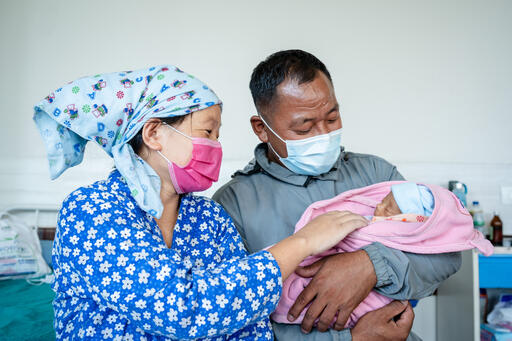
The government is preparing to extend paid maternity leave to six months, and paternity leave to 42 days, presenting the move partly as a response to Nepal’s declining population growth rate.
A bill registered in the House of Representatives proposes amending the Safe Motherhood and Reproductive Health Rights Act, 2018, which currently provides 98 days of maternity leave and 15 days of paternity leave.
Under the proposed amendment, women working in government, non-governmental and private organisations would be entitled to six months of paid leave before or after childbirth. Male employees in these sectors would receive 42 days of paid leave before or after their wives give birth if the bill is passed without changes.
The government says the proposed extension is intended to encourage population growth.
“According to Nepal’s latest national census, the country’s population growth rate has been on a continuous downward trend. It is therefore necessary to amend the law to introduce measures, including incentives through leave provisions, to encourage population growth,” Health and Food Hygiene Minister Nisha Mehta wrote, explaining the rationale behind the bill.
Defending the proposal in the House of Representatives, Mehta argued that maternity leave should be understood as more than an employment benefit.
“We should not understand six months of maternity leave merely as a benefit or a period of leave granted to employees. It is an important issue connected to respect for motherhood, the health and nutrition of mothers and newborns, and the state’s long-term investment in human capital,” she said.
Extending leave, she added, should be viewed as an investment in the country’s future.
“When making laws, we should not look only at today’s needs. We must also consider what kind of society we want to build for tomorrow,” Mehta said. “We want to build a healthy, capable and productive workforce. Investing in the health of mothers and children is an investment in the human capital of tomorrow.”
But can longer maternity and paternity leave reverse a demographic trend that has been decades in the making? Nepal’s experience with population control, together with the difficulties other countries have faced in encouraging people to have more children, suggests there are no easy answers.
A population growth rate in decline
Nepal began conducting national censuses in 1911. More than a century later, its population growth rate has fallen below one per cent for the first time in eight decades.
The rate was negative in the country’s earliest censuses, standing at minus 0.13 per cent in 1921 and minus 0.07 per cent in 1931. It subsequently remained positive for decades, reaching 1.16 per cent in 1941, 2.27 per cent in 1951, 1.64 per cent in 1961, 2.05 per cent in 1971 and 2.62 per cent in 1981.
The rate then fell to 2.08 per cent in 1991 and 2.25 per cent in 2001, before dropping to 1.35 per cent in 2011 and 0.92 per cent in 2021.
The 2.62 per cent growth rate recorded in 1981 remains the highest in Nepal’s census history, according to records maintained by the National Statistics Office.
The decline is not confined to the national level. Thirty-four districts and 319 local governments have recorded negative population growth.
Concerned about the trend, some local governments have introduced incentive payments and other programmes to encourage people to have children.
The national government is now considering longer maternity and paternity leave as part of its response. Yet the declining growth rate is not simply the result of recent social changes. It also reflects decades of policies that encouraged smaller families, as well as broader transformations in society.
Understanding whether the trend can be reversed requires looking back at how population growth came to be treated as a problem in the first place.
How population control became a policy priority
Long before Nepal conducted its first national census, British economist Thomas Robert Malthus had published An Essay on the Principle of Population, outlining a theory that would influence population debates for generations.
Malthus argued that population grows geometrically while food production increases only arithmetically. In his formulation, population grows from 1 to 2, 4, 8 and 16, while food production rises from 1 to 2, 3, 4 and 5. Over time, he concluded, the imbalance would lead to crises such as famine.
He identified two ways of checking population growth: natural and artificial. Floods, landslides, earthquakes, epidemics and diseases were examples of natural checks. The artificial alternative was to limit reproduction by marrying late, remaining unmarried, choosing not to have children after marriage, or having fewer children.
In 1968, seven decades after the turn of the century and long after Malthus’s death, American biologist Paul Ehrlich published The Population Bomb. He warned that rapid population growth would trigger famine, food shortages and a crisis of natural resources, arguing that the Earth might struggle to sustain everyone if its population continued to expand too quickly.
Ehrlich’s ideas gave further impetus to debates about contraception, family planning and population control.
The influence of Malthus and Ehrlich soon spread across Asia, where governments adopted increasingly aggressive measures to curb population growth.
In India, Prime Minister Indira Gandhi’s government introduced an aggressive sterilisation programme. Experts say the state of emergency declared in 1975 was used to carry out the programme, with millions of people forcibly sterilised.
A few years later, China introduced its one-child policy in 1979. Demographers say families who had more than one child faced fines and, in some cases, forced abortions.
Yet population control was never solely about balancing numbers against food supplies or natural resources. It was also shaped by ideas about which populations should grow and which should not.
One of the starkest examples was the eugenics movement in Europe and the United States. Eugenics promoted discouraging reproduction among marginalised or targeted communities while encouraging it among groups considered to be of supposedly superior ancestry.
The ideology reached its most extreme expression in Nazi Germany’s population policies. Eugenics was subsequently criticised for seeking to improve what its proponents called genetic quality while effectively eliminating the populations of other groups.
After the Second World War, population politics became increasingly consequential for countries in the Global South, including Nepal. Their populations were often portrayed as causes of poverty, political instability and other social problems. These countries were frequently labelled the “Third World” by those who considered themselves part of the First World.
Nepal, too, came under the influence of international non-governmental organisations promoting population control.
Nepal’s long campaign for smaller families

When Nepal launched its first five-year plan in 1956, a decade had passed since the end of the Second World War. From the outset, the country took a position against rapid population growth.
In 1959, before the first five-year plan had even ended, the Family Planning Association of Nepal was established. The Nepali term niyojan, used in the association’s name, means planning or control and can refer to measures taken to prevent conception.
The name itself reflects the emphasis placed on controlling reproduction at the time. For at least three decades, Nepal appears to have pursued a population control policy.
“The first through the fifth five-year plans emphasised migration, family planning, and maternal and child health programmes,” states the National Population Policy, 2014.
From the 1960s onwards, the government pursued aggressive policies to reduce birth rates for three consecutive decades. Public messaging repeatedly associated having many children with being uncivilised, uneducated, poor and backward. Smaller families, by contrast, were presented as a sign of development and prosperity.
The effects began to emerge after three or four censuses. Nepal’s population growth rate peaked at 2.62 per cent in 1981 before falling to 2.25 per cent in 2001, 1.35 per cent in 2011 and 0.92 per cent in 2021.
Following Nepal’s political transformation in 1990, the Family Planning Association of Nepal began to describe its purpose in terms of reproductive health rather than population control.
The shift reflected a broader change in international thinking. In particular, following the 1994 International Conference on Population and Development in Cairo, greater attention was paid to individual reproductive rights, women’s empowerment, healthcare and voluntary family planning.
Dr Bal Krishna Mabuhang, a retired population expert from Tribhuvan University, argues that Nepal had also absorbed the influence of eugenics, including the idea that people from wealthy backgrounds and certain geographical regions were more civilised than others.
“Caught in the trap of eugenics, we too adopted a policy that essentially said having too many children was a problem, while having few was just right,” Mabuhang says. “The eugenicist argument that European and American ancestry was superior while Asian and African ancestry was inferior has already been discredited.”
Mabuhang believes Nepal followed prevailing international thinking without sufficiently examining whether the traditional aspiration for children to populate the country’s hills and mountains was appropriate.
His criticism raises a broader question: did Nepal’s population policies adequately consider the long-term consequences of encouraging smaller families, or did the country simply follow the prevailing international consensus?
Can governments persuade people to have more children?
Nepal is not alone in confronting declining population growth. Governments around the world have introduced measures to encourage people to have children, including maternity and paternity leave, financial incentives, tax breaks, fertility treatment subsidies and guarantees relating to children’s education, healthcare and employment.
Some have also offered employment support to parents.
But reversing a decline that has developed over decades is considerably more difficult than introducing incentives.
Various studies and population experts generally conclude that policies intended to increase population growth have had limited success. Incentives may influence family decisions, but they do not necessarily reverse the long-term decline in fertility associated with social, economic and cultural change.
The United Nations has also acknowledged the difficulty.
Its report World Population Policies 2021: Policies Related to Fertility states: “Although various approaches and initiatives to reduce fertility rates have produced results globally, reversing the long-term downward trend in total fertility rates driven by social, economic and cultural transformations has proved extremely difficult.”
The experience of countries that have tried to encourage larger families illustrates the challenge.
Dr Yogendra Bahadur Gurung, a professor of population studies, says increasing a population growth rate that has already declined is an extremely difficult task.
“Nevertheless, incentive programmes introduced to increase fertility rates may help stabilise the population growth rate,” Gurung says.
Countries such as France, Germany and Hungary appear to have had some success in preventing further declines in their population growth rates. However, experts caution that maintaining those rates over the long term remains difficult.
Gurung believes improved employee benefits are worthwhile, but should not be treated as a comprehensive solution to declining population growth.
“In an open and free society like ours today, it is not good to formulate manipulative policies dictating whether the population should increase or decrease,” he says.
The challenge is that decisions about having children are shaped by much more than government incentives. Sociologists say more people are choosing to marry later, remain unmarried, or have no children or fewer children after marriage.
These are broader social changes that cannot necessarily be reversed by extending leave entitlements alone.
From population control to population growth

Nepal’s policy thinking has gradually shifted alongside these changes.
In 1992, the country’s eighth five-year plan began explicitly recognising the importance of population in national policy. Following the 1994 Cairo conference, Nepal introduced a 20-year long-term plan covering 2067–2087 in the Nepali calendar.
More recent population policies, as well as the maternal protection bill now registered in Parliament, suggest that the government is increasingly interested in encouraging population growth rather than merely controlling it.
The question is whether this shift in policy can produce the intended results.
The National Statistics Office projects that Nepal’s fertility rate will range between 1.13 and 2.1 over the next 15 years. According to its Population Projections for 2021–2051, the country’s total population could reach 33.5 million within the next 25 years.
These projections offer a picture of the country’s possible demographic future, but they do not settle the question of what population Nepal should aim for.
Mabuhang argues that the issue cannot be reduced to a single ideal number.
“There is no such thing as a country having too many people, too few people or just the right number of people in absolute terms,” he says. “The population a country needs depends on the resources, opportunities and other conditions available within that country.”
That distinction matters as Nepal considers extending maternity and paternity leave. Paid leave can be defended on its own merits, particularly in relation to maternal health, newborn care, nutrition and the well-being of families. Whether it can also reverse the country’s declining population growth rate is a separate question.
The government may hope that better support for parents will encourage people to have more children. But Nepal’s own history shows how deeply population trends can be shaped by public policy, while international experience suggests that changing those trends is rarely straightforward.
Population policy affects far more than the number of people in a country. It intersects with reproductive rights, gender equality, public health, economic opportunity and access to resources.
For that reason, experts argue, decisions about population growth require sustained public debate and careful consideration of the country’s circumstances, rather than an assumption that either a larger or a smaller population is inherently better.