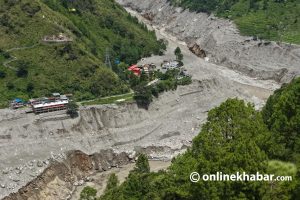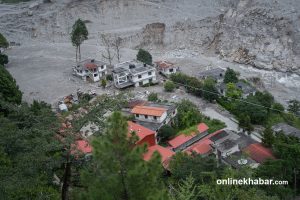


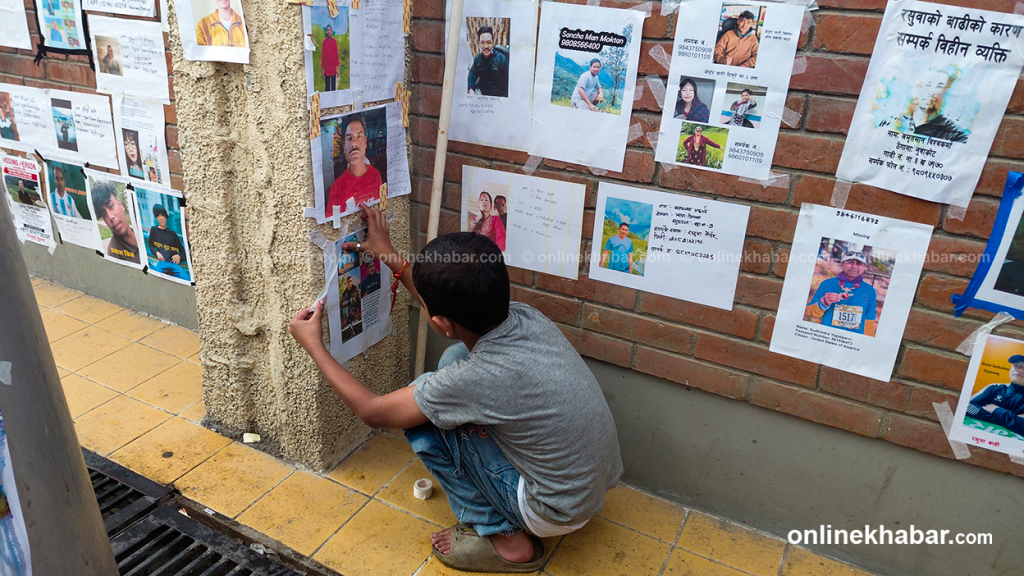
At Tribhuvan University Teaching Hospital in Maharajgunj, a wall is covered with papers bearing photos, names, ages, addresses, and contact numbers of people who went missing in the Bhotekoshi flood. Some are large colour photos, others small black-and-white ones. Anyone standing before the wall shows visible exhaustion, worry, and tears; some verify details on their phones, while others search for a spot to post a relative’s photo.
In the middle of this crowd is a boy carrying a roll of white tape, moving busily from person to person and asking anyone who looks like they might be a flood victim’s relative, “Do you have a photo to put up?”
Once handed a photo, he sizes it up, finds space on the wall, cuts tape, and sticks it in place, even climbing on others’ shoulders when he can’t reach the upper sections himself.
The boy is 12-year-old Bibek Pariyar.
He isn’t doing it for money. When people try to pay him, he shakes his head and says he won’t take it, though he says he sometimes accepts because people clearly want to give, joking that he even has some Indian currency to show for it.
Bibek is a fifth grader at Mahendra National Secondary School in Baluwatar, which is close to where he lives and close to the hospital too. Since the Bhotekoshi flood on August 26, his routine has shifted: school in the morning, helping flood victims in the afternoon, then home in the evening.
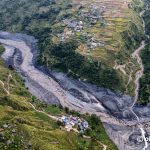
No one asked him to do this; he started it himself. The day after the Rasuwa flood, he noticed people posting pictures at the hospital and asked a man why. The man explained he was searching for a relative lost in the flood. Bibek had watched a YouTube video about the flood that morning, so he understood immediately. He recalled hearing that a glacial/ice collapse had caused the flood, and that many people had gone missing, so he thought helping put up photos might help someone be found.
By now the wall is nearly full, and Bibek estimates he personally put up about 80 percent of the photos there. He still returns daily; regulars now recognise him and ask him to help place photos higher up, which he does by climbing onto someone’s shoulders.
A mother finds out from the TV
His mother, Pramila, initially didn’t know what he was doing; she was busy caring for a patient in someone else’s home. Her employer called her to the television and pointed: her son was on screen, helping post photos of the missing at the hospital. She worried at first that he might have been begging for money, but learned he wasn’t; he’d simply started helping after hearing about the flood.
None of the missing was his own relatives, but he seemed to feel that behind every photo was a family. So he kept going back every day. When people offered him money, he initially refused; later, some began slipping money into his pocket anyway.
Once his mother learned of this, she was worried that a 12-year-old spending his days at the hospital among strangers could be at risk. She told him not to accept money or food from strangers, warning that someone could lure him away. Still, alongside her worry, she felt proud; he had seen others’ suffering and wanted to act.
“I didn’t teach him this,” she says. “Children learn these things on their own.”
Family background
Pramila, 42, is originally from Lamjung but has no permanent home there since her ancestral land sits on government property. She came to Kathmandu years ago for treatment after developing a health condition, and after recovering, chose to stay rather than return to a village with no work opportunities. She built connections doing domestic and caregiving work, eventually brought her family to Kathmandu, and the family found a room in the alley behind the teaching hospital.
Life was becoming more stable until, about a year and a half ago, her husband Hari suffered a sudden stroke. He was treated at Bir Hospital, partly free of cost given the family’s circumstances. He survived but can no longer work as before and cannot manage household responsibilities, so the burden has fallen on Pramila. She earns roughly 18,000–22,000 rupees a month between two caregiving jobs, most of which goes to rent, food, her husband’s medicine, and her children’s schooling. Some days there isn’t enough to eat.
Where is Bibek’s childhood?

While his peers play, use phones, and enjoy outings with parents, Bibek’s home has other pressing needs ahead of leisure. His father is unwell, his mother works all day, and three of his sisters are already married. Given the family’s financial hardship, Bibek seems to have grown up faster than his years, understanding early that money doesn’t come easily, that people should help each other in hardship, and that money others give isn’t always his to keep.
For Pramila, what her son is doing matters more than money or praise.
“Right now, flood victims need even five rupees,” she says. “Even a small snack given in kindness matters. If we can’t give money like others, maybe someone can find their family through the photo my son put up.”
She reflects that things might be different if he’d been born into wealth, but adds that he was born into a poor household; some days there’s food, some days there isn’t.
Even so, growing up amid hardship, Bibek has learned to see others’ pain. No one in his own family went missing in the flood, but other families’ loved ones did. He went to the hospital for them, put up photos, and helped in the search for people, seemingly hoping some family would find their missing person through his efforts- a lesson drawn from his own family’s experience of how much someone’s support matters in hard times.