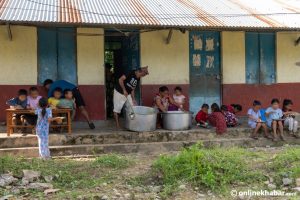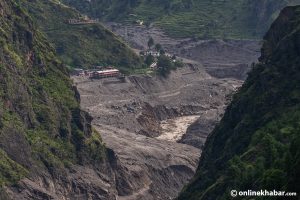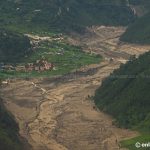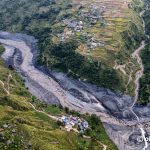


Six days after the devastating flood in the Bhotekoshi River, Pemba Lhamu Tamang of Gosainkunda Rural Municipality-3 in Rasuwa has yet to receive any relief.
The food stored at her home is running out, leaving her increasingly anxious. She says the fear of being left without food has begun to affect her health.
Since the flood swept through settlements on August 26, Nepal Army helicopters have not reached the area where she lives.
Whenever she hears the sound of a helicopter, Tamang said she hopes relief is finally coming. But the helicopters have so far left behind only the sound of hope.
The lack of electricity has added to the hardship.
“We are surviving for now on whatever food we had at home. But if relief does not arrive soon, we will suffer a lot,” Tamang told Onlinekhabar. “There is no electricity and the entire village is in darkness. With all the roads washed away, it feels as if someone has locked us in a prison and left us to starve.”
Residents of wards 2 and 5 of Gosainkunda are facing a similar situation. With even rice and lentils running out, some residents are reportedly spending their days drinking water available at home.
Gosainkunda Rural Municipality chairperson Kaising Nurpu Tamang said that despite repeated efforts, not even a bottle of water had reached some areas in the municipality.
“Everyone calls just to ask whether relief has reached us. But no one is actually sending it,” he said. “Everyone is saying the state is neglecting us. I have also been trying day and night to arrange relief, but I have not been able to get it here.”
Meanwhile, Amachhodingmo Rural Municipality chairperson Buchung Tamang said some relief had arrived initially but had already run out.
The situation has become even more difficult because the lack of electricity has disrupted communication with residents.
“Because there is no electricity, we have not been able to remain in constant contact with everyone. Our village feels completely cut off,” he said. “We may somehow manage to get through today, but if relief does not arrive by tomorrow, there will be a crisis.”
Government says relief is being delivered

The government, however, says relief supplies have been continuously sent to the affected areas.
According to figures released by the National Disaster Risk Reduction and Management Authority on Monday, 37 trucks and 35 Bolero vehicles had transported food and non-food relief supplies to affected areas. Eight helicopter flights had also been used to transport supplies.
The authority said that on August 30, five portable generators, along with food, non-food items, medicines and other health supplies, were sent to Rasuwa by road and air. Relief materials were also mobilised to Nuwakot through 13 vehicles and helicopters.
The Nepal Army has also posted photographs and videos on its Facebook page showing helicopters transporting relief materials, although it has not specified where all the supplies were delivered.
Prime Minister Balen Shah has also been providing updates on relief efforts through his social media accounts.
However, his updates have largely detailed where relief materials were collected and which military facilities they were taken to, rather than where they were distributed to affected residents.
According to Shah, relief materials collected at warehouses and government facilities in Kathmandu are being transported by air and road to the Nepal Army’s Maithil Barracks in Battar, Nuwakot, and to Uttargaya in Rasuwa.
He said the materials are then being distributed in affected areas by a committee coordinated by the assistant chief district officer and comprising security personnel and other stakeholders.
Shah also said an MI-17 helicopter transported food supplies from Tribhuvan International Airport to Dhunche on Monday, while essential food and non-food relief materials were sent to Dhunche and Uttargaya by road.
International assistance has also been arriving in Nepal. According to Shah, India, China, the United States and other countries have provided relief materials. India alone has sent 57.5 tonnes of humanitarian assistance and essential medicines in three phases.
Where is the relief going?

Despite the government’s figures, the situation on the ground raises questions about whether relief supplies are reaching those who need them most.
Most of the cargo vehicles travelling along the road towards Nuwakot are carrying relief supplies. But many appear to stop in Battar.
Local resident Rakesh Neupane said relief vehicles are often seen stopping around the Maithil Barracks of the Nepal Army.
“When people see those rescued by the army being brought to this barracks, many assume that relief will be distributed here. But as soon as distribution starts, there is a rush and people fight to get supplies,” Neupane told Onlinekhabar. “That is why genuine victims are not getting relief. Those who come to distribute it also choose places that are convenient for them, take photographs and leave. Without the government delivering relief further into the affected areas, it is impossible for it to reach the victims.”
Abhinav Joshi, who has been involved in collecting relief since the day after the flood, said poor road conditions are preventing supplies from moving beyond Nuwakot.
“Look at the condition of the vehicles carrying relief supplies even today,” he said. “Even if our relief has not reached them, government relief should at least have reached the victims by helicopter.”
The government’s own updates indicate that large quantities of relief have been taken to Battar, but do not clearly establish how much has subsequently reached individual communities in upper Rasuwa.
Asked where the relief was being distributed, Shanti Mahat, spokesperson for the National Disaster Risk Reduction and Management Authority, said 14 task forces led by joint-secretary-level officials had been formed to respond to the floods.
“You should probably ask the person in charge of relief for that information,” she told Onlinekhabar.
Joint Secretary Jagannath Tiwari, who heads the authority’s relief task force, said the supplies recorded in government figures are reaching affected people.
“We have not received information that relief has failed to reach anywhere. Where did this information come from?” he said.