

Kathmandu, November 28
The government is preparing to form a special task force to tackle fraud and labour exploitation in foreign employment, including cases involving recruitment scams, workers being assigned jobs different from those promised, withheld wages and benefits, and human trafficking disguised as travel on visit visas.
A high-level meeting chaired by Home Minister Sudan Gurung on November 20 decided to establish a task force involving relevant agencies to curb fraud linked to foreign employment and consultancy services.
The Ministry of Youth, Labour and Employment is leading the process of forming the task force, which will include representatives from relevant government agencies.
The meeting also decided to establish separate targeted teams within the Ministry of Education and Sports, Nepal Police, the Department of Foreign Employment and the Department of Immigration.
These teams will share information based on their respective jurisdictions, with cases involving foreign employment fraud forwarded to the Department of Foreign Employment and information related to human trafficking passed on to Nepal Police.
The heads of the teams will meet weekly under the leadership of a relevant division chief at the labour ministry to review their work and develop strategies.
The government says the arrangement is intended to strengthen coordination and surveillance among agencies to prevent fraud in foreign employment. However, questions remain over why another task force is needed when several existing agencies are already mandated to investigate and address such cases.
More than 35,000 fraud cases under investigation

Fraud in the name of foreign employment is not a new problem in Nepal. The government has established laws, regulatory agencies, complaint-handling mechanisms and various task forces over the years to address it.
The Foreign Employment Act, 2007, assigns the Department of Foreign Employment responsibility for regulating and controlling fraud in foreign employment. The department has powers to monitor recruitment agencies, conduct raids, investigate complaints, obtain arrest warrants, make arrests and take action against offenders. It also functions as a quasi-judicial body.
The Labour Ministry operates a Shramadhan call centre, while complaints are also submitted through the government’s Hello Sarkar platform under the Office of the Prime Minister and Council of Ministers.
The new government has also introduced an Action Command Centre (ACC) at the labour ministry under Labour Minister Ramji Yadav, where complaints can be filed through WhatsApp, Viber, email, telephone or in person.
Despite these mechanisms, the number of people falling victim to foreign employment fraud has not declined significantly. More than 35,000 fraud cases are currently under investigation at the Department of Foreign Employment alone, with around 5,000 new complaints filed annually.
The government is now attempting to address the problem through another specialised task force.
According to Home Ministry spokesperson Anand Kafle, targeted teams have already been established at the Department of Immigration, the Department of Foreign Employment and Nepal Police. The teams will monitor activities and collect information within their respective jurisdictions.
“There are separate task forces in three agencies, and they conduct surveillance in their own ways,” Kafle said. “Meetings will then be held under the leadership of the relevant division chief at the labour ministry to review their work and coordinate.”
He said the task force is intended to improve coordination among agencies and identify individuals and groups involved in illegal activities through more intensive monitoring.
Officials at the labour ministry also say the task force is being formed to ensure agencies share information about ongoing investigations and coordinate their responses.
Repeated task forces, little continuity
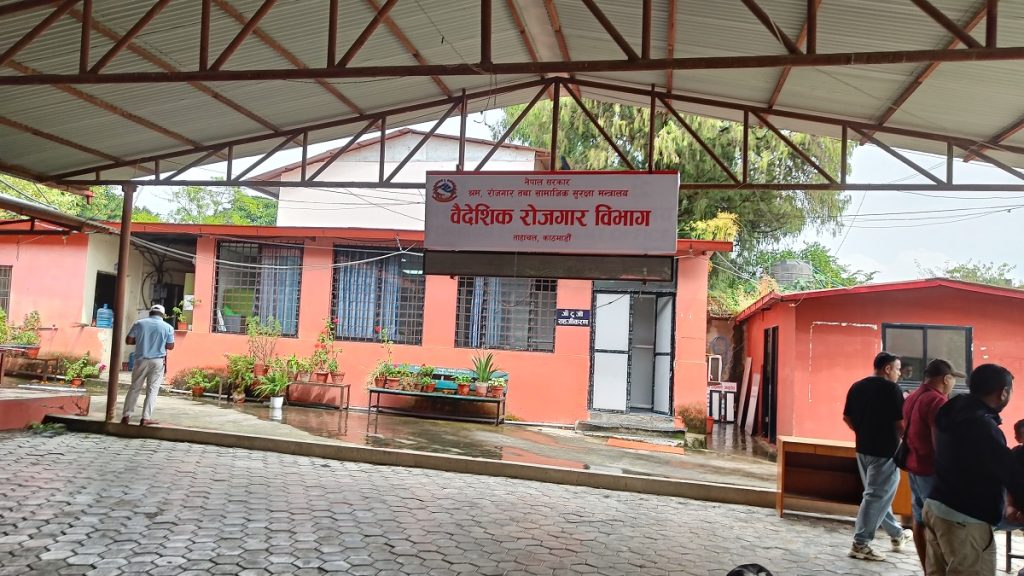
The government has repeatedly established special task forces and mechanisms to address fraud in foreign employment. While some have carried out initial work, many have eventually become inactive.
A previous government formed a special task force after the Gen Z movement to tackle fraud in foreign employment.
The task force, which included officials from the Department of Foreign Employment, the Office of the Attorney General and security agencies under the Home Ministry, was tasked with expediting fraud investigations and addressing problems in the sector.
Former labour minister Rajendra Singh Bhandari had established a mechanism of around 15 members through a secretary-level decision. However, the mechanism failed to continue its work effectively after the government changed.
Before that, the government had also formed various task forces, held secretary-level meetings across ministries and established other coordination mechanisms to curb human trafficking and illegal activities linked to foreign employment, particularly at the airport.
Labour migration expert Rameshwar Nepal says the continuity and effectiveness of such mechanisms have long been a concern.
Nepal says the state has already recognised foreign employment as a particularly sensitive area, establishing a dedicated law, regulatory body and judicial structure to address the sector’s problems. In his view, the government should focus on strengthening existing mechanisms rather than creating additional structures.
“This is a special and sensitive sector, particularly because it involves economically vulnerable citizens. That is why a separate law and judicial mechanism were established to ensure cases are resolved quickly,” he said. “What the government needs to do now is strengthen the existing system.”
He said if the Department of Foreign Employment is overwhelmed with investigations, the government should increase the number of investigators, provide them with necessary training and improve their investigative capacity.
He also stressed the need to close loopholes at various stages of the foreign employment process.
“If there are weaknesses in investigations, investigators need training. If there is a shortage of personnel, more should be recruited. The loopholes at every stage of the labour migration process need to be closed,” Nepal said.
He said the misuse of visit visas, airport collusion and human trafficking have been longstanding concerns, and addressing them requires improving the capacity and performance of the agencies responsible.
Coordination is necessary, but what is the task force’s legal authority?

The labour ministry says one of the main purposes of the task force is to improve coordination among agencies. Tackling fraud in foreign employment involves the Labour, Home and Foreign Affairs ministries, the Department of Immigration, Nepal Police and the Department of Foreign Employment.
However, coordination gaps have persisted. In some cases, decisions made by one ministry have been rejected by another, agencies have questioned each other’s decisions and disputes over jurisdiction have emerged.
Nepal acknowledges the need for a coordinating mechanism but says its legal authority and mandate must be clearly defined.
“Coordination is necessary, but it must also have a legal basis. Under which provision of which law is this mechanism being established? What authority does it have?” he asked.
He said the task force must have a clear legal basis to issue coordination directives to agencies or ensure they implement decisions. A mechanism established solely through an executive decision cannot exercise powers that have not been legally assigned to it.
“Government actions must be grounded in law. If a mechanism is established through an executive decision but is not given any authority, how effective can it really be?” he said.
Drawing on past experience, Nepal warned that the new task force could also become inactive over time.
He said the government can reform existing structures if it finds them ineffective, but establishing another task force without identifying why previous mechanisms failed will not solve the problem.
“An earlier system should not be discarded simply because it was established by a previous government. Instead, the government should examine why it did not work and strengthen it,” Nepal said. “Establishing a new task force is not necessarily wrong, but its responsibilities, authority and legal basis must be clear.”
A system stuck in complaint management rather than action
Complaints related to foreign employment fraud can be submitted through several channels. But establishing more complaint-handling mechanisms does not necessarily guarantee justice for victims.
The fact that more than 35,000 complaints remain under investigation at the department suggests that the problem lies not merely in collecting complaints but also in investigation, prosecution and the judicial process.
Those most affected by foreign employment fraud are often economically vulnerable people who borrow money to travel abroad for work. When they are cheated, the financial losses can also affect their families’ livelihoods.
Keeping victims waiting for justice for extended periods compounds the problem. The priority, therefore, should be to make existing legal and investigative mechanisms more effective and expedite the resolution of fraud cases.