My wife and I have lived in the United States for 20 years. While we often wish we could celebrate traditional festivals in Nepal with our parents and relatives, we have been fortunate to celebrate them with our vibrant Nepali community here. During our first five years, however, we were unable to participate much in community activities as we were constantly moving, navigating professional training and searching for stable jobs.
Since relocating to Wisconsin in 2012, our schedules have become more predictable, allowing us to actively engage in local Nepali community events. We are members of Milwaukee Nepali Pariwar (MNP), an umbrella organisation for Nepalis living in the greater Milwaukee area and beyond. Founded in 2012, the same year we moved from New York to Wisconsin, MNP is a volunteer-run, non-political and secular nonprofit organisation. We quickly fell in love with both the community and the organisation.
MNP’s primary mission is to bring members closer together, foster harmony and support one another. Over time, our collective ambitions have expanded to include helping communities in need, particularly in Nepal. Initially, our activities focused on celebrating major festivals such as Teej, Dashain, Tihar and the Nepali New Year. Gradually, the organisation became more involved in fundraising for causes such as disaster relief in Nepal and, most recently, teaching Nepali language, culture and arts to younger generations.
Beyond festival celebrations, MNP also hosts a hugely popular annual summer picnic. It provides an excellent opportunity to connect with others, make new friends, renew old acquaintances and showcase local talent through sports and entertainment, all while enjoying authentic Nepali food. More than 150 people attended our most recent picnic in 2026.
We also frequently collaborate with local organisations, including the Hindu Temple of Wisconsin (HTW), Peace 360, Gaura Samaj and Sewa Milwaukee. These organisations have been instrumental in strengthening our community’s presence in broader society, generously providing venues, co-organising cultural programmes and supporting our fundraising efforts.
Following the devastating 2015 earthquake in Nepal, our community rallied together to raise significant funds to support those affected back home. Similarly, following the devastating floods of August 2026, MNP launched another fundraising campaign, which quickly gained momentum thanks to the enthusiastic support of our members.
As Nepal continues to recover from this year’s unprecedented flooding and the immense suffering it caused, people back home are still trying to come to terms with the tragedy and rebuild their lives. Amid these difficult times, just as people in Nepal came together during the annual festival season, we too gathered here in the United States to celebrate our rich traditions.
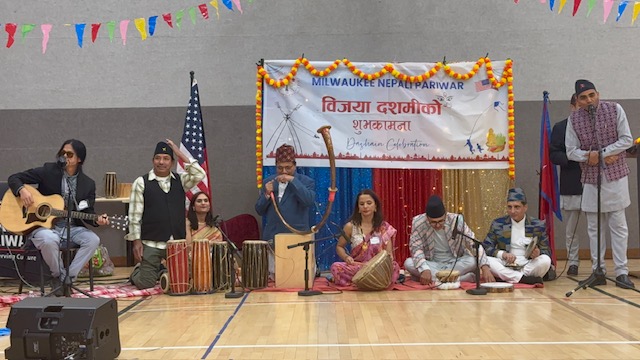
This year, we celebrated Dashain and Tihar a little differently. We welcomed well-wishers and friends from outside the Nepali community and invited representatives from our partner organisations. It was a wonderful opportunity to showcase some of our unique cultural traditions, including Panche Baja, as well as popular folk songs and dances such as Kaura and Sorathi. We borrowed the Panche Baja instruments from our sister organisation, Gaura Samaj. Several of our talented members quickly learned the basics and prepared to perform in front of an audience.
As preparations for the event took shape, we were delighted to see so many local performers eager to participate. As a volunteer-run organisation with limited financial resources, we cannot afford to hire professional sound engineers or entertainers. More importantly, promoting local talent and community participation is central to our mission. We also wanted to encourage the younger generation to take ownership of preserving our culture, so we encouraged every child to participate.
The programme was an incredible success, with the Panche Baja performance and accompanying songs becoming an instant hit. We hope to feature these instruments and beloved folk and ceremonial songs at future events and eventually introduce them to audiences beyond our community.
We were particularly encouraged by the number of young people, both in the audience and among the performers. Children from our Nepali language class delivered a moving rendition of the national anthems and beautifully recited peace mantras. We also honoured distinguished guests and community members for their outstanding contributions.
By the end of the evening, we felt as though we had brought Nepal a little closer to home. Though thousands of miles away, we felt deeply connected to our homeland and to one another. Sharing so much in common made our differences seem insignificant. The delicious food catered by a local Nepali restaurant made the evening even more enjoyable.
Some of us grew up celebrating these festivals in Nepal, while others were born or raised in the United States, learning about these traditions from their parents and grandparents. Many of our children are growing up balancing two wonderful worlds. They attend American schools, make friends from diverse backgrounds and pursue their dreams here, all while learning the language, stories, music and traditions of Nepal. It is inspiring to see their curiosity about their heritage and the pride they take in the multicultural roots that shape their families.
For those of us who came to America as adults, Nepal will always hold a special place in our hearts as the land of our childhood memories. For our children growing up here, Nepal represents a heritage to discover, embrace and carry forward in their own unique ways. And for all of us, America is where we build our lives, contribute to our communities, pursue our dreams and create new memories.
Some people occasionally ask me, “Is it necessary to celebrate all this when we are in America, thousands of miles away from Nepal? Does it compete with American values?” My answer is simple. It does not compete with American values. Rather, it complements them and helps build a vibrant, inclusive and tolerant community. Research has often highlighted the benefits of multiculturalism and multilingualism in fostering inclusive and resilient societies. Indeed, diversity is one of the defining features of America, a country where people from around the world have come to make their home.
As the saying goes, “Once a Nepali, always a Nepali.” Though life may take us far from our homeland, relatives and parents, we are never truly detached from our roots. We continue to share a love for our culture, traditions, language and arts, as well as one another’s joys and sorrows and the ongoing challenges facing Nepal.
National boundaries may separate us geographically, but they cannot define or divide our shared humanity. Wherever we live or work, we will always cherish and promote the rich Nepali heritage we grew up with. It remains an important part of who we are, no matter where life takes us.
It has been an absolute pleasure to be part of this wonderful community. I sincerely hope that Nepalis living in the greater Milwaukee area and beyond will join us and make this organisation their home, a place where we can uphold our shared values, fulfil our collective purpose and find deeper meaning in being Nepali.