
Kathmandu, November 23
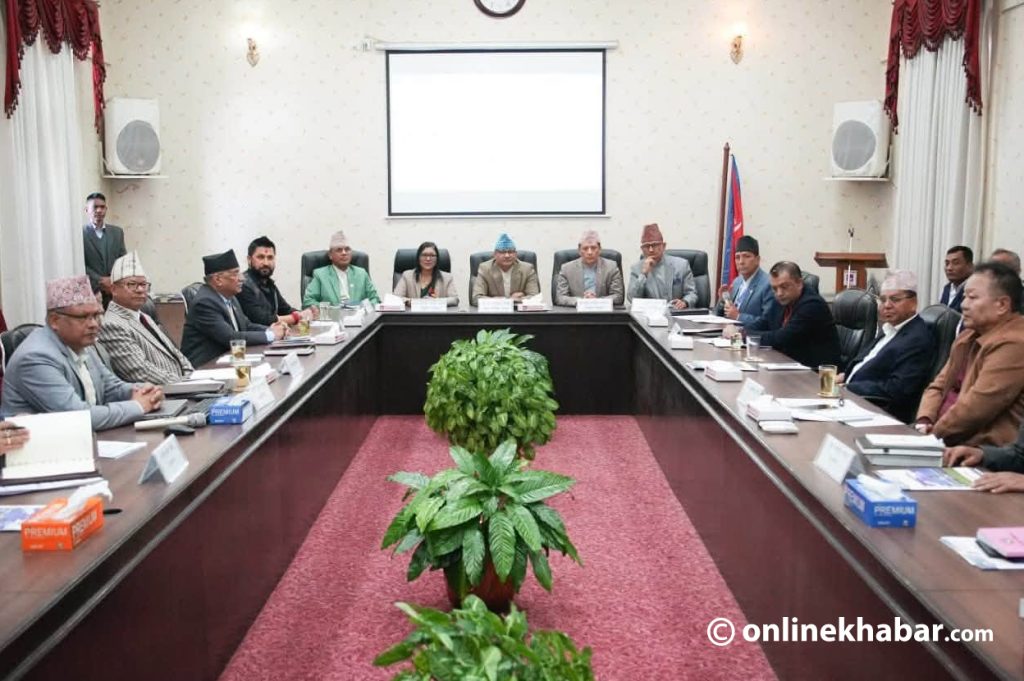
The ruling Rastriya Swatantra Party (RSP) is in favour of holding local and provincial elections simultaneously, while the two opposition leftist parties, the CPN-UML and the Nepali Communist Party (NCP), insist that the elections should be held separately in accordance with constitutional provisions. The main opposition Nepali Congress, however, appears to be closer to the RSP’s position.
The Rastriya Prajatantra Party (RPP) has also backed the ruling party’s position, while the Shram Sanskriti Party is yet to reach a conclusion on the matter.
The terms of office of local representatives are set to expire in May 2027, while provincial assembly members’ terms will end in November 2027. Under the Local Level Election Act 2017, local elections must be held two months before the terms of local representatives expire.
Under the legal provision, local elections should be held by March 2027. If local and provincial elections are to be held simultaneously, local elections would have to take place by March 14, 2027. The terms of representatives at the two levels are set to expire at least six months apart.
Political parties have presented differing arguments over whether the two elections should be held together or separately.
The ruling side argues that simultaneous elections would reduce electoral expenditure and minimise disruptions to government operations caused by repeated election cycles. In 2027, elections for the local and provincial levels, as well as the National Assembly, president and vice-president, will have to be held.
RSP spokesperson Jagadish Kharel argues that holding the elections separately would keep the government occupied with electoral processes throughout the year.
“If local elections are held in March, provincial elections in November, National Assembly elections around January, followed by elections for the president and vice-president, our attention would be consumed by elections throughout the year,” Kharel says.
The ruling side has also assessed the impact of repeated elections on government development expenditure. It argues that the election code of conduct often restricts government decisions and activities, making simultaneous elections preferable.
The election code of conduct is generally enforced around 45 days before voting. If elections are held separately, the federal government could face restrictions on decision-making for around three months, with two separate 45-day periods.
“Once the election period begins, major expenditures cannot be made. Budget allocation also faces several constraints. If elections are held in November, we cannot make decisions from October onwards,” Kharel says. “We are already struggling to spend on development. If elections continue throughout the year, how are we supposed to carry out development expenditure? There is an option of holding elections simultaneously without undermining the spirit of the Constitution, provided a national consensus is reached.”
The ruling side also believes simultaneous elections would significantly reduce costs. Local elections held on May 13, 2022, cost more than Rs 11 billion, while the parliamentary and provincial elections held later that year together cost more than Rs 16 billion. The government argues that holding local and provincial elections together would reduce expenditure.
The NCP, however, does not agree with the argument that electoral costs justify holding elections contrary to constitutional provisions.
NCP leader Prakash Jwala says elections must be held separately if a provincial assembly is dissolved before completing its term.
“If a provincial government cannot complete its five-year term and goes into an early election, that election would have to be held separately for that province. The House of Representatives was dissolved midway, which is why we have this situation now. If a provincial assembly is dissolved for any reason, its election would have to be held separately,” Jwala says.
There are also legal complications in holding the two elections simultaneously. The government has yet to initiate dialogue with opposition parties to address them.
Nepali Congress president Gagan Thapa says the government must first clarify its position on holding local and provincial elections together.
“The government must first say whether it is considering this option. Then there can be discussions among the parties, within the parties themselves and between political parties,” Thapa says.
Thapa also argues that elections held at different times affect the functioning of all levels of government, with the election code of conduct particularly affecting the federal government.
“Once elections are announced, the code of conduct binds all three levels of government. It affects the federal government the most,” he says.
Thapa said the government bears the primary responsibility for initiating dialogue with other parties to address constitutional and legal hurdles if the elections are to be held simultaneously.
The UML, another opposition party, remains firm that the elections should be held separately in accordance with constitutional provisions. UML vice-chair Guru Baral says there is no provision to postpone local elections or advance provincial elections to align the two.
“Each election should be held separately when its respective term expires,” Baral told Onlinekhabar. “This is not something that can be done simultaneously simply through national consensus or constitutional amendment.”
The NCP shares the UML’s position. NCP leader Jwala says elections should be held separately after representatives at both levels complete their respective five-year terms.
He warns that holding elections outside the constitutional and legal framework could create complications that may jeopardise the electoral process.
“Local elections should be held in April and provincial assembly elections in November. The Constitution and the law do not allow shortening the provincial assembly’s term or extending the local representatives’ term,” Jwala told Onlinekhabar.
The RPP, another party represented in the House of Representatives, favours holding local and provincial elections together. RPP parliamentary party leader Gyanendra Shahi argues that holding elections twice would increase unnecessary expenditure.
“Holding elections twice increases unnecessary costs. The state cannot afford such expenditure,” Shahi told Onlinekhabar. “If there are legal complications, a government with a two-thirds majority could resolve the difficulties through an ordinance.”
The Shram Sanskriti Party has yet to decide whether the elections should be held together or separately. The party’s general secretary, Aaren Rai, said it would formulate its position after discussions within the party and with other political parties.