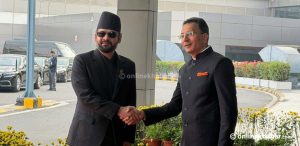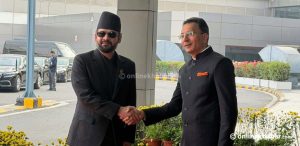

Kathmandu, November 22
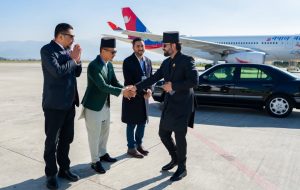
As Prime Minister Balendra Shah prepares for his visit to India, a question had been circulating among senior officials at Nepal’s Foreign Ministry — how would he raise the border dispute in New Delhi, and how would he approach his Indian counterpart, Narendra Modi?
There were two reasons the issue had drawn attention within the ministry.
The first was Shah’s remarks on the border dispute in Parliament on May 31.
“I may say something that sounds surprising. I came to know after becoming prime minister that India has encroached on Nepal’s land in many places, but Nepal has also encroached on India’s land in many places. We intend to study what they have encroached upon and what we have encroached upon, and resolve the issue together as friends,” Shah had said.
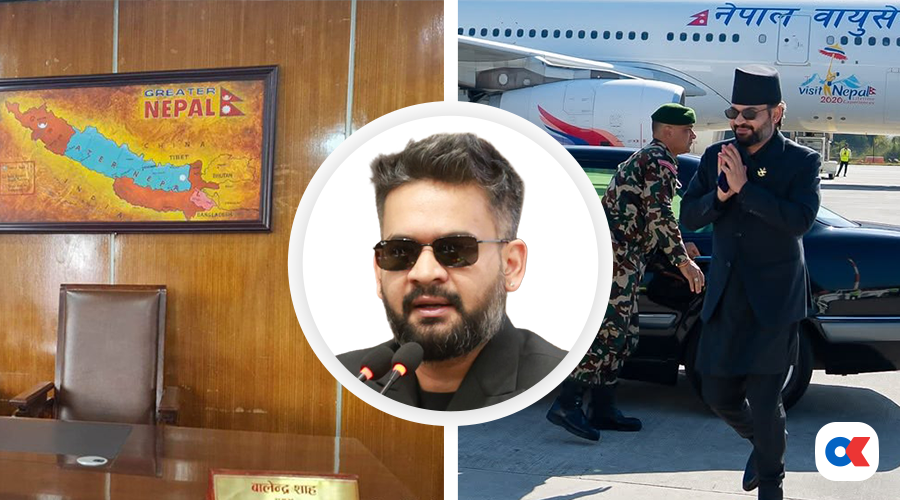
The second was Shah’s decision to display a map of Greater Nepal in his office when he was Kathmandu mayor. He had put up the map after India installed a mural depicting ‘Akhand Bharat’ in its new Parliament building, which included territories claimed by Nepal.
However, on Sunday morning, the day Shah departed for India, foreign ministry officials were not merely surprised but also taken aback. The border dispute was nowhere mentioned in the agenda for the visit.
This means Shah is not expected to raise the border dispute during his India visit.
A senior official at the Foreign Ministry said the border issue had been discussed from the outset of preparations for the visit. However, despite preparations for the visit having progressed and other issues largely settled, the border dispute was suddenly left out.
“At first, even whether the visit would take place was uncertain. And even after it was confirmed, no one expected it to be this short,” the official said. “Since preparations began, the border issue had received the most attention. It is not that the groundwork was not done. But today, we suddenly could not find the issue included anywhere.”
A senior source at the Prime Minister’s Office also confirmed that the border dispute was not on the agenda for Shah’s India visit. According to the source, Shah had explicitly instructed officials not to include contentious issues in the agenda.
“We had discussions on the border dispute as part of the bilateral talks. But when raising the border issue threatened to jeopardise the entire visit, the prime minister had it removed from the agenda,” the source told Onlinekhabar. “There are many issues to discuss in terms of dialogue and cooperation, so the border dispute was not prioritised for now.”
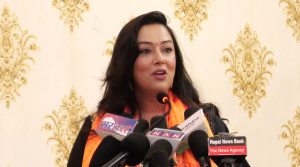
The Rastriya Swatantra Party (RSP), in its election manifesto for the House of Representatives election held on March 5, had pledged to pursue diplomatic efforts to resolve border disputes based on facts and evidence rather than emotions.
Former Nepali ambassador to India Nilambar Acharya, however, believes the border dispute should be raised even if it is not formally included in the agenda. He says neither country can afford to leave the issue unaddressed.
“This is an issue that continues to bother both countries. Even if a solution cannot be reached immediately, the door to dialogue should be opened,” Acharya said. “Keeping this issue suppressed serves no one. I believe it will be discussed.”
Diplomatic affairs expert Mohan Krishna Shrestha also believes the border dispute should not have been left off the agenda for the prime minister’s India visit. He argues that since it remains a contentious issue for both countries, meaningful discussions are long overdue.
“The issue should have been included in the agenda for its resolution. Both countries need to prioritise it,” he said. “If they do not even discuss it, how can a solution be reached?”