Kathmandu, November 20
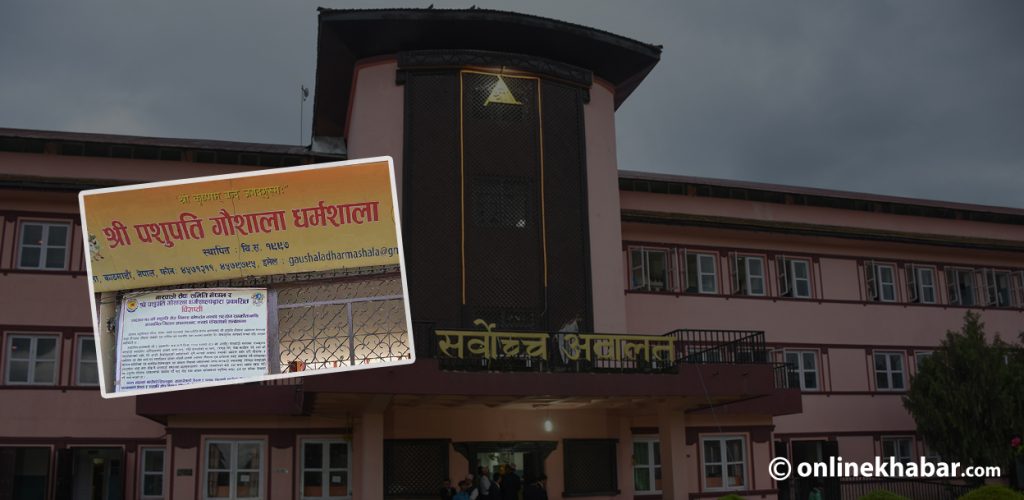
The Supreme Court has upheld lower court rulings recognising the Pashupati Area Development Trust (PADT) as the sole owner of the Gaushala Dharamshala in Kathmandu, bringing an end to the Marwari Sewa Samiti’s long-running claim over the property.
A bench of Justices Tek Prasad Dhungana and Shanti Singh Thapa dismissed the Samiti’s petition seeking a review of the earlier verdicts, ruling that there were no grounds to reopen the case.
The decision means the rulings of the Kathmandu District Court and the Patan High Court, which found that the Samiti had no tenancy rights over the land, can now be implemented.
The Kathmandu District Court had previously ruled that the Marwari Sewa Samiti had no legal claim to the property owned by the PADT. The Patan High Court upheld that decision, finding that no tenant rights had been established over the land and that the Samiti could not claim indefinite use of the property.
Both courts also questioned the use of land originally provided for religious purposes for commercial activities. They observed that the Samiti had generated income from structures built on the premises without adequately sharing the financial benefits with the PADT. The courts said the Trust could also seek compensation if it had been deprived of income from the property.
The Supreme Court dismissed the Samiti’s petition to overturn the lower court decisions, finding no reason to review the case.
The order, issued on September 13, 2083, makes the earlier rulings final and clears the way for their implementation.
An institution established to protect bulls
The dispute over the Gaushala Dharamshala dates back decades.
Traditionally, young calves raised on their mothers’ milk were brought to Pashupati and dedicated as bulls. As calves deprived of milk began dying, an order was issued in 1999 BS to grow grass to feed and protect bulls dedicated to the Pashupatinath Temple.
Under the arrangement, Ram Kumar Agrawal, a member of the Marwari community, received a plot of land. A Gaushala Dharamshala was subsequently established under his leadership, where cattle were kept and cared for.
For years, the Marwari community and the Marwari Sewa Samiti operated the facility and used the land without a formal agreement.
Questions were eventually raised over the use of Pashupati’s land without clear contractual arrangements. On May 9, 2003, an agreement was signed between the Amal Kot Kachahari, which operates under the PADT, and the Marwari Sewa Samiti.
The agreement stated that the land would not become anyone’s private property. It also prohibited the sale of meat and alcohol in structures built on the premises and stipulated that ownership of those structures would pass to the PADT if the agreement ended. The Samiti was also required to protect bulls dedicated in the name of Pashupati.
Under the agreement, the Samiti paid the Trust an annual rent of just Rs 51,000. However, it used buildings on the premises for commercial purposes and generated income from them. It also constructed additional structures over time.
Amid growing questions about the arrangement, the PADT’s governing council decided to review the agreement on August 17, 2023. The Trust cancelled the existing agreement and asked the Samiti to come forward within 15 days to sign a new agreement under what it described as fair and reasonable conditions.
The Samiti then approached the Kathmandu District Court.
Marwari Sewa Samiti’s two claims
The Samiti made two main claims before the court.
First, it argued that since the agreement did not specify an expiry date, it was entitled to continue using the land indefinitely.
Second, it claimed tenant rights over the land registered in the name of the Amal Kot Kachahari. The Samiti argued that it had been issued a tenancy registration certificate on April 25, 1989, and was therefore entitled to rights as a tenant.
The Kathmandu District Court rejected the claims, saying the Samiti had failed to produce sufficient evidence to establish its tenancy rights. The mere mention of ‘Pashupati Gaushala Dharamshala’ in the tenant column of a land record was not enough to establish such rights, it ruled.
The district court issued its verdict on October 16, 2024. The Patan High Court upheld it on May 21, 2026.
In its full-text verdict, the High Court noted that although the name ‘Pashupati Gaushala Dharamshala’ appeared in the tenant column of the documents, no registered institution by that name existed. It therefore found the claim of tenancy rights unsubstantiated.
The courts also referred to an earlier Supreme Court ruling. On July 11, 2011, the Supreme Court had held that the Marwari Sewa Samiti was not a tenant of the land. The High Court said the Samiti had effectively accepted the Amal Kot Kachahari’s full ownership of the property.
The district court also questioned whether Mahabir Prasad Agrawal, who filed the case as the Samiti’s general secretary, had the legal authority to do so, noting that the institution under whose name the claim was filed was not registered.
Courts question commercial use of religious property
Both the district and high courts highlighted the public importance of protecting land and structures within the Pashupati area, which is part of a UNESCO World Heritage Site.
They said officials responsible for managing and preserving property in such an important location must act transparently and remain fully accountable.
The courts also questioned the annual rent of Rs 51,000, particularly as buildings on the premises had been rented out but the PADT had no clear information about the income generated.
The full-text verdict stated that there was no clear evidence that the property had been used exclusively for non-profit public services or religious purposes.
The courts also raised concerns about additional structures built without obtaining the required building permits.
The Supreme Court’s full-text verdict further noted that a 30-bed dialysis facility, reportedly built at a cost of Rs 120 million, was operating on the premises. It viewed this as a breach of the contractual conditions agreed with the PADT.
The court said that if the Samiti had used the Dharamshala’s property for financial gain without paying the Trust its rightful share, the PADT could seek compensation through legal proceedings.
The district court had earlier upheld the PADT’s decision to cancel the agreement in August 2023, ruling that the Samiti had failed to comply with the contractual conditions and that the Trust was entitled to terminate the arrangement.
It had concluded that the Samiti’s demand to overturn the PADT’s decision could not be upheld.