

Kathmandu, November 5
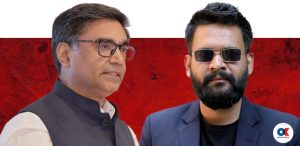
Two contradictory statements by government spokesperson Sasmit Pokhrel and Rastriya Swatantra Party (RSP) spokesperson Jagadish Kharel offer a glimpse into how little coordination may have gone into the government’s decision to replace Nepal Police chief Dan Bahadur Karki with Manoj Kumar KC.
Speaking after Wednesday’s Cabinet meeting, Education Minister and government spokesperson Pokhrel claimed that Karki had been removed and KC appointed on the instructions of the government’s own party, the RSP.
Before Pokhrel’s statement had even disappeared from online news headlines, RSP spokesperson Kharel disputed it, saying the party had issued no such instruction.
The conflicting accounts from two leaders of the same party point to a lack of consultation and coordination over a decision concerning one of the state’s most sensitive institutions — the police, which is entrusted with enforcing the law.
Although Karki and KC are the visible figures in the latest dispute, the power struggle within the ruling establishment runs much deeper. The consequences are being felt by Nepal Police, an institution whose functioning is particularly sensitive to political interference. Similar disorder has also been seen in appointments involving the judiciary, universities, ambassadors and other public offices.
According to sources close to Prime Minister Balendra Shah, a series of actions are expected within the police before Shah’s planned visit to New Delhi, following KC’s appointment. Some of those who could come under scrutiny may include figures at the highest levels of the RSP itself.
This report examines the turmoil within Nepal Police and the political forces behind it. Tracing the roots of the current crisis takes us back three decades, revealing how a pattern of political interference has survived changes in governments and political leadership. Rather than disappearing, the practice has taken new forms.
Karki removed, KC appointed

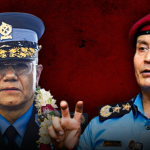
At an emergency Cabinet meeting on Wednesday, the government removed IGP Dan Bahadur Karki and appointed Additional Inspector General (AIG) Manoj Kumar KC as the new police chief.
The Cabinet decision stated that the post of Prime Minister’s Special Security Adviser, at the rank of IGP, would be created at the Office of the Prime Minister and Council of Ministers to provide the prime minister with security-related advice and recommendations and strengthen the country’s law and order situation under the prevailing circumstances.
Under the decision, Karki was assigned to the newly created position. However, the government has not provided a clear explanation of his responsibilities. Whatever justification has been offered, the move appears to have been designed to make way for KC as IGP.
KC received his insignia and assumed office on Wednesday. The decision to remove Karki, who still had 17 months remaining in his tenure, came as a surprise to many.
The government has yet to provide a convincing explanation for why Karki was removed and KC appointed.
Pokhrel, the government spokesperson, said the decision was prompted by changing circumstances and a need to address sensitive issues.
“The circumstances have changed. The party had instructed the government that something needed to be done on sensitive matters. His responsibilities have been changed. But advising the prime minister is also a sensitive responsibility,” Pokhrel said.
Although the government has insisted that Karki was not punished, security experts view the removal of an IGP from his post and his reassignment elsewhere as a significant disciplinary action.
Inam Sapkota, who has been accused of acting as a middleman by cultivating access to judges and the courts, is currently in police custody. The background and credibility of statements attributed to him, in which he reportedly named people close to the government, IGP Karki, opposition leader Gagan Thapa and several judges, are now under investigation.
As the matter remains under investigation, it is not yet possible to establish whether Karki was involved. The government’s decision to remove him has come amid these unresolved allegations and controversies.
Audio and video recordings expose police divisions

Recent developments suggest that serious internal tensions have been building within the police organisation, with officers apparently attempting to undermine one another.
A telephone conversation between AIG Dr Manoj Kumar KC, now the IGP, and a man identified as Nirajan Bhandari was made public. The 1-minute-and-56-second recording was released on Monday by the Nepal Lead YouTube channel.
In the audio, the speakers appear to discuss alleged links between middleman Inam Sapkota and senior police officials, including the IGP and AIG Rajan Adhikari. They also refer to a possible resignation by the IGP. When Bhandari raises the issue of resignation, KC, who was then an AIG, can be heard responding, “Oh, yes.”
Soon after the recording emerged, a short video purportedly showing Bhandari meeting IGP Dan Bahadur Karki was also made public. The video was released by the online outlet Diyo Post.
The footage, reportedly recorded at a hotel in Kathmandu, appears to show Karki and Bhandari standing and talking. However, the content of their conversation has not been disclosed.
Neither Karki nor KC has publicly commented on the audio or video. They have not denied that the conversation in the recording is theirs, nor have they disputed the identities of the people shown in the video or described the footage as fabricated.
The two incidents have brought the conflict between Karki and KC into public view. The dispute is no longer a matter of concern only to security observers; the public has also become increasingly aware of the infighting within the police.
But while Karki and KC are at the centre of the visible dispute, the internal conflict within the RSP is believed to be much deeper.
Prime Minister Shah and RSP chair Rabi Lamichhane are understood to have differing interests, a divide that Home Minister Sudan Gurung may not have fully anticipated. Some remarks reportedly made by Lamichhane about the prime minister have also drawn Shah’s attention.
People close to the prime minister have told Onlinekhabar that the Prime Minister’s team has little regard for Lamichhane. They say the team is aware of Lamichhane’s remark that he could remove the “black glasses” with a snap of his fingers, and that a recording of the statement has been preserved.
Some members of Shah’s team have also openly suggested in conversations with their associates that alleged misconduct by Lamichhane could soon be exposed.
According to sources close to the prime minister, several actions are expected before Shah’s visit to New Delhi, following KC’s appointment. Some senior RSP figures could also become targets.
Former IGP Sarbendra Khanal warns that such public displays of internal conflict can damage the police organisation.
“Not everyone will have a good relationship with everyone else. One person may dislike another’s character, and someone else may have a different opinion. That is a separate matter. But as an organisation, everyone must stand together,” Khanal said. “Such incidents affect the morale of the entire organisation.”
Security observers believe the release of the audio and video recordings could be an attempt by the individuals involved to discredit one another. However, some security officials say it would be difficult to conclude that the recordings and other developments originated solely within the police.
“This is not all happening within the police. If the government cannot or will not reprimand Karki and KC and ask them why this is happening, then it cannot be said that these things are being driven only from within the police,” said former Nepal Police DIG Hemant Malla Thakuri.
The government’s decision to remove one IGP and appoint another, he said, also indicates that the controversy was not merely an internal police matter.
A six-hour meeting failed to contain the dispute

The public release of the audio and video recordings is only one part of the crisis.
On October 29, a meeting of the Police Coordination Committee (PCC) was held at Police Headquarters. Normally, the IGP chairs such meetings with DIGs and AIGs serving in the Kathmandu Valley.
On this occasion, however, DIGs from all seven provinces were also instructed to attend.
Karki, who had taken an aggressive position during a virtual meeting the previous day, directed the provincial DIGs to be present. A participant told Onlinekhabar that the nearly six-hour meeting also saw sharp exchanges between Karki and KC.
Without naming anyone, Karki reportedly criticised certain individuals for frequently visiting the ministry and working against the head of the organisation. He warned them against such conduct. KC challenged his remarks.
Karki emphasised that police officers needed to stand together because the organisation was under attack. KC, however, argued that allegations against individuals should be addressed by those individuals and should not be linked to the entire organisation.
“We have also been written about in the media. We are dealing with these issues ourselves. Allegations against individuals cannot be linked to the organisation,” KC reportedly said.
Karki’s decision to call provincial DIGs to the PCC meeting was seen as an attempt to secure collective support, much as senior police officials had rallied together during the controversy involving RSP lawmaker Khagendra Sunar.
Sunar had accused the police of corruption in the procurement of election police uniforms and demanded that the IGP be dismissed and investigated. Following his remarks, AIGs and other senior police officials had jointly met the Speaker of the House of Representatives to register their concerns.
As reports emerged that relations between the government and IGP Karki had deteriorated and that the government was preparing to remove him, Karki appeared to expect similar solidarity from the police leadership.
“One would have expected the DIGs to send a message that the internal dispute between the IGP and AIG should be resolved through dialogue, but that the organisation itself should not be discredited in this way. But the meeting did not turn out like that,” a senior police official told Onlinekhabar.
Former DIG Malla believes Karki’s attempt to bring senior officers together through the PCC meeting was understandable.
“It is normal for an IGP to call a PCC meeting and try to keep everyone within his grip. This has happened before as well,” he said.
But the meeting did not lead to a collective approach to the prime minister or home minister, nor did it stop the infighting. Instead, the divisions became more visible, culminating in the removal of Karki and the appointment of a new IGP.
Government’s role in the media house incident

As former DIG Malla suggests, there is little basis for assuming that all the developments are being driven from within the police alone.
Last Friday, police entered a media house and detained journalists. The Prime Minister’s Secretariat subsequently issued a statement saying it had not been informed about the incident.
Deepa Dahal, press adviser to Prime Minister Shah, said that after the prime minister learned of the incident, he directed the police to release the journalists.
Home Minister Sudan Gurung has remained silent on the matter. The developments appear to have gone beyond his understanding and control, making it difficult for him to assess the situation effectively.
However, a statement issued by Nepal Police spokesperson and DIG Abinarayan Kafle contradicted the Prime Minister’s Secretariat’s account.
“Acting on the concern expressed by the Prime Minister’s Office, the Cyber Bureau of Nepal Police called some journalists to its office with the proper intention of obtaining general information about the truth, factual basis and legal grounds of the publicity surrounding the matter. This was part of the police’s official duties,” Kafle said.
On Monday, some journalists had sought clarification from Police Headquarters about the detentions. The response from the police suggested that they had acted under pressure from the Prime Minister’s Office.
But a former IGP said that pressure from the government did not mean police officers had to follow unlawful orders.
“We faced even greater pressure during our time. But this is not how such matters should be handled,” the former IGP said.
While the police statement linked the questioning of journalists to concerns raised by the Prime Minister’s Office, government spokesperson and Education Minister Sasmita Pokhrel dismissed the matter as an internal police issue.
Former DIG Malla says these developments indicate that the police are facing more than an internal leadership dispute.
A familiar battle over the IGP’s post
The current controversy has echoes of a dispute from 2016, when the appointment of Nepal Police chief became a battle between Nawaraj Silwal and Jay Bahadur Chand.
At the time, police officers were accused of pursuing journalists they believed were working against them. The rivalry over who would become IGP brought the organisation into disrepute.
While Silwal and Chand were locked in a dispute, a third candidate, Prakash Aryal, eventually became IGP.
The government initially appointed Chand, prompting Silwal to move the Supreme Court. The court issued an interim order in his favour and later directed the government to appoint the IGP on the basis of performance evaluation scores. Aryal was subsequently appointed.
Silwal, who had been ranked first, faced allegations of manipulating performance evaluation records after discrepancies were found in the scores. The court also called for an investigation into the suspected forgery. Silwal later resigned from the post of DIG.
The tendency of senior officers to undermine one another when competing for the top police post, or to resign when passed over, has surfaced repeatedly.
When the government appointed Dhiraj Pratap Singh as IGP despite Biswaraj Pokharel being senior by around 18 months, Pokharel resigned. He is now an RSP lawmaker.
Ramesh Kharel also resigned after Sarbendra Khanal was appointed IGP. Even after Khanal took charge, his relationship with another AIG, Pushkar Karki, remained strained. The police organisation became divided into factions, with officers being identified as either belonging to Pushkar Karki’s camp or the IGP’s camp.
However, the conflict had not previously escalated to the point where audio and video recordings of one another were made public.
The current situation threatens not only the unity of the police but also the morale of its personnel. It could also affect crime investigation and prevention.
Former DIG Malla believes the government itself appears to be contributing to the turmoil.
“Accusations and counter-accusations between individuals have already become public. Even as details of investigations are being leaked, the government has said nothing. The sensitivity of investigations has been compromised. There is now a greater risk that investigations may not succeed in the future. Looking at these developments, it seems that there are efforts from all sides to weaken the police. At a time like this, the government should be providing institutional support to the police. Instead, it is watching the spectacle while playing games over the removal of the IGP,” Malla told Onlinekhabar.
Former DIG Hemant Malla Thakuri also believes that other state institutions face similar risks.
“It is not just the police. The situation in the judiciary is equally exposed. The prime minister appears to be disregarding the legislature, while the executive’s approach seems to involve bringing civil servants in, detaining and threatening them,” an official said.
Former senior police administrator Rabindra Nath Regmi argues that the police have long been caught in the middle of political disputes.
“Police officers are always made servants of political events. Politicians keep sending the message that if you do not show obedience, you will face consequences. The current incident is the latest example of that. The government itself appears to be actively interfering in the police,” Regmi said.
The 30-year-old playbook returns
The decision to remove Karki and appoint KC has also revived memories of a political manoeuvre from three decades ago.
Until 1992, Nepal Police had no 30-year service limit. The Police Regulations of 1958, 1976 and 1992 did not provide for such a limit. Retirement was determined only by age and the duration of service in a particular post.
The government led by then Prime Minister Girija Prasad Koirala had a strained relationship with IGP Ratna Shumsher. Sher Bahadur Deuba was home minister at the time. The government wanted to send Ratna Shumsher as an ambassador and appoint Motilal Bohara as IGP.
“King Birendra raised his finger and warned that seniority carried great importance in the force and that the government should think carefully. Girija then stopped,” Bohara, a former IGP, recalled. “Later, I was appointed IGP without even being informed.”
After its initial attempt failed, the government introduced a service limit that had not previously existed in the police force. The 30-year service rule was introduced through an amendment to the Police Regulations of 1992, paving the way for Ratna Shumsher’s removal.
The regulations were amended, and Ratna Shumsher and 48 other officers were sent home. The government then announced that Bohara had become the new IGP.
The 30-year service limit was not the only provision introduced to facilitate Bohara’s appointment. The amendment also allowed the service limit to be extended by two years. Under this arrangement, Bohara served as IGP from 1992 to 1996.
Bohara was succeeded by Achyut Krishna Kharel. But just 36 days after Kharel became IGP, on April 5, 1997, he was transferred to head the National Investigation Department. Dhruva Bahadur Pradhan was appointed in his place.
At the time, Lokendra Bahadur Chand of the Rastriya Prajatantra Party was prime minister and Bamdev Gautam was home minister. On the 24th day after taking office as home minister, Gautam transferred the serving IGP to head the intelligence agency — a move unprecedented in the history of Nepal Police and not recognised by law.
After the decision to replace Kharel with Pradhan, the latter went to Kharel to receive the IGP insignia. But Kharel refused to confer it, arguing that the government’s decision was unlawful. He challenged the transfer in the Supreme Court and did not report to the National Investigation Department.
The cases involving Bohara and Pradhan are often interpreted as attempts to weaken the police by injecting political interests into the organisation. Regmi, who spent much of his career in police administration, says the current developments resemble those earlier efforts to manipulate the force for political purposes.
Eight months after his removal, Kharel won his case in the Supreme Court and returned as IGP. He served a second term from November 1997 to October 2000.
After Kharel’s reinstatement, the government transferred Pradhan to the position of the prime minister’s special security adviser. Pradhan did not resign or challenge the transfer in court. Instead, he continued working in the new position.
Before his retirement, Kharel had gone on leave after handing over acting responsibility to AIG Pradeep Shumsher Rana. He was later pressured to resign and left the force before reaching retirement age.
A similar incident took place during the tenure of Ramesh Chand Thakuri, who served as IGP from December 2008 to June 2011.
After Thakuri was implicated in the Sudan Darfur scandal involving alleged irregularities in the procurement of armoured personnel carriers for Nepal Police personnel deployed on a United Nations mission, the government transferred him to the position of the prime minister’s security adviser and appointed Rabindra Pratap Shah as IGP. Thakuri was later suspended after a corruption case was filed against him and was subsequently convicted.
The police as the face of government
Given its role, its direct engagement with citizens and its responsibility for maintaining law and order, the police are often described as the visible face of the government.
The way the police operate is closely linked to how the government functions and the state of governance. Whether the government is acting lawfully, whether it is committed to good governance, whether it is free of controversy or surrounded by scandals, and whether state institutions are following the law or simply carrying out orders — these are questions that the police’s conduct often brings into focus.
In security circles, the phrase “the face of the government” is frequently used to describe the police and the responsibilities they carry.
The government has yet to provide convincing answers to the questions raised by the latest developments. Wednesday’s decision appears to be another continuation of a long-standing pattern of political interference, the consequences of which Nepal Police will once again have to bear.