
Kathmandu, November 4
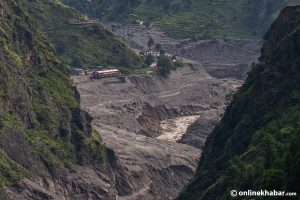
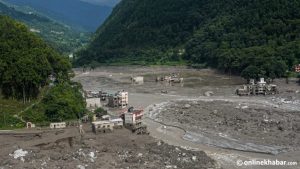
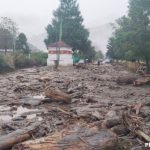
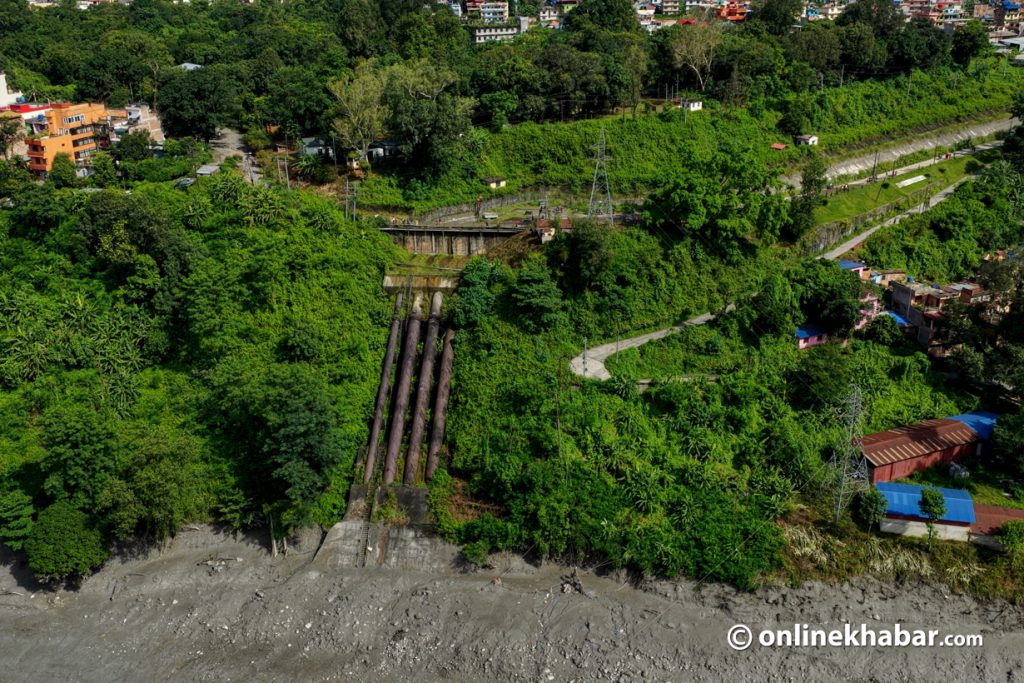
The devastating floods in the Bhotekoshi River on August 26 damaged 14 hydropower projects in Rasuwa and Nuwakot, causing preliminary estimated losses of more than Rs 12.46 billion.
Seven projects owned by the Nepal Electricity Authority and its subsidiaries, and seven operated by private companies, were affected. More than two months after the disaster, however, there is still no clear plan for rebuilding the damaged projects.
Project structures, access roads and bridges have been damaged, and some sites remain difficult to reach. Private developers are also waiting for decisions on reconstruction costs, insurance payouts, government assistance and revised project designs.
The Chilime Hydropower Project, owned by the Nepal Electricity Authority, has invited bids to remove debris and sediment accumulated inside its underground powerhouse. However, reconstruction work at the other affected projects has yet to move forward.
The Ministry of Energy, Water Resources and Irrigation says discussions are under way on reconstruction and possible redesigns. Ministry spokesperson Mohan Kumar Shakya said details of the damage had been submitted to the National Planning Commission for a Post-Disaster Needs Assessment (PDNA).
“The report is yet to be finalised. We have tentative data, but we cannot provide a final assessment of the damage until the PDNA report is received,” Shakya said. “Discussions are under way on how reconstruction should proceed, but no specific approach has been finalised.”
The government plans to determine the reconstruction model only after a detailed damage assessment and technical report. In the meantime, private project operators remain uncertain about when they can resume work.
Project viability must be assessed before reconstruction

The Rasuwagadhi Hydropower Project, one of the projects affected by the floods, is also awaiting a reconstruction plan. Its operating company is collecting damage details, preparing insurance claims and assessing the project’s financial viability. It says work cannot proceed until the government completes its technical assessment and decides on a reconstruction model.
Narnath Neupane, secretary of Rasuwagadhi Hydropower Company, said the company was compiling details of damage to its property, buildings, vehicles and structures under construction. It is also coordinating with insurance company surveyors to prepare its claims.
“We are currently collecting details of the damage, following up with the insurance company and discussing the claims with its surveyors,” Neupane said.
The company is also assessing whether rebuilding the project would be financially viable. It is examining what kind of government support might be available, whether reconstruction is feasible under the circumstances and whether the project could generate sufficient returns for shareholders.
Neupane said the government first needed to complete its technical assessment and decide on the reconstruction model. It is not yet clear whether the project can be rebuilt according to its original design.
“First, we need the government’s report and technical assessment. If the project can be restored at the same location under a revised design and cost estimate, we can proceed with that,” he said. “If the design has to be changed, the cost will also vary accordingly.”
He said the government would need to provide grants or concessional loans to make reconstruction possible. Securing additional loans from the market would be difficult under the current circumstances, he added.
Although the project is no longer generating revenue, it must continue to meet its interest obligations to banks and financial institutions. The company said it had paid bank interest up to the end of the last fiscal year but was unlikely to be able to repay the principal. Neupane also said it had been unable to pay its instalment to the Employees Provident Fund in Ashoj.
The delay in reconstruction therefore threatens not only to increase project costs but also to add to the companies’ debt burden.
‘Projects cannot be rebuilt without a government support package’
Private-sector energy developers say government assistance is essential to rebuilding the hydropower projects damaged by the floods.
Bijay Mohan Bhattarai, manager of the Langtang Khola Hydropower Project and secretary of the Independent Power Producers’ Association, Nepal (IPPAN), said the affected projects could not simply be restored to their previous condition.
Considering the loans taken to build the projects, potential insurance payouts, reconstruction costs and the time required to resume operations, some projects risk becoming financially unviable, he said.
“The government needs to introduce a support package. There were efforts for rescue and relief, but now we need a package for reconstruction,” Bhattarai said. “It is not feasible to rebuild projects in the same condition after they took 25 to 30 years to develop.”
He said the government should offer special concessions to the affected projects, including additional time and debt restructuring.
“If banks restructure the loans over a longer period, it will become easier to repay the instalments, and the projects can be rebuilt,” he said.
Reconstruction will increase project costs, while companies will also lose revenue during the construction period. Projects that were already operational before the floods could take another two years to rebuild, Bhattarai estimated.
With revenue lost during that period and interest accumulating on construction loans, insurance payouts alone would not be enough to cover reconstruction, he said.
“Insurance money alone will not be sufficient. Reconstruction costs will rise, and we will also lose two years of revenue. The government therefore needs to introduce a special reconstruction package,” he said.
Bhattarai warned that without timely government decisions, some affected projects could remain permanently shut. He said reconstruction should not be treated merely as a problem facing private companies, as restarting the projects would also revive economic activity in the affected areas.
“Once the projects resume operations, economic activity in the region will increase. At present, the local economy has come to a standstill,” he said.
Damaged roads and bridges pose another obstacle
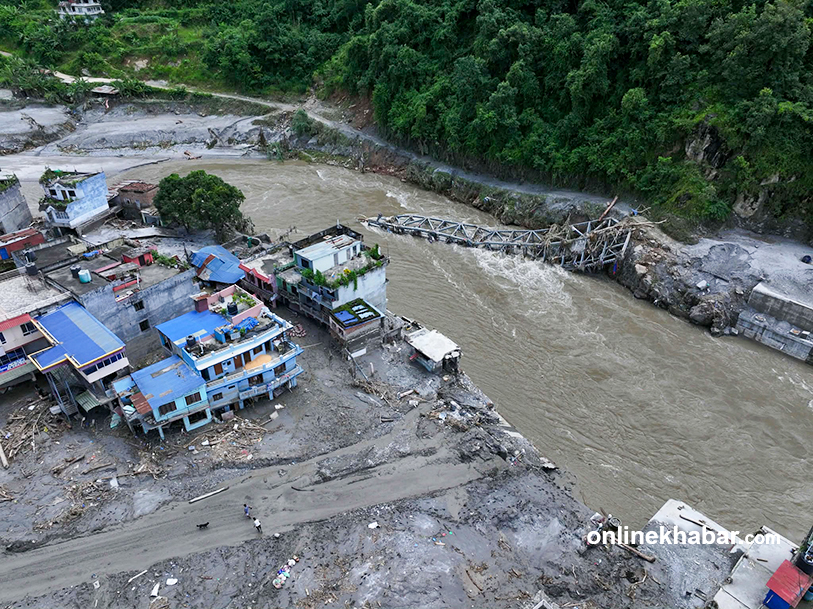
The lack of government decisions on reconstruction is not the only challenge. Restoring roads and bridges leading to the project sites has also become a major hurdle.
The Rasuwagadhi Hydropower Project needs bridges in areas including Syafrubesi, Ronga and Yangyang to regain access. According to the company, around six bridges are required to reach the headworks, desander and powerhouse. The company says it will have to build two of them, while the government is responsible for the remaining four.
Neupane said work was underway on the foundations for a Bailey bridge at Syafrubesi, but that alone would not be enough to support the project’s reconstruction.
Although a Bailey bridge could restore basic access, it would not be capable of carrying the heavy construction equipment needed at the site, he said.
Bhattarai also said temporary bridges and Bailey bridges would not be sufficient. Bridges with adequate load-bearing capacity would be needed to transport equipment to the project sites.
“Installing a Bailey bridge alone will not be enough. We need a bridge with a 50-tonne capacity to transport equipment, so construction of permanent bridges must also move forward,” he said.
Private developers complain that the government has yet to carry out a detailed assessment of the access roads and bridges required for reconstruction.
Who will bear the cost of insurance, relief and concessional loans?
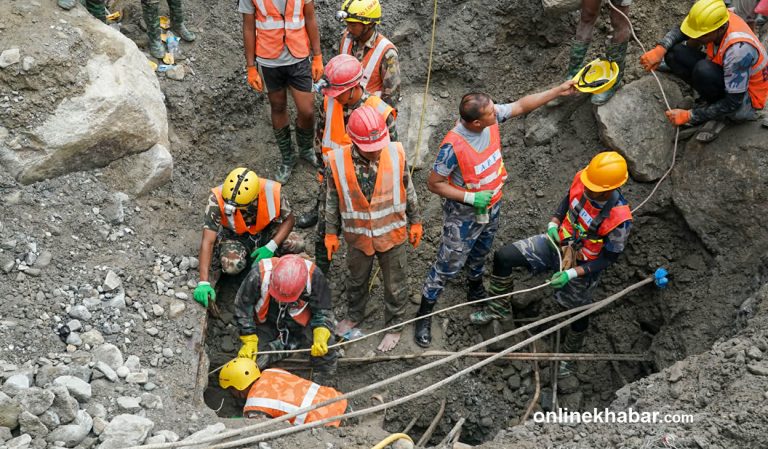
How much of the reconstruction cost can be covered by insurance also remains uncertain. The Electricity Regulatory Commission is studying how the costs could be shared among insurance payouts, government relief and concessional loans.
Commission chair Ram Prasad Dhital said the commission was examining the principle that the entire burden of a natural disaster should not fall solely on project developers or electricity consumers.
“It would not be fair to make developers bear the entire burden for something that was not their fault, nor the authority’s fault, but was caused by nature,” Dhital said.
The commission is also working on a risk-based insurance premium system under which projects in high-risk areas would pay higher premiums, while those facing lower risks would pay less.
Dhital said the study would examine how much of the total reconstruction cost should be covered by insurance, how much should come from government relief funds, how much could be provided through concessional loans and how much of the remaining burden might eventually affect electricity tariffs.
“We need to verify the costs. If the estimated cost is Rs 100, we have to determine how much insurance will pay, how much will come from the relief fund, how much will be covered by soft loans and how much impact it will have on consumers’ electricity bills,” he said.
The commission is also working on a new regulatory framework covering the safety measures hydropower projects should adopt before, during and after disasters.
Scientific assessment needed before reconstruction decisions
The Energy Ministry has formed a committee to conduct a scientific study of the unusual flooding in the Bhotekoshi River. The committee, coordinated by water policy and governance expert Debesh Belbase, is examining the nature, causes and risks associated with the event.
Tika Baral, joint-secretary at the Water and Energy Commission Secretariat, said the event was rare even by global standards and required a detailed scientific investigation.
“This is a rare event globally. We cannot reach a conclusion without a detailed study,” Baral said.
The government is also preparing a PDNA report under the leadership of the National Planning Commission. The Energy Ministry says it will decide how reconstruction should proceed only after the report is completed.
For private hydropower developers, however, time is becoming the biggest concern. They warn that every delay in reconstruction decisions will add to project costs and debt obligations.
Rebuilding the hydropower projects damaged by the floods is no longer simply a technical challenge. It is also tied to insurance, debt, government assistance, access infrastructure and the long-term financial viability of the projects.