

Kathmandu, October 29
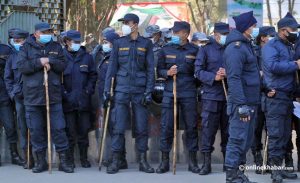
A meeting of the Nepal Police Policy Coordination Committee (PCC) on Thursday saw extensive discussions on the need for unity within the force amid mounting criticism of its leadership, according to a participant.
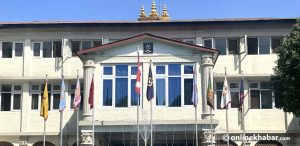
The meeting, called for 2 pm at the Nepal Police Headquarters, began around 15 minutes late and was still underway at 7 pm, having lasted more than five hours.
A participant told Onlinekhabar that discussions focused on growing indiscipline within the force and what was described as media trials against the organisation and its leadership, including from within the police itself.
Participants reportedly stressed that police officers should stand together in response to attacks on the leadership to preserve unity within the organisation.
The discussions also touched on whether police officers should collectively meet Prime Minister Balendra Shah, following reports of strained relations between the government and Inspector General of Police (IGP) Dan Bahadur Karki and claims that the IGP was being pressured to resign.
“The possibility of everyone going together to the Prime Minister’s Office was also raised, given the crisis facing the leadership,” an officer who attended the meeting told Onlinekhabar.
The officer said participants argued that the police force should remain united regardless of who heads the organisation. According to a source, the discussion also touched on the possibility of making collective decisions if necessary.
The meeting is believed to be among the longest PCC meetings in Nepal Police history. It was still underway at the time of reporting.
IGP issues stern warning to police officers
The PCC meeting came a day after IGP Karki addressed police officials virtually on Wednesday, issuing what one officer described as unusually forceful instructions.
From police headquarters, Karki addressed officials and representatives from all seven provincial police offices, provincial police offices, highway security and traffic police offices, provincial police training centres, special security battalions, provincial police battalions, district police ranges, district police offices and subordinate units authorised to handle cases.
Karki instructed officers to remain fully committed to serving citizens. He also issued a stern warning to individuals he accused of working against the organisation and its chief.
“He specifically targeted certain individuals and warned them. Actions such as arranging media trials against the organisation or getting articles written against the head of the organisation will no longer be tolerated,” an officer quoted Karki as saying.
The IGP reportedly said the organisation was closely monitoring the activities of its personnel.
Following Wednesday’s address, Karki called the PCC meeting for Thursday. The meeting had not been scheduled in advance.
Controversy over election police uniform procurement
The meeting has drawn particular attention amid allegations of irregularities in the procurement of uniforms for election police, complaints filed with the Commission for the Investigation of Abuse of Authority (CIAA) and the parliamentary Public Accounts Committee, and the formation of a subcommittee to investigate the matter.
Questions have also been raised over alleged contact with Inam Sapkota, described in reports as a middleman, alongside concerns about relations between the government and the IGP.
The timing of the meeting has added to the scrutiny. Previously, PCC meetings generally involved deputy inspector generals (DIGs) and additional inspector generals (AIGs) working in the Kathmandu Valley. For Thursday’s meeting, however, the headquarters called in police chiefs and DIGs from all seven provinces for the first time.
Provincial DIGs had been instructed to arrive at headquarters by noon on Wednesday. They travelled to Kathmandu on Thursday and joined senior officers from the Valley, including senior superintendents of police (SSPs), DIGs and AIGs, for the meeting chaired by Karki from 2 pm.
PCC meetings are generally held to discuss policy matters and make organisational decisions. However, participants said Thursday’s discussions focused largely on news reports concerning the police chief and whether officers should collectively approach the prime minister.
Some participants reportedly expressed support for meeting the prime minister as a group.
Dispute over election police uniforms
Rastriya Swatantra Party lawmaker Khagendra Sunar has repeatedly called for Karki’s resignation over alleged irregularities in the purchase of election police uniforms. He has also demanded an investigation and action, including dismissal if warranted.
Sunar and the IGP have clashed during parliamentary committee discussions. During one exchange, Karki questioned the kind of people the country was being governed by, according to reports of the meeting.
Complaints concerning the uniform procurement have been filed with both the CIAA and the parliamentary Public Accounts Committee.
Nepal Police procured uniforms for election police in Magh. Sunar has continued to raise questions over the process, alleging irregularities.
For the House of Representatives election held on March 5, Nepal Police recruited 133,980 election police personnel, while the Armed Police Force recruited another 15,110, bringing the total to 149,090.
Depending on the geographical area of deployment, the expenditure per election police personnel ranged from Rs 50,954 to Rs 86,484. The personnel received payments covering 40 days of service, including wages, rations, transportation and meal allowances.
The government allocated separate amounts for uniforms based on deployment areas: Rs 11,500 per person for the Himalayan region, Rs 7,945 for the hills and Rs 6,170 for the Tarai.
According to police officials, around Rs 1 billion was released under the uniform expenditure heading.
Police headquarters also provided Rs 848 per person as preparation expenses for travelling to and returning from deployment locations, along with a lump sum of Rs 1,200 for snacks during four days of training. The uniform allowance is the component at the centre of the current controversy.
Both Nepal Police and the Armed Police Force have maintained that there were no irregularities in the purchase of election police uniforms.