

Barcelona, October 29
When people move abroad, they often have to start many things from scratch — work, language, relationships and sometimes even their sense of identity. Sarala Sapkota, 48, went through much the same experience after moving to Spain. Having worked as a nurse in Nepal for years, she arrived in Barcelona and began rebuilding her professional life in a new language and an unfamiliar society.
As time passed, however, her concerns shifted from her own life to the next generation. Would Nepali children born in Spain grow up speaking Nepali? Would they learn to read and write it? Would they be able to speak to their grandparents in their own language?
The search for answers to these questions led her to start a small initiative that has now completed 12 years.
The Nepali language school in Barcelona began in 2014 with just five children. Today, classes are held every Saturday. Hundreds of children have attended over the years, and around 40 are currently learning Nepali.
Sapkota is not the school’s principal classroom teacher. Her work happens largely behind the scenes — recruiting teachers, bringing parents together, finding a venue, organising programmes, resolving problems and, perhaps most importantly, ensuring that the school continues to operate.
That is why she is known in Barcelona’s Nepali community as the coordinator of the Nepali language school.
Her 12-year journey is about more than a school. It is the story of an immigrant community’s sustained effort to keep the next generation connected to its language, cultural heritage and ancestral roots.
From nursing to life as a migrant
Sarala Sapkota spent her childhood in Rayale, Kavre, now part of Ward No. 1 of Panauti Municipality. Her father ran a small shop, and she grew up as one of five children. She enjoyed studying, although school life in the village also meant that students had to take responsibility for everyday school activities.
She began her education at Shanti Niketan Lower Secondary School before moving to Kushadevi Secondary School, where she completed her School Leaving Certificate (SLC).
After the SLC, she tried studying law in Kathmandu. But the practical difficulties of living away from home and pursuing her education eventually brought that path to an end. She then chose nursing. After completing her studies at Maharajgunj Nursing Campus, she worked as a nurse in Nepal for around eight years.
After getting married, she moved to Spain in April 2005.
Barcelona was not the city with a sizeable Nepali population that it is today. Sapkota remembers there being only around 50 Nepalis in the city at the time. The community was small, and people knew one another well. New arrivals were invited into people’s homes, community members shared one another’s joys and hardships, and everyone helped where they could.
But Sarala Sapkota, like many migrants, was also trying to rebuild her own life in a new country.
She continued working as a nurse in Spain, spending around six years working in residential care facilities. She learned workplace practices from her local colleagues, but the language was a challenge.
“I realised that knowing the language was essential to becoming part of society here,” she recalls.
Her experience taught her that having professional skills was not enough when moving abroad. One also had to understand a new society, learn a new language and be willing to acknowledge what one did not know.
Perhaps that experience made her more conscious of the language her own children would grow up speaking. She could see that, although Nepali was spoken at home, her children’s wider world was taking shape in Spanish and Catalan.
The question was no longer just a personal one. How could the Nepali community preserve its language for the next generation?
An initiative that stalled, but an idea that endured
Between 2009 and 2011, Sarala Sapkota served on the executive committee of the Non-Resident Nepali Association (NRNA) in Spain. During that period, discussions began about teaching Nepali to children growing up abroad.
An attempt was made to organise weekly classes, but regular attendance proved difficult. On some occasions, only two children turned up out of the seven who had been expected. Eventually, the initiative stalled.
Sapkota, however, did not abandon the idea. For her, the question remained unanswered.
During the Christmas holidays in 2013, a meeting at the home of her friend Nita brought the idea back to life. Their children were playing together when the conversation once again turned to Nepali language classes.
This time, they decided not to wait for someone else to take the initiative.
“We started it ourselves,” Sapkota says.
The Nepali language school opened in the first week of 2014 with five children. The first classes were held at the home of Keshari Shrestha Nemkul, who took charge of teaching. Sapkota focused on management and coordination, helping form a team to oversee the school.
The number of students gradually increased. Before long, 22 children were attending classes at the house. Space became a problem, and the children had to be divided into two groups.
The school soon grew beyond the classroom and textbooks.
Celebrations of Dashain and Tihar became part of its activities. Children began appearing on stage in Nepali traditional dress, singing songs, reciting poems and performing the national anthem. When one family saw its child on stage in Nepali attire, another family was encouraged to enrol its own child.
The school continued to grow, but increasing enrolment was not Sapkota’s greatest challenge. Keeping the initiative going was.
“Starting something is easy, but continuing it is difficult,” she says.
From a room at home to a public community centre
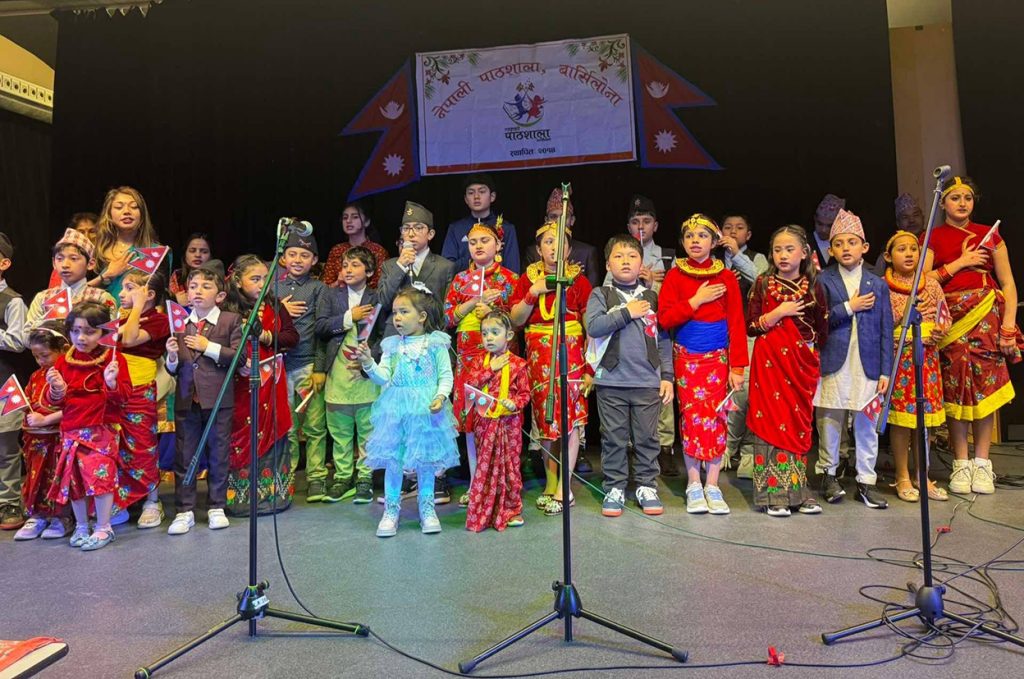
In February 2016, the school moved to the NRNA office. Later, an opportunity arose to work with Centre Cívic Sedeta, a civic centre in Barcelona. What began as an arrangement for a few months continued for years.
Today, Nepali classes are held there every Saturday, with the venue provided free of charge.
For an immigrant community, securing space in a local public institution to teach its children their heritage language is an achievement in itself. But finding a venue is one thing; earning and maintaining trust is another.
According to Sapkota, the school gradually built that trust through its conduct and consistency.
“Over time, our behaviour helped us earn their trust,” she says.
The community behind the school
The school has never been the work of Sarala Sapkota alone. Over the years, more than a dozen volunteer teachers have contributed their time. Some taught for a few months, while others stayed for years. Parents brought their children every Saturday and supported school activities and events. Other members of the community offered help whenever it was needed.
Sapkota herself continued to oversee many aspects of the school, from deciding which teacher would take a particular class to coordinating with parents. She helped prepare programmes, arrange venues and resolve problems whenever they arose. If a child stopped attending regularly, she would speak with the parents to understand why.
Her role became less that of a classroom teacher and more that of a coordinator and guardian of the school.
“This has not been my effort alone,” she says. “Many teachers, parents and members of the community have given their time.”
Perhaps that is why the school has grown beyond an individual’s initiative to become a shared space for the community.
More than a language, a connection to their roots
Around 40 children, aged between four and 12 or 13, are currently learning Nepali at the school. Hundreds have attended over the years, although not all have stayed. Some families have moved elsewhere, while others have seen their children grow into teenagers, with schoolwork, friendships and new interests making it harder to attend Saturday classes regularly.
Yet the school has taught children much more than the Nepali alphabet.
They learn to read, write and speak Nepali. They sing songs, recite poems and deliver speeches in the language. They learn about Dashain, Tihar and Nepali culture. They are also encouraged to explore their family histories — which district in Nepal their family comes from, which village their parents grew up in, and where their grandparents’ homes are located.
For Sarala Sapkota, language and culture cannot be separated.
“Teaching the language alone is not enough. Children must also understand their culture and their roots,” she says.
Sometimes, the impact of the school becomes apparent not in the classroom, but when children travel to Nepal.
A child may read a signboard in Nepali on the street, recognise the name of their ancestral village or speak to their grandparents in Nepali. When parents share such experiences with Sapkota, she feels that the school’s purpose is gradually being fulfilled.
For her, recognising Nepali letters is only part of the achievement. It is also about helping children recognise a part of their own family and identity.
Today’s students, tomorrow’s teachers
After 12 years with the school, Sarala Sapkota’s dream is not to remain at its centre forever. She wants the children studying there today to take responsibility for it in the future.
She hopes today’s students will become tomorrow’s teachers, manage the school and pass the language on to the next generation.
“I want it to continue even after we step away,” she says.
That aspiration gives her work a significance beyond keeping weekly classes running. She has helped establish a foundation that the next generation can take forward in its own hands.
A class that began in a room at someone’s home now meets every Saturday in a public community centre in Barcelona.
Teachers have changed. Students and families have come and gone. Some children have grown up, while others have moved elsewhere. Yet the school has continued.
Perhaps that is the greatest measure of Sapkota’s 12 years of work.
Preserving a language abroad does not always begin with a large institution, a substantial budget or a major campaign. Sometimes, it begins with five children and a class in someone’s living room. When a small initiative is nurtured and sustained over the years, it can become a lasting inheritance for an entire generation.
Those Nepali letters carry more than a language. They hold memories of home, the names of ancestral villages, cultural traditions and the roots being passed from one generation to the next.
For 12 years, Sarala Sapkota has been helping keep those roots alive in Barcelona.