Kathmandu, October 25
The CPN-UML has questioned Finance Minister Swarnim Wagle’s statement that the era of linking Nepali nationalism with anti-Indian sentiment has ended.
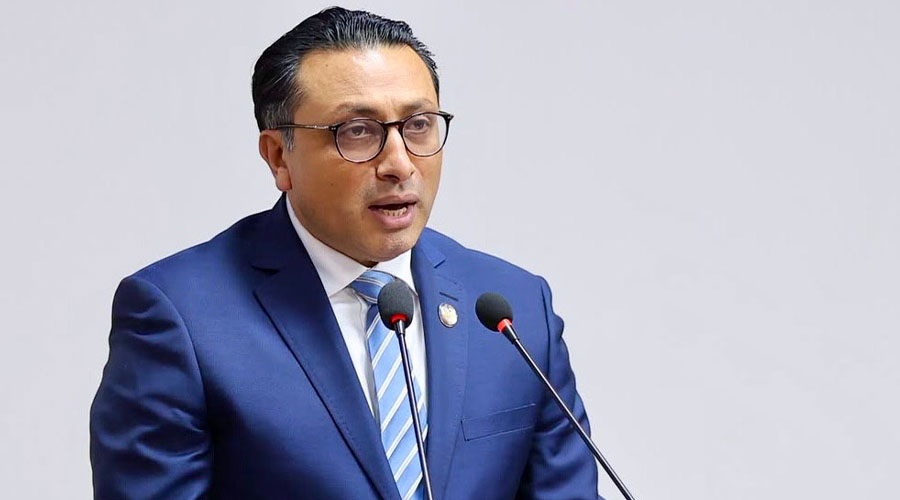
Niraj Acharya, head of the UML’s Publicity Department, questioned the political message and diplomatic rationale behind Wagle’s remarks during his visit to New Delhi, India.
In a social media post, Acharya said Nepal is a sovereign nation with an independent foreign policy based on sovereign equality, mutual respect and national interest.
Nepal has been a member of the United Nations since 1955, he noted, adding that Wagle was unlikely to be unaware of these fundamental principles.
“The political message and diplomatic justification for declaring during a visit to India that the old narrative linking Nepali nationalism with anti-Indian sentiment has ended are open to question,” Acharya wrote. “Nepali nationalism is not based solely on opposition to India.”
He said protecting national independence, sovereignty and national interests was an integral part of nationalism. Strengthening relations with India, he added, should not come at the expense of Nepal’s national interests and dignity.
Wagle is currently visiting India. Speaking at the NDTV World Summit 2026 in New Delhi, he said the era of associating Nepali nationalism with anti-Indianism had come to an end.
He said the aspirations of the younger generation centred on economic prosperity and good governance, adding that Nepal’s foreign policy was moving in a positive direction.
According to Wagle, decades of ideological conditioning had helped establish a narrative that equated Nepali nationalism with opposition to India.
“But our generation is different. We have seen the world, and our aspirations are economic. We want good jobs, good governance and good relations with our neighbours,” Wagle said. “So I can say with great happiness that the era of linking Nepali nationalism with anti-Indianism is now over.”
Acharya said Nepal-India relations were rooted in historical, geographical, economic, social and cultural ties, with cooperation and dialogue continuing since the establishment of formal diplomatic relations.
He said the relationship should continue to develop on the basis of mutual respect, trust, equality and shared interests.
“Maintaining friendly relations with neighbours is a necessity for Nepal, but that does not require us to refrain from expressing our national concerns and perspectives, or to engage in excessive flattery,” Acharya wrote.
Arguing that diplomacy was not simply about criticising or praising another country, he said Nepal should protect its national interests while expanding cooperation in areas of mutual benefit.
He identified trade, transit, energy, investment and connectivity as key areas for cooperation with India, while stressing that Nepal must also clearly present its position on bilateral concerns, including border disputes.
“Both the idea that disagreeing with a friendly country will damage relations and the notion that all disagreements should be set aside in the name of improving ties, effectively adopting an attitude of total submission, are extreme positions,” Acharya said.
He added that a country pursuing an independent foreign policy must express its views according to its own national interests and priorities.
“Questions naturally arise about the message conveyed when, while visiting another country, a leader characterises their own country’s nationalist perspective as outdated or irrelevant,” he wrote.
Acharya said Nepal-India relations were neither built solely through temporary political statements nor determined by the views of any single leader.
“This is a relationship connected to the people of both countries, their shared history and their long-term interests,” he said, adding that Nepal’s interests would be best served by diplomacy based on mutual respect, clear national positions and practical cooperation, free from both unnecessary flattery and provocation.