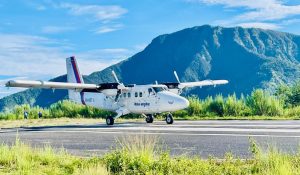


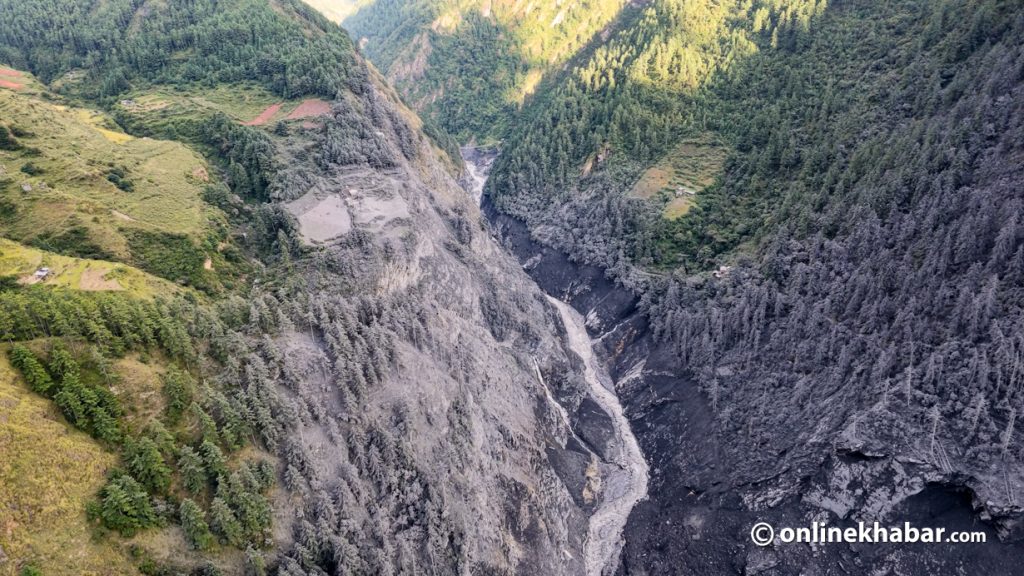
On October 11, the Onlinekhabar and Himalaya TV teams flew over the flood-hit areas of Gorkha. From above, the landscape told a grim story. The mountain was dark, and the Budhi Gandaki flowed black below it. Landslide debris scarred the slopes, while damaged villages and roads showed the extent of the destruction.
The scene was painfully familiar. Barely a month and a half ago, floods in Rasuwa’s Bhotekoshi area had left a similar trail of devastation. Once again, people have lost their homes, infrastructure has been damaged, and communities have been forced to confront the risks of living in Nepal’s fragile terrain.
Every disaster brings grief, rescue efforts and promises of recovery. But it also raises questions that we have repeatedly failed to answer. Why do we continue to build settlements in hazardous locations? Are our schools, hospitals, roads and hydropower projects adequately protected against natural disasters? And when reconstruction begins, will we make the difficult decisions necessary to prevent the same tragedy from happening again?
Nepal has had no shortage of warnings. The 2015 earthquake, the Melamchi disaster, landslides in Khotehang and the 2024 glacial lake outburst flood in Thame have all exposed different aspects of our vulnerability. Yet, each new disaster seems to bring us back to the same starting point.
The latest devastation along the Budhi Gandaki must prompt more than an immediate response. It must force us to reconsider how and where we live, how we plan development and what we understand by disaster preparedness.
Safety must come before attachment to place
Leaving one’s home is never easy. For many families, a house represents generations of hard work, memories and an enduring connection to their ancestral land. Asking people to abandon such a place is not a decision that can be taken lightly.
But when a settlement faces a serious and recurring threat from floods or landslides, the question of safety cannot be ignored. No attachment to a home should outweigh the need to protect the lives of those living in it.
This does not mean that people should simply be told to leave. For families whose livelihoods depend on their land, relocation can mean losing not only a home but also their means of survival. Moving to a safer place is possible only when there are viable alternatives, access to essential services and support to rebuild livelihoods.
The responsibility, therefore, lies not only with residents but also with the state. Authorities must identify high-risk settlements, communicate the dangers clearly and work with communities to develop practical relocation plans. Where the risks are too great, helping people move to safer locations must become a priority rather than a last resort.
The same urgency is needed when deciding where to build schools and hospitals. These facilities are essential to community life, yet their importance alone does not make them safe. Their locations must be assessed for exposure to floods, landslides and earthquakes, taking into account the stability of the surrounding terrain and the risks that may emerge over time.
A building can be structurally sound and still be unsafe because it stands in the wrong place.
Development must account for the land beneath it
The vulnerability of settlements is only one part of the problem. Roads, bridges, hydropower projects and other infrastructure are also exposed to the hazards of Nepal’s geography.
The destruction caused by floods and landslides should compel us to examine whether our development projects are being planned with sufficient understanding of the terrain. The 341 MW Budhi Gandaki hydropower project’s construction camp in Salleri, Chumnubri, and the footbridge associated with the 14–15 MW Dovan Khola project underline the importance of assessing the risks faced by infrastructure and the people who depend on it.
Such assessments cannot be limited to the structures themselves. They must consider the stability of surrounding slopes, river behaviour, drainage patterns, landslide-prone areas and the possibility of debris flows. Without this understanding, even substantial investments can be lost, while the communities around them remain exposed.
Nepal’s difficult geography makes infrastructure development challenging, but that is precisely why planning must be more rigorous. Projects cannot be designed solely around immediate costs, construction timelines or engineering requirements. They must also account for the environmental and geological conditions in which they will operate.
This calls for detailed risk assessments before construction begins, regular monitoring once projects are operational and infrastructure designs suited to local conditions. Approaches developed for other countries or landscapes cannot simply be replicated without considering Nepal’s particular vulnerabilities.
Rebuilding in the same place may mean repeating the disaster
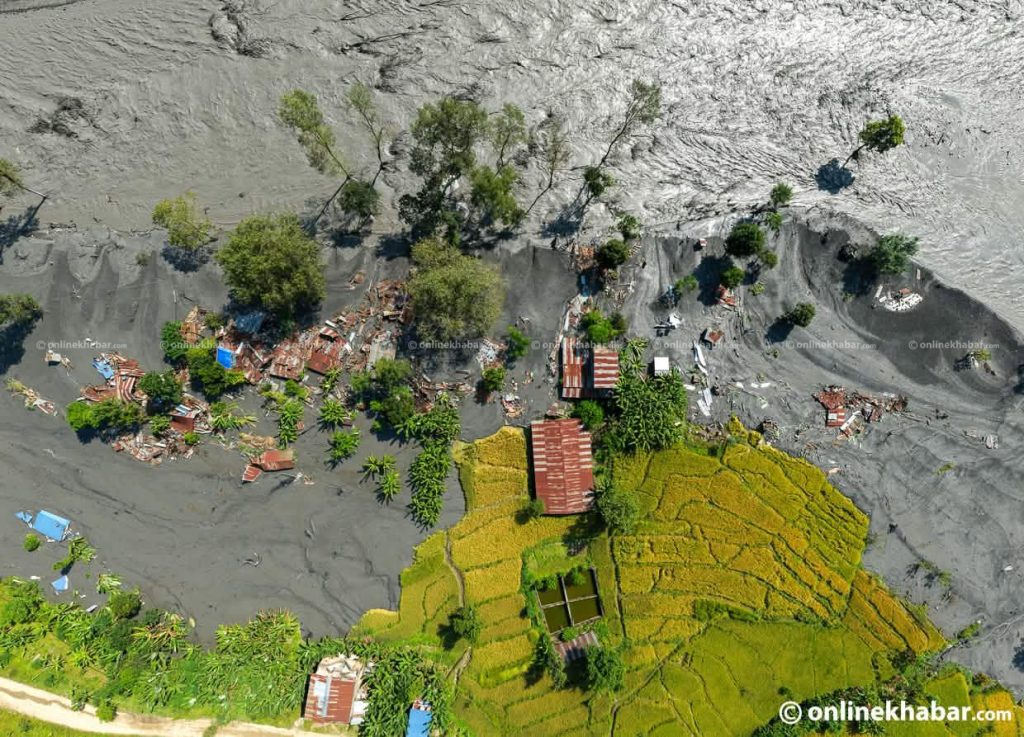
The pressure to restore normal life after a disaster is understandable. Families need shelter, roads must be reopened and local economies must recover. But urgency can become dangerous when it leads to reconstruction without a proper assessment of the risks.
If a house has been destroyed by a landslide, rebuilding it on the same unstable slope may expose its occupants to the same danger. If a river has swept away a settlement, reconstructing it along the same vulnerable riverbank without adequate scientific assessment could invite another tragedy. Areas where landslide debris accumulates must also be examined carefully before people are encouraged to return.
Reconstruction must begin with an understanding of why the destruction occurred. Geological investigations and detailed risk mapping should guide decisions about which places can be made safe, which require protective measures and which are unsuitable for habitation.
This may slow the rebuilding process, but the alternative is to spend public money restoring structures that could be destroyed again. A road reopened or a house reconstructed is not necessarily evidence of successful recovery. The real measure of progress is whether people are safer than they were before the disaster.
The state must also recognise that relocation involves more than providing land or constructing houses elsewhere. Families need secure livelihoods, access to schools and healthcare, and the opportunity to participate in decisions that affect their futures. Without these considerations, even a technically sound resettlement plan may fail.
Local governments have a crucial role in this process because they understand their communities and the conditions on the ground. They must be equipped with the technical expertise, reliable data and financial resources needed to identify risks and make informed decisions.
Preparedness must begin long before disaster strikes
One of Nepal’s persistent weaknesses is the gap between recognising a disaster risk and taking action to reduce it. After a tragedy, attention turns to rescue, relief and reconstruction. Political leaders and officials visit affected areas, announce assistance and promise that lessons will be learned. But the real test comes later, when public attention fades and difficult decisions must be made.
Preparing for disasters requires sustained investment in geological studies, risk mapping, early-warning systems and safer infrastructure. It also requires an integrated system through which weather forecasts, hazard information and local response mechanisms can work together. Communities need timely, understandable warnings, while authorities need clear plans for acting on them.
Our preparedness must extend beyond the monsoon season. Landslides and other geological hazards can occur outside periods of heavy rainfall, and disaster planning must account for these risks as well. A system that responds only when a crisis is visible will always be a step behind.
Public resources must also be used more strategically. Instead of directing most attention and expenditure towards emergency response after a disaster, the state must invest in reducing the likelihood and impact of future losses. Prevention may be less visible than rescue operations, but it is often far more effective.
None of this can be achieved by the government alone. Development partners, infrastructure companies, elected representatives, political parties, local authorities, journalists and citizens all have a role in demanding safer settlements, more responsible development and better preparedness.
The question is whether we will learn this time
Albert Einstein is often credited with the observation that “Education is what remains after one has forgotten what one has learned.” For Nepal, the challenge is to turn the experience of repeated disasters into lasting changes in how we plan and act.
We cannot prevent every flood or landslide. But we can identify dangerous settlements before they are destroyed, assess infrastructure before it fails, build early-warning systems that reach vulnerable communities and ensure that reconstruction does not return people to the same risks.
The devastation along the Budhi Gandaki is another reminder of the consequences of failing to do so. The destruction we witnessed from above was not merely a scene of damaged roads, broken settlements and a river running black. It was also a warning about the decisions Nepal must make before the next disaster strikes.
The country has already paid a heavy price for its vulnerability. Whether that price leads to meaningful change now depends on what we do after the immediate crisis has passed. The government, development partners, infrastructure companies, political representatives and citizens must ensure that this disaster becomes more than another painful memory.
If we continue to respond to every tragedy with the same promises and return to the same patterns of settlement and development, the next disaster will find us just as vulnerable.
The most important lesson from the Budhi Gandaki disaster, therefore, is not simply that Nepal must prepare for natural hazards. It is that we must change the decisions that turn those hazards into human tragedies.