

Kathmandu, October 9
Kathmandu Valley Crime Investigation Office, which investigates serious crimes across Kathmandu, Lalitpur and Bhaktapur districts, received a tip-off that Chinese nationals were operating an illegal gold-processing facility in Budhanilkantha, Kathmandu.
Acting on the information, investigators verified the tip-off and stepped up surveillance of the suspected operation. After gathering sufficient information to establish that gold was being traded illegally, Pillar No. 4 of the office began preparing a raid.
The operation was named Bravo Golf. Police typically assign code names to operations involving major cases, complex investigations or matters of significant public interest.
At around 5 pm on Thursday, a team from the office arrived at a house in Upper Bhangal, Budhanilkantha Municipality-2, where the suspected facility was operating. Having already conducted reconnaissance, the team cordoned off the property and launched the operation.
Police encountered minor physical resistance from the Chinese nationals while opening the door. Once inside, however, they discovered far more gold than they had anticipated.
“We had received information about four kilograms of gold. But when we raided the premises, we found a much larger quantity,” Senior Superintendent of Police (SSP) Santosh Khadka of the Crime Investigation Office told Onlinekhabar.
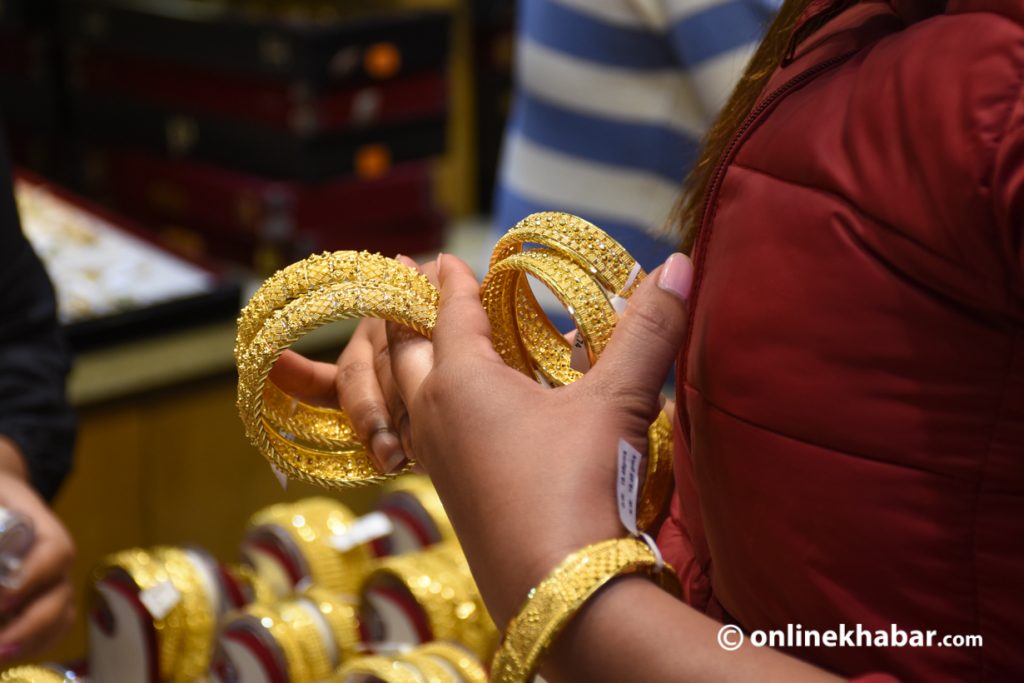
The raid yielded 21 kilograms and 750.68 grams of gold, valued at Rs 546,007,320, or approximately Rs 546 million, at the market rate on the day of the seizure.
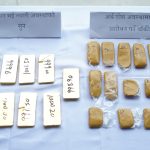
The recovered gold included loose pieces, biscuit-shaped bars, gold in a paste-like form and pieces of metal in a similar state.
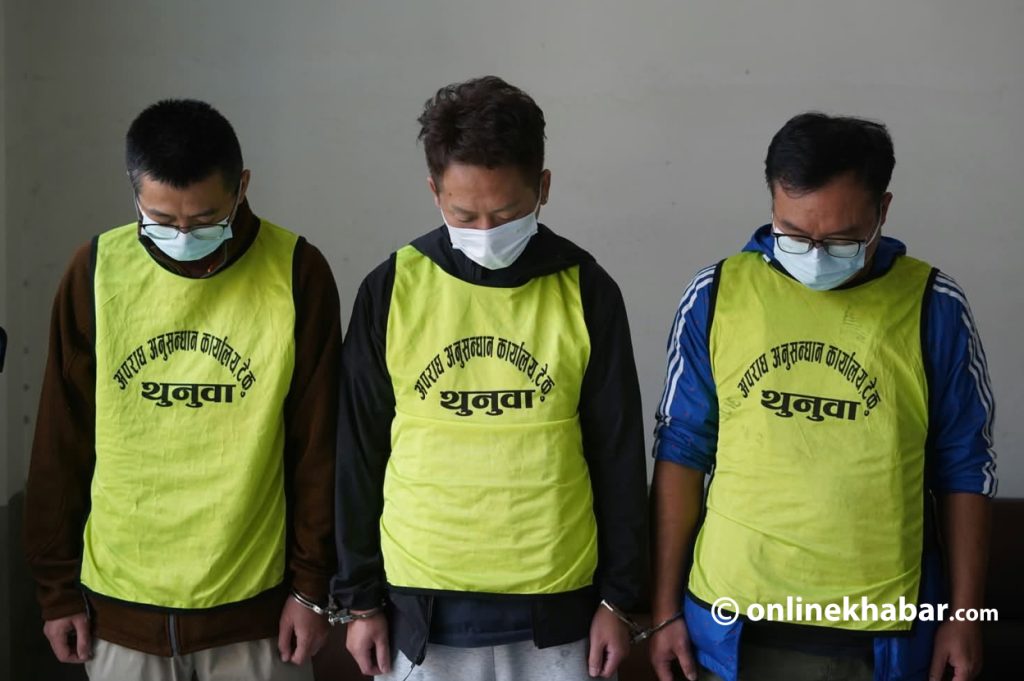
Police arrested three Chinese nationals in connection with the seizure: Han Fei, 37; Zhou Longqing, 47; and Wang Jianzhen, 36. All three are Chinese citizens, according to police.
House rented for Rs 330,000 a month
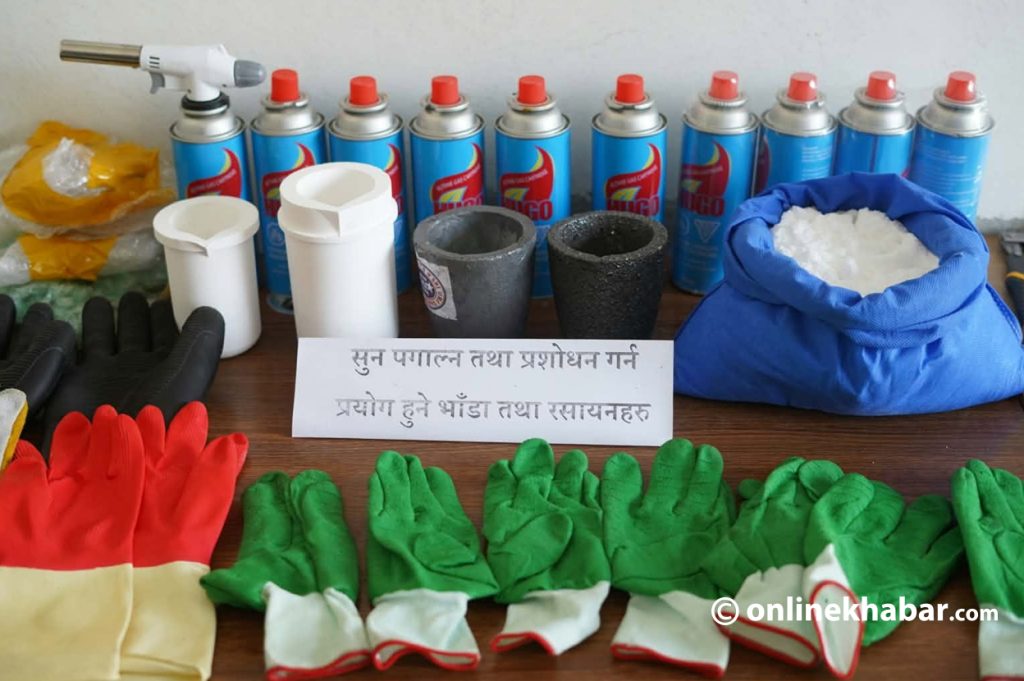
Investigators believe the group rented an entire house to melt smuggled gold, mould it into different shapes and prepare it for distribution.
The property belongs to a person surnamed Bista, who currently lives in the United States. Police say a Chinese national identified as Xu Can rented the house for Rs 330,000 a month and arranged for it to be used as a gold-processing facility.
According to SSP Khadka, Xu Can signed a rental agreement with the landlord on July 24 and paid four months’ rent in advance, amounting to Rs 1.32 million.
Xu Can was not among those arrested. Police say immigration records show that he returned to China on August 15. According to an investigating officer, Xu Can handed the keys to the rented house to another Chinese national, Zhen Jia Le, in China. Preliminary findings suggest that Zhen Jia Le later passed the keys to Han Fei, who travelled to Nepal with them.
Han Fei and the two other arrested men allegedly used the two-and-a-half-storey house as a gold-processing facility.
The property had a large compound, which police believe the group used to melt gold, mould it into different shapes and prepare orders for delivery to designated destinations.
Investigators suspect that the gold was brought into Nepal in a paste-like form and wrapped in plastic. At the rented house, the group allegedly placed the material in a dryer before processing it in a melting machine. The gold was then moulded into bars, including biscuit-shaped pieces, for distribution to the market.
The arrangement suggests that the property was being used not merely to store gold but also to process it and prepare it for distribution.
Two one-kilogram gold bars found in a car
Police also seized a car from the compound of the rented house. Investigators say the group had hired the vehicle to transport gold.
The car had been rented from September 27 to October 11 at a rate of Rs 8,000 a day. Police say Han Fei arrived in Kathmandu from China on September 27 carrying the keys to the house and hired the vehicle soon after landing at Tribhuvan International Airport.
According to police, the car was rented through a vehicle dealership or rental service.
When police raided the property on Thursday morning, they also found two gold bars inside the vehicle. Each weighed one kilogram and was wrapped in paper. The bars were concealed in a compartment near the driver’s seat.
The discovery of finished gold bars in the car has strengthened police suspicions that the group was preparing to transport the gold to a buyer or another destination.
Investigators have yet to establish where the gold was headed.
“We are yet to determine the precise destination of the gold. But the recovery of finished gold bars from the car suggests that they were being taken to the market,” SSP Khadka said.
Police have not established who was supposed to receive the gold or where it was to be delivered.
Alleged network directed from China
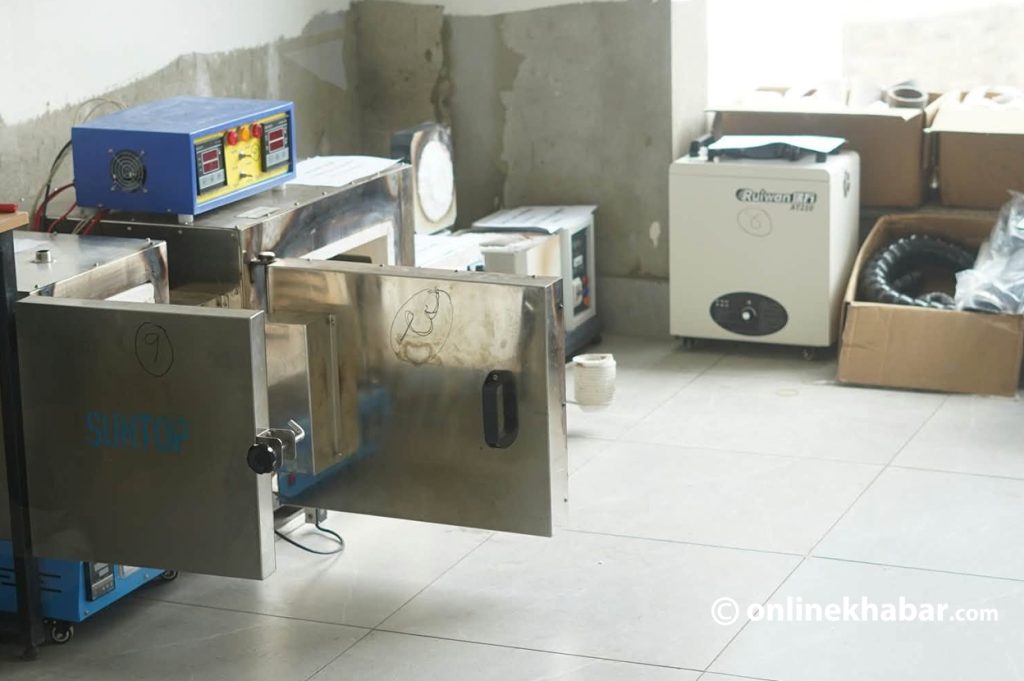
Preliminary investigations indicate that the operation in Kathmandu was being run under the direction of Chinese nationals based in China.
An investigating officer, citing Han Fei, who is currently in custody, said the arrested men appeared to have been working in Kathmandu under the direction of Zhen Jia Le, who is based in Guangzhou.
Zhen Jia Le allegedly received the keys to the house rented for the gold-processing operation through Xu Can in China. According to statements given to police by the arrested men, he directed the operation in Nepal and instructed them where to deliver the processed gold.
“After the gold was processed and prepared at the facility, Zhen Jia Le, who is based in Guangzhou, would use WeChat to instruct them on where, how and to whom the gold should be delivered in Kathmandu,” SSP Khadka said.
Investigators are now trying to establish the full chain of command, identify the intended recipients and determine how the gold entered Nepal.
The statements made by the arrested men form part of the preliminary investigation. The alleged roles of those involved remain subject to further verification.
Studying Nepal’s gold market before setting up the operation
Police believe Xu Can initially travelled to Kathmandu to assess Nepal’s gold market and understand local trading conditions before making arrangements for the suspected operation.
Investigators suspect that the group may have intended to sell the gold within Nepal, potentially targeting the festive season, when demand for gold typically increases.
According to an investigating officer, Xu Can studied the local market, explored potential customers and arranged to rent the property before returning to China. A separate team subsequently arrived in Kathmandu and began operating the facility.
“It appears that Xu Can studied Kathmandu’s gold market and identified potential customers before renting the house and returning to China. Another team then came to Kathmandu and began operating the facility,” the officer said.
Police say Han Fei and the other two arrested men entered Nepal on tourist visas. Immigration records show that Han Fei arrived on September 27, while another member of the group arrived on October 1. Investigators are examining the suspects’ movements, including their repeated visits to the airport, as part of the inquiry.
The suspected operation appears to have involved distinct roles, from arranging the premises and studying the market to processing the gold and preparing it for delivery.
Police suspect gold was smuggled in by air
Police suspect the seized gold was smuggled into Kathmandu by air, possibly in its paste-like form, which may have made it easier to conceal and transport.
Immigration records show that all three arrested Chinese nationals travelled to Kathmandu via Hong Kong. Two arrived at Tribhuvan International Airport on October 11, while the third arrived on October 15.
Investigators have also found that the men travelled to and from the airport three or four times after arriving in Kathmandu. Their movements, along with their travel route, have prompted police to investigate whether the gold was brought into Nepal by air.
Police believe the paste-like form may have made the gold easier to conceal during transportation. However, investigators have not yet confirmed the precise route used to bring it into Nepal.
“We still need to investigate and confirm where the gold came from and where it was headed,” SSP Khadka said.
Police are continuing to question the suspects with the assistance of interpreters. Further investigation will be needed to establish the origin of the gold, its intended destination, the identities of its intended recipients and the extent of the alleged network operating between China and Nepal.