

Kathmandu, October 7
Former leaders of the Nepali Congress-affiliated Nepal Student Union (NSU) are playing a prominent role in the party’s ongoing leadership contest, underscoring the student organisation’s long-standing role as a training ground for future Congress leaders.
In its 56-year history, the NSU has had 21 presidents, including both elected and ad hoc leaders. Its history began in 1970 with the election of founding president Bipin Koirala and has now reached the tenure of its current president, Karuna Katuwal.
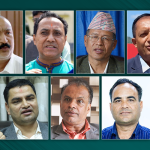
The NSU has long been regarded as an organisation that produces political leaders for the Nepali Congress. The current 15th General Convention provides another illustration, with a significant number of former NSU presidents contesting key party positions.
Kishor Singh Rathore, who is contesting for the post of party president, previously led the NSU representing the Nepali Congress (Democratic) faction during the party split. Rathore entered mainstream party politics through the student organisation and served as the Free Student Union president at Tri-Chandra Campus on an NSU ticket.
Party president Gagan Thapa also rose through student politics and served as NSU general secretary, although he never became the organisation’s president. Another candidate for party president, Shyam Krishna Khadgi, did not have a background in student politics.
Senior Vice President-elect Bishwa Prakash Sharma is also a former NSU president. He was elected president at the organisation’s eighth general convention in 2000.
Two other candidates for vice president, Dhanraj Gurung and Govinda Bhattarai, are also former NSU presidents.
Gurung, who was elected vice president of the Nepali Congress at the previous general convention, is seeking another term in the same position. He took over the NSU leadership in 1996 and led the organisation for seven months. Later that year, the NSU’s seventh general convention elected Govinda Bhattarai as president. Bhattarai is now contesting for vice president of the Nepali Congress.
Ranjit Karn, another vice presidential candidate, also has a history in the student organisation. He led the NSU as president of an ad hoc committee in 2012.
The contest for general secretary also features three former NSU presidents. Pradip Paudel, Gururaj Ghimire and Nain Singh Mahar are all running for the post.
Paudel, who currently serves as Nepali Congress general secretary, is seeking another term. He was elected NSU president at the organisation’s 10th general convention in 2007.
Ghimire was elected NSU president at its ninth general convention in 2002, while Mahar was elected president at the 11th general convention in 2016.
Former NSU president Rajiv Dhungana is also contesting for joint general secretary. He led the organisation as president of an ad hoc committee in 2018.
Several other former NSU presidents are participating in the general convention without contesting for office. Former presidents Balkrishna Khand and Gyanendra Bahadur Karki are among them. Khand was elected NSU president at its fifth general convention in 1987, while Karki became president in 1982.
Meanwhile, the legacy of the NSU is also reflected in the competing convention plans within the Nepali Congress. A faction led by former party president Sher Bahadur Deuba, who was the NSU’s second president, is preparing to hold a separate general convention.
Former NSU presidents Bimalendra Nidhi and NP Saud have openly backed the Deuba faction’s convention plans. Former NSU president Dujang Sherpa, however, has said he will not participate in either faction’s convention. Another former president, Kalyan Gurung, has so far maintained silence over the competing conventions.
The large presence of former NSU leaders in the current leadership race highlights the organisation’s enduring influence within the Nepali Congress, with decades of student politics continuing to serve as a pathway into the party’s senior leadership.