

Kathmandu, October 7
The next time you buy meat in Kathmandu Valley, the government wants to make sure it has already passed a health check.
Starting November 17, the government will begin enforcing the Animal Slaughterhouse and Meat Inspection Act, 1999 across all 21 local levels of Kathmandu, Lalitpur and Bhaktapur.
The law has existed for 28 years but has never been implemented effectively across the country. This time, the federal government, provincial agencies and local governments are preparing to enforce it as a public health measure.
The government says the system is intended to address the widespread practice of slaughtering animals in open spaces, along roadsides and riverbanks, as well as the sale of meat without inspection.
Such practices can increase the risk of zoonotic diseases — infections that can pass from animals to humans.
227 inspectors headed to the Valley
The government has begun preparing the machinery needed to enforce the law. The Ministry of Agriculture, Forest and Environment has assigned 227 veterinarians and meat inspectors to Kathmandu Valley. Kathmandu will receive 137 inspectors, Lalitpur 56 and Bhaktapur 34.
The deployment has been divided among local governments according to population, the number of meat shops and the volume of slaughtering activity.
Kathmandu Metropolitan City will have the largest team, with 53 inspectors. Budhanilkantha will have 16, while Kirtipur and Chandragiri will each have 13. Tarakeshwar will have 10, Tokha eight and Nagarjun seven. Gokarneshwar will have six, Kageshwori Manohara five, Shankharapur four and Dakshinkali two.
In Lalitpur, 33 inspectors will be stationed in Lalitpur Metropolitan City. Mahalaxmi will have 12 and Godawari eight. Konjyosom, Bagmati and Mahankal rural municipalities will each have one.
In Bhaktapur, Madhyapur Thimi will have 12 inspectors, Bhaktapur and Suryabinayak will each have eight, and Changunarayan will have six.
From the animal to the butcher shop
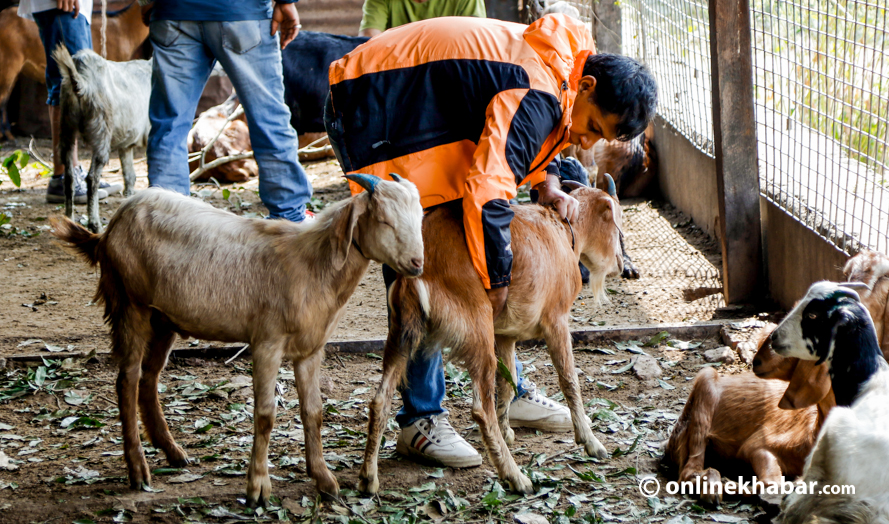
The new system will introduce checks at two points — before and after slaughter. Inspectors will first determine whether an animal is healthy before it is slaughtered. The meat will then be examined to establish whether it is fit for human consumption. Only meat approved by inspectors and bearing an official stamp will be allowed to reach retail outlets.
Dr Umesh Dahal, director general of the Department of Livestock Services, said the purpose was not to shut down existing meat businesses.
“The implementation of this law does not mean displacing existing meat businesses or taking away their livelihoods,” Dahal said. “It is about bringing traditional businesses into a more organised, dignified, modern and legal framework.”
According to Dahal, previous attempts to enforce the law in isolated wards or smaller areas failed to produce lasting results. The government has therefore decided to implement it across the entire Kathmandu Valley at the same time.
He acknowledged that enforcing the law simultaneously across the Valley would be difficult but said the government would continue adjusting its approach based on what it learns during implementation.
13 task forces to support local governments
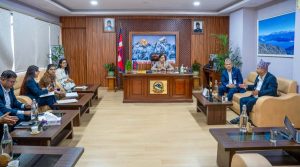
The government has also created a separate monitoring and coordination structure for the rollout. Eight technical joint-secretary-level officials have been assigned to oversee implementation in the three districts.
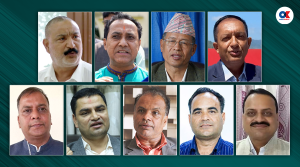
In Kathmandu, the responsibility has been assigned to Dr Binay Kumar Karn, Dr Hemraj Awasthi and Dr Sujan Rana. Dr Barun Kumar Sharma, Dr Sulochana Shrestha and Dr Pragya Koirala will oversee Lalitpur, while Dr Bikash Shrestha and Dr Jagadish Pandey will be responsible for Bhaktapur.
The Department of Livestock Services has also formed 13 task forces made up of under-secretary-level officials. The task forces will work with the 227 inspectors and local governments to provide technical support and monitor implementation.
They will map meat shops and slaughtering locations, assess slaughterhouses against required standards and recommend improvements where necessary. The teams will also meet meat traders and other stakeholders to explain the law and discuss the changes businesses will need to make.
Their field reports will be sent regularly to the department, allowing officials to identify problems and adjust the implementation strategy.
The plan does not stop at Kathmandu
The Valley is only the first step. From January 15, 2027, the government plans to extend the law to all metropolitan cities, sub-metropolitan cities and municipalities outside Kathmandu Valley.
From July 17, 2027, it will be extended to all rural municipalities.
The government’s stated goal is to bring meat production and sales under a system in which animals are inspected before slaughter, meat is checked afterwards, and only approved meat reaches consumers.
After 28 years on the books, the government is now attempting to turn the meat inspection law into a system that consumers can actually see — from the slaughterhouse to the kitchen.