

There was considerable anticipation surrounding Prime Minister Balendra Shah’s address to the United Nations General Assembly in New York.
Shah came to the UN at a particular political moment. He had emerged as prime minister after a major political upheaval, carrying with him expectations that go well beyond those normally placed on a newly elected leader. In Nepal, particularly among young people, there was curiosity about what he would say. The same was true among Nepalis living in the United States and elsewhere abroad.
Would he raise uncomfortable questions? Would he speak about the issues confronting Nepal in a way that went beyond the usual diplomatic language?
After listening to the speech, my impression was that it was thoughtfully prepared and, overall, effective.
It appeared to have been shaped by people who had tried to understand the current global situation, particularly the environmental crisis, rather than simply assemble the standard language of a diplomatic address. Shah, for his part, made a serious attempt to present those arguments effectively.
A question for political leadership
Shah began with an important question — the failure of political leadership.
His argument was that environmental crises are becoming deeper and the damage they cause greater because political leaders have failed to act in time and have remained indifferent to problems that require urgent intervention.
The point was not simply to describe the crisis. It was to argue that much of the damage could still be reduced if political leaders made the right decisions and intervened at the right time.
Infrastructure could be protected. Lives could be saved.
There was a degree of self-criticism in that argument because Shah himself is now part of the political leadership he was questioning.
But his position as a relatively new political leader also gave the argument another meaning. He was, in effect, questioning those who have held power for decades and who have played a major role in shaping the international order.
That question is necessary.
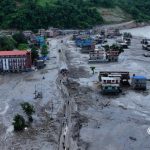
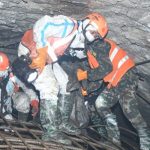
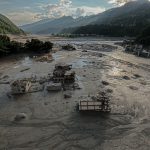
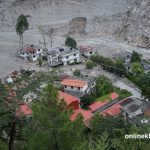
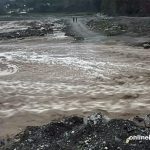
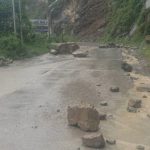
Political failure and political indifference have consequences, and Nepal has experienced them repeatedly. The recent Bhotekoshi floods are only the latest example. Nepal has suffered major disasters before, while elsewhere, including Pakistan and Sikkim, communities have also endured enormous losses.
Shah tried to place those experiences within the larger global climate crisis.
That was one of the stronger aspects of his address.
War, farmers and the global order
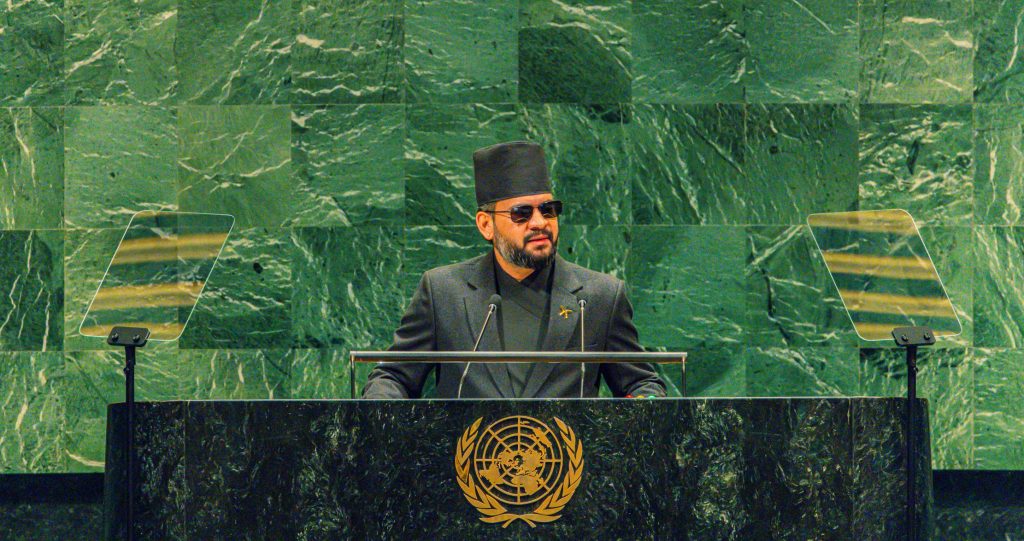
Perhaps the most interesting part of the speech was the way Shah connected war with the predicament of ordinary farmers.
There is an extraordinary contrast in the way the world mobilises resources.
When it comes to war, countries can mobilise enormous amounts of money, technology, logistics and political will. Yet there is no comparable urgency when it comes to ensuring that an ordinary farmer can continue farming.
At the same time, wars disrupt global supply chains. Those disruptions have consequences far beyond the battlefield. They affect the ability of ordinary people to produce food, earn a living and maintain their livelihoods.
Shah used this contrast as a metaphor.
He did not directly name the United States. Nor did he name the powers involved in wars around the world or those providing resources that sustain them.
But the question was there. And because he was raising it from New York, the setting mattered.
The argument was essentially this: If the world can mobilise extraordinary resources for war, why can it not demonstrate the same urgency when ordinary people are facing a crisis that threatens their livelihoods?
Others have raised similar questions, sometimes in much more direct language, at the UN.
But Shah’s use of the farmer-and-war imagery gave the question a particular force.
For Nepal, this is not an abstract argument. Nepali farmers are already experiencing the consequences of environmental and economic disruption.
The speech therefore moved beyond simply saying that Nepal is vulnerable to climate change. It asked who bears the cost of a global system that Nepal has contributed relatively little to creating.
Nepal cannot face the crisis alone
Shah was also clear about one thing. Nepal cannot confront the crisis by itself.
He emphasised cooperation with India and China and appealed to other neighbouring and friendly countries as well. That was important.
Nepal’s contribution to the global environmental crisis is comparatively small, yet the country is paying a disproportionately large price.
Those with greater resources and greater capacity, therefore, have a greater responsibility to contribute.
I had expected Shah to make this point more directly to the United States.
He was in New York, after all, speaking on American soil. I had expected him to explicitly name the United States and ask it to help Nepal.
He did not.
But by speaking about war, global supply chains and the changing global order, he still raised questions that could not easily be separated from the role of the major powers.
That was significant.
Why end with Pashupatinath and Buddha?
The ending of the speech raises a different set of questions.
After speaking about climate change, political failure and the need for international cooperation, Shah concluded by invoking Pashupatinath and Buddha.
He said in Nepali, “May Pashupatinath bless everyone.”
The phrase has a particular political and cultural history in Nepal. It is traditionally associated with the country’s kings and is particularly familiar from former King Gyanendra, who often used it at the end of his speeches.
Shah used it in a similar way, while also invoking Buddha.
There is a positive way to understand this.
He may have been deliberately bringing Nepal’s cultural identity into an international setting. By ending in Nepali and invoking symbols associated with Nepal’s cultural and religious heritage, he was perhaps trying to present a particular image of the country to the world.
But there is another, more critical interpretation.
Shah had spent much of the speech arguing that political leadership has failed.
That criticism can arguably extend beyond national political leaders.
The United Nations itself is part of the global system of institutions created to manage international crises and promote cooperation. If that system is failing to respond adequately to the crises before us, then the failure of leadership cannot be confined to individual governments.
So where does hope lie?
If human beings, political leaders, international institutions and global mechanisms of cooperation are all failing to adequately confront an increasingly severe crisis, what remains?
Shah’s invocation of Pashupatinath and Buddha can therefore also be read as an expression of uncertainty — even despair.
Perhaps the message was that we have reached a point where human institutions are proving inadequate to the scale of the problems we have created.
There is also a more critical question.
Could the speech have ended in a way that was more inclusive, more explicitly hopeful and more representative of Nepal’s identity without relying on a religious invocation?
It could have.
The stronger message was solidarity
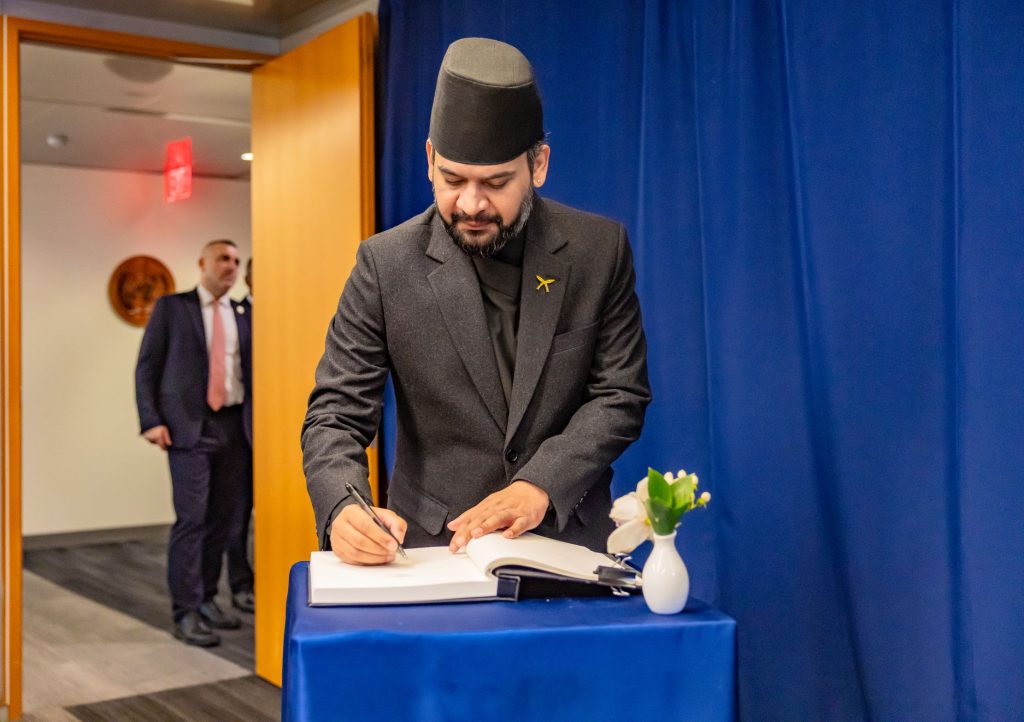
Still, the religious reference should not overshadow the more important message with which Shah was trying to conclude.
Before the final invocation, he repeatedly used phrases such as “Let’s do this” and “Let’s do that”.
Those lines were rhetorical, but they carried a clear message.
Commitment. Recommitment. Solidarity.
Shah was not presenting himself as someone who had come simply to accuse other countries. He was presenting himself as someone seeking cooperation.
That distinction matters.
The speech was essentially saying that the crisis is too large for any one country to solve, and that international cooperation is not optional.
That was perhaps the most constructive part of the address.
A speech is not an achievement by itself
The speech was good. But it could have been better.
Its delivery could have had greater force. The arguments could have been presented with more energy and in a manner that held the audience’s attention more strongly.
There is plenty to debate about how it could have been improved. But there is an even more important point.
This speech is not the end of the story. Nor is it everything.
A powerful speech at the UN does not, by itself, produce a major achievement for Nepal. Neither does an interesting address automatically translate into international cooperation, climate finance or protection from future disasters.
The real test comes afterwards.
What does Nepal do with the arguments it has made? What cooperation does it secure? What commitments does it pursue? And how does the government translate the language of climate justice and international solidarity into actual policy?
Those questions matter even more because of the circumstances in which Shah became prime minister.
He has emerged after a major political transformation, at a time when expectations are unusually high. That makes his appearance on the world stage more consequential than a routine diplomatic speech.
Watching the address from near New York, I felt both pleased and proud.
A young Nepali leader stood before the world and questioned the failures of political leadership. He tried to make sense of a rapidly changing global order. He raised the plight of farmers, the consequences of war and the disproportionate burden carried by countries such as Nepal.
He did not have all the answers. But he asked some important questions. And, at a time when the world is struggling to answer them, that matters.