
The political boundaries we draw across the map of the Himalayas are a dangerous fiction. They may make sense on a government map, but they mean very little to a mountain, a glacier or a river. While diplomats and governments dispute over lines, the mountains themselves operate on a completely different scale.
Natural hazards do not respect national sovereignty. They need no visa to cross borders, nor do they wait in the queue at immigration. A landslide does not stop at a checkpoint. A flood does not check which side of a river it is on. A collapsing glacier certainly does not care where one country’s territory ends and another begins.
If we continue to govern these hazards through the narrow lens of administrative borders, we are not merely failing to prepare for disaster. We are actively choosing collective disaster.
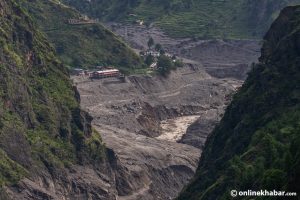
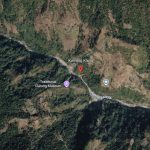
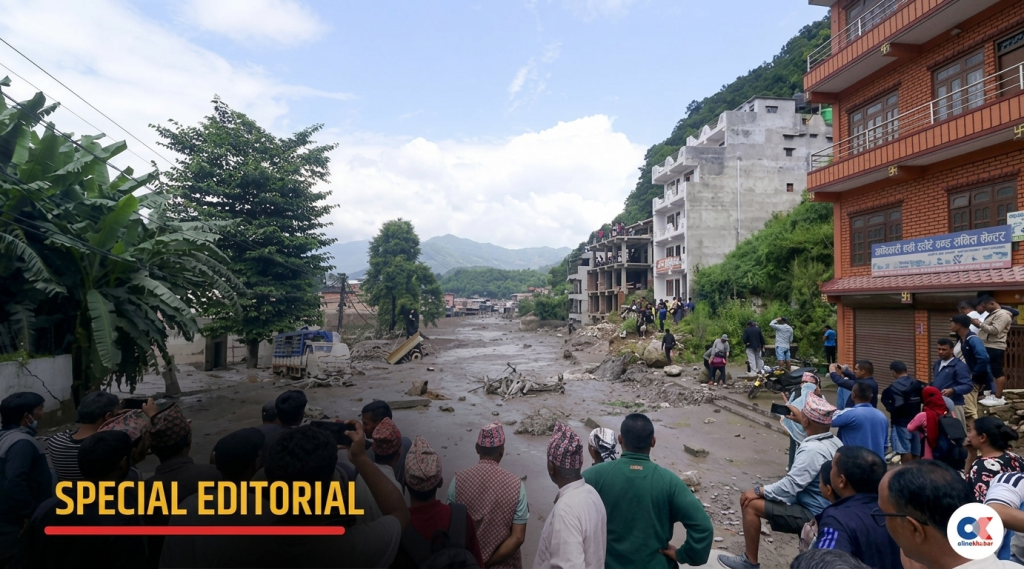
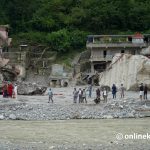
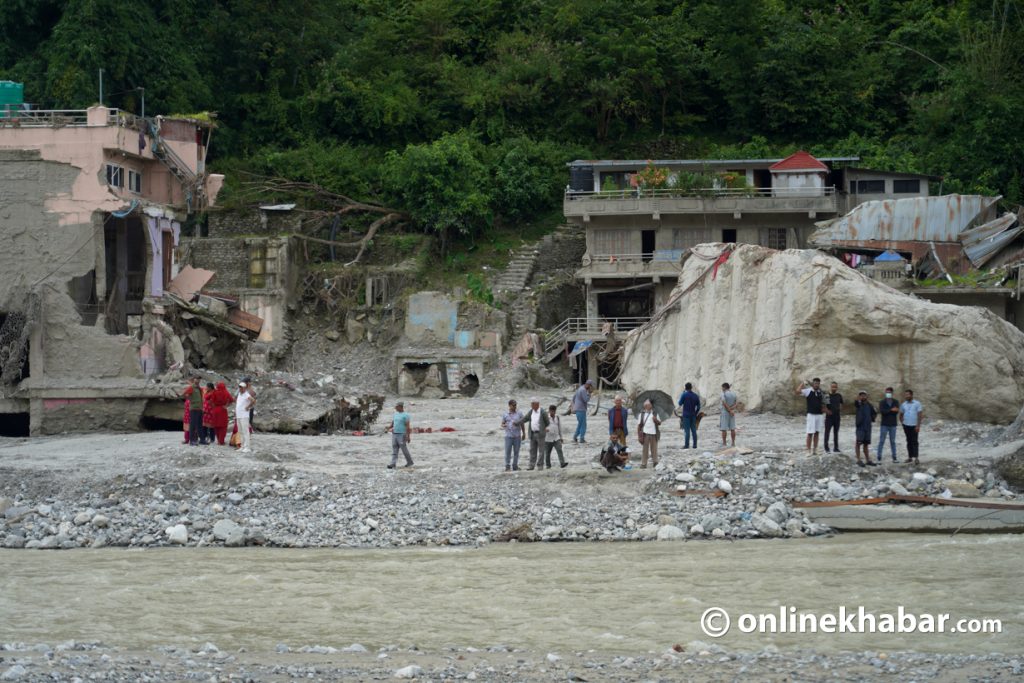
The terrifying velocity of the Bhotekoshi event in Rasuwa district of Nepal is a recent example of what this looks like in practice. Recent satellite images and publicly available videos show that a bedrock and glacial collapse originated on the Nepal side, near the China border, on the backside of the Langtang range. It triggered a cascading flood that surged northward across the international boundary.
That should force us to confront an uncomfortable reality that our traditional systems of disaster management are simply not designed for the speed and scale of the hazards we now face.
When a devastating mountain fracture can cross a border in the time it takes to make a cup of tea, our traditional, localised communication models are fundamentally outmatched by the catastrophic scale of modern disasters like the Rasuwa flood.
It is easy to blame these tragedies on a lack of bilateral data sharing. Better data sharing is certainly necessary, but that diagnosis does not tell the whole story. For sudden cryospheric collapses, the fundamental challenge is not simply the inability to share data. It is the physical limitation of knowing where and what to monitor in real time across a massive, inaccessible landscape.
It is, quite literally, like trying to pinpoint microscopic fractures across the vast Himalayan range.
That is the scale of the problem we are dealing with. And pretending otherwise will not make the mountains any safer.
We must also accept a reality that is uncomfortable but unavoidable: some of the damage to our mountains is already done, and it cannot be undone. We cannot unmelt a glacier. We cannot reverse every ecological change that has already taken place. And we cannot simply wish away the increasingly severe climate impacts that Nepal now faces every single year.
We have been seeing this at every global climate summit, like COP, where leaders endlessly debate the Loss and Damage Fund. For Nepal, however, this fund cannot remain a theoretical concept or another diplomatic talking point that disappears once the summit ends.
Nepal is now in a powerful position to demand Loss and Damage funds. And we should. This is not charity. It is a matter of survival.
Nepal contributes about 0.1% of global carbon emissions and yet is being forced to endure climate calamities year after year. We should not have to apologise for demanding resources to deal with destruction we did so little to create.
The global promises on climate finance must therefore become physical funding on the ground. They must rebuild communities, restore infrastructure and compensate people for damage that cannot simply be adapted away.
Nepal must strategically combine the global Loss and Damage Fund with international grants and loans to restore what has been lost and protect our future.
First, the Loss and Damage Fund must be used as direct, non-repayable compensation to cover what is permanently lost. This money must go directly toward rebuilding shattered communities in valleys and river basins, restoring destroyed public infrastructure such as roads and bridges, and compensating families who have lost their houses, land and livelihoods.
A developing nation should not have to take on debt to pay for damages it did not contribute to.
That is not simply an economic argument. It is a matter of climate justice.
Second, we must secure climate grants from wealthier nations to build long-term resilience. These funds should be prioritised for scientific research and technology, setting up transboundary monitoring systems and early warning systems along river basins, and conducting multi-hazard risk assessments.
This is no longer a luxury or an academic exercise. It is an absolute necessity for our new reality.
Finally, like any other developing country impacted by disaster, Nepal must utilise concessional soft loans from bilateral cooperation and development banks. But we must be clear about how this money is used. These funds should never be used simply for relief or cleaning up disaster damage. They should be strictly spent on building resilience to withstand devastating compound hazards in the future.
We cannot keep rebuilding the same roads, bridges and settlements after every disaster and call that resilience.
Yet our response to this escalating threat, and the scope of coordination required, remains characterised by a profound blindness toward the socio-economic drivers of vulnerability.
I reject the naive, detached notion that we can manage this crisis by simply ordering vulnerable populations to pack up and move away from active hazard zones.
It is an easy solution to propose from a distance. It is also a deeply unrealistic one.
People live, work and build in these dangerous valleys because of economic realities and the pursuit of their livelihoods. They are not living there because they have failed to understand the risks. They are there because this is where jobs, trade, transport and economic opportunity exist.
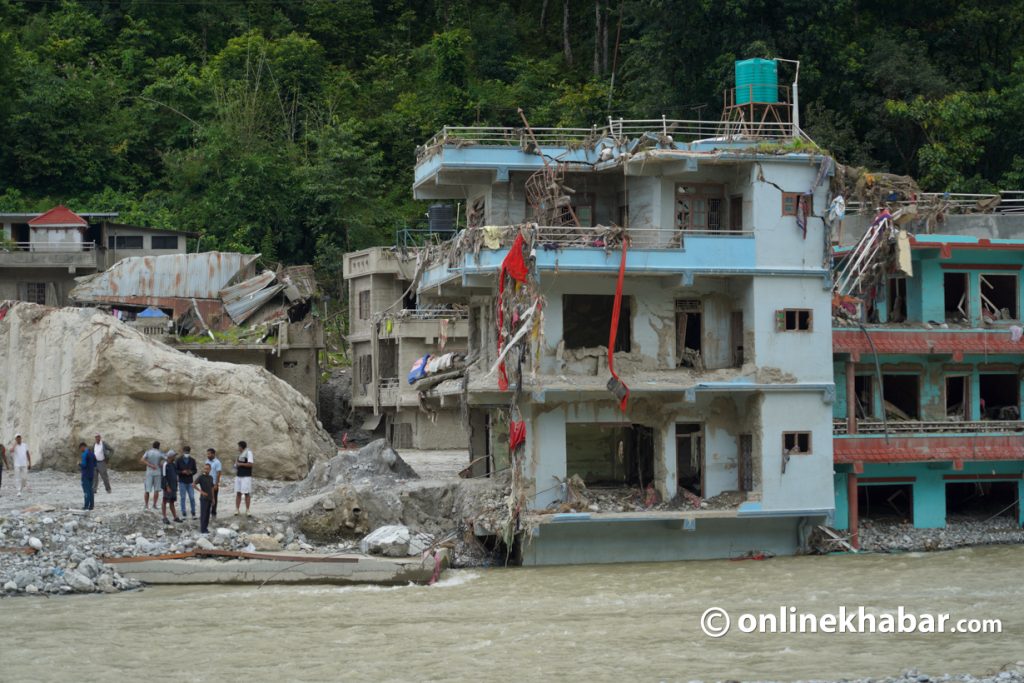
Rasuwa has served as a major transit point for more than a decade now, leading to rapid urbanisation and unplanned settlements. Aggressive hydropower development has pulled thousands of workers into intensive projects directly in the path of active landslides, floods and earthquakes.
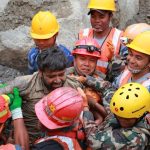
We have seen workers trapped inside tunnels, demonstrating the devastating human cost of isolated infrastructure planning.
These are not simply unfortunate consequences of development. They are warnings about how we are developing.
It is vital to recognise that vulnerability and risk are not merely natural outcomes. They are systemic byproducts actively shaped by our economic choices.
We cannot halt development in these regions. Nor should we pretend that stopping development is a realistic or desirable answer for communities that depend on it. Our only ethical path forward is therefore to make development risk-informed.
If we are going to build in the mountains, we have a responsibility to understand the mountains.
To do this, we must stop treating one country, one settlement or one project as an individual entity. We must also stop treating one event as simply a flood, landslide or GLOF affecting several people or pieces of infrastructure.
A disaster occurring in one river basin can instantly devastate communities and assets downstream.
The watershed, not the administrative boundary, must therefore become the basic unit of planning, monitoring and coordination.
This requires us to think differently about disaster risk. We must replace single-hazard assessments with multi-hazard risk assessments that evaluate the combined forces of seismicity, shifting seasonality, climate change and population movement.
The government needs to proactively develop a framework that integrates national and local governments, authorities, scientific institutions, private developers and mountain communities into one cohesive planning structure.
The alternative is to continue planning in silos and then act surprised when the hazards refuse to do the same. Effective disaster management also requires mastering two operational timelines.
The first is long-term strategic planning. The second is immediate, real-time crisis response. These are not competing priorities. We need both.
Strategic resilience relies on sustained scientific research, multi-hazard assessments and basin-level diplomacy. Immediate response, meanwhile, hinges on rapid cryospheric monitoring and localised action.
We must aggressively finance early warning systems capable of operating during high-velocity mountain collapses.
When the warning window is exceptionally brief, even a few minutes of advance notice can mean the difference between life and death for downstream populations and workforce infrastructure.
Ultimately, we must recognise what the melting of our glaciers and the fracturing of our peaks really represent: a physical bill being handed to a country that is being forced to pay for it with the lives and livelihoods of its people.
We did not create this crisis, but we are living with its consequences.
While we fight to buy precious minutes of lead time through early warning systems, the global community must accept that some climate destruction is already too severe for traditional adaptation.
This is precisely why the Loss and Damage Fund cannot remain an empty diplomatic promise.
It must materialise on the ground.
It must pay for the irreversible damage done to our mountain valleys. It must help rebuild shattered communities, establish transboundary safety networks and protect the workers building our future.
And Nepal should not approach this as a passive recipient waiting for generosity. We should demand it as a matter of climate justice and survival.
The accelerating pace of climate-induced hazards can tempt observers into passive acceptance. It can make the scale of the problem seem so overwhelming that inaction begins to feel inevitable. It is not.
Giving up is not an option.
The crisis is urgent, but it is not hopeless. We have choices about how we respond, how we build, how we monitor our mountains and how we protect the people who live and work in them.
But those choices cannot wait.
If the international community finally acts on its moral obligation to fund our survival, and if Nepal finally treats disaster risk as a central part of development rather than an afterthought, the decisions we make today will decide who lives and who dies tomorrow in the shadow of the Himalayas.