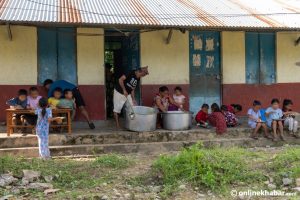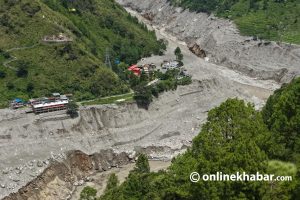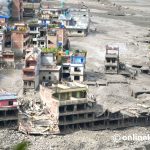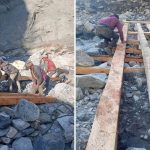

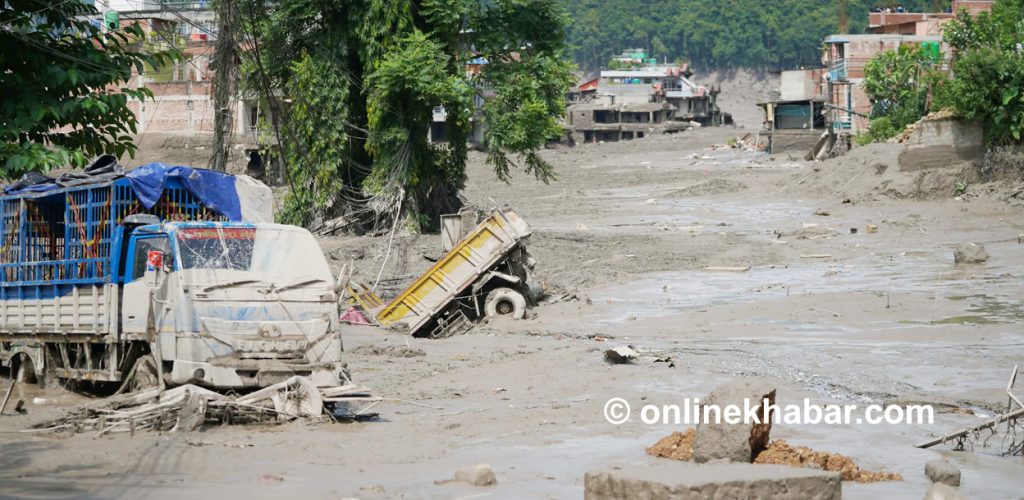
When the Bhotekoshi River flash-flooded on the morning of August 26, families mainly in Rasuwa and Nuwakot districts had little time to run and no time to save anything. Homes, livestock, land documents, bank cheques and ATM cards, and life savings kept in cash at home were gone within minutes.
So far over 1,300 lives have been confirmed lost, thousands remain missing, and more than 17,000 children are now in urgent need of humanitarian assistance. The immediate story, the one filling the news bulletins, is one of rescue and grief. But another crisis is already beginning, and it will unfold over the coming months largely out of the headlines: a household-level financial crisis, in which families with no savings, no insurance, and no documentation to prove what they owned are left to rebuild their lives with nothing to rebuild them on.
Approximately Rs 50 billion in aid support, including domestic and international pledges, has been collected for flood victims to sustain emergency response and support recovery. This aid is essential, and it is saving lives right now. But relief funding has a shelf life measured in weeks, while rebuilding a home, a hectare of farmland, or a small shop takes years.
Nepal’s own experience from the 2015 earthquake is instructive here: many households that lacked savings, insurance, or access to formal credit turned to informal moneylenders to rebuild, often at high interest rates that took years to repay. For many families, the financial struggle began exactly when the aid ended.
The cost of that gap is now being counted, and almost none of it will be paid by an insurer. According to a commentary published by the global insurance rating agency AM Best just days after the disaster, insured losses from this flood are expected to be modest relative to the scale of economic damage, largely because insurance penetration in Nepal remains among the lowest in Asia.
Whatever coverage does exist is concentrated in commercial risk — hydropower plants, infrastructure, cross-border trade — not in the homes, farmland, and small businesses of ordinary families in flood-prone valleys. Even large infrastructure isn’t fully protected: the flood damaged or destroyed 14 hydroelectric projects, wiping out 12 percent of the country’s generating capacity, much of it uninsured. Small shop owners, ordinary farmers, and daily-wage households are in a far weaker position. What’s left for them is debt, migration, or relief that won’t last.
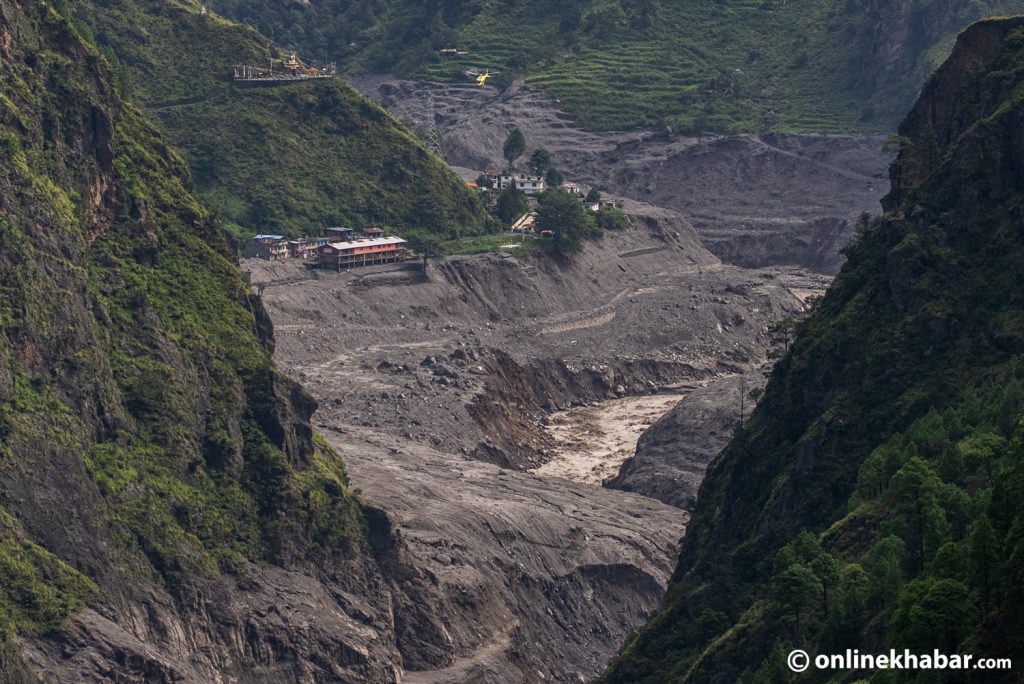
It should not have been a surprise. Nepal has watched this pattern build for years. In 2021, a sudden debris-flow devastated Melamchi in Sindhupalchok. In 2024, heavy monsoon rains killed over 300 people and caused billions of rupees in damage nationwide, including in Kathmandu itself. In 2025, a glacial lake outburst flood in Rasuwagadhi swept away the Nepal-China Friendship Bridge and halted cross-border trade for months. Scientists have long warned that Langtang’s thinning glaciers make further collapses and outburst floods increasingly likely. The physical risk, in other words, was known. What was missing was financial readiness to absorb the shock, at both household and national level.
The case for financial preparedness literacy is not simply that disasters happen. It is that in developing countries like Nepal, a handful of structural weaknesses amplify disaster risk into something far more damaging than the disaster itself. Three stand out. First, the informal economy: a majority of Nepali households earn and hold wealth outside the formal financial system in the form of cash, land, livestock, or unregistered savings groups that vanish or lose all value the moment a flood hits. Second, the near-absent insurance penetration described above means the shock is absorbed almost entirely by the household itself, with no one to share the loss. Third, poor formal credit access pushes desperate families toward informal moneylenders at predatory rates, precisely when they are least able to negotiate. These are common features of most climate-exposed developing countries.
A household that has never been shown how insurance works, how to access formal credit, how to protect documents, or how to build even a small emergency reserve cannot reasonably be expected to make sound financial decisions in the middle of a crisis. That is not a failure of the household, but rather a failure of preparation. This is precisely what financial preparedness literacy addresses: building something more structural, well before the disaster. Call it the SHIEL approach: five pillars that turn a vague call for “financial literacy” into something a government or a cooperative can actually build.
- Savings and community reserves. Grow cooperative and community-based emergency savings schemes, so households enter a disaster with a buffer they built themselves.
- Hazard insurance for households. Expand affordable micro-insurance for homes, crops, and small businesses in known high-risk zones — not just hydropower and infrastructure.
- Information and document protection. Help families digitize land records and identification before disaster strikes, so financial identity survives even when the paper doesn’t.
- Efficient access to relief. Simplify relief packages and government’s compensation schemes so households can claim them without hassles.
- Literacy and digital access. Teach basic budgeting and safe borrowing, backed by mobile savings that work when banks and roads don’t.

We can learn from international experiences. For instance, in Bangladesh, the long-running Cyclone Preparedness Program pairs early-warning systems with community-level organization, including guidance on protecting essential documents and valuables before a storm — a low-cost intervention that has measurably reduced both loss of life and post-disaster financial disruption over decades. Kerala (India) took a different piece of the puzzle: after catastrophic flooding in 2018, the state government and its banks introduced loan moratoriums and restructured repayment terms for affected borrowers, buying families time instead of pushing them into default. Likewise, in the Philippines, microinsurance distributed through cooperatives has given even low-income households modest payouts after disasters without depending on ad hoc charity.
Experts agree on one thing: glacial collapse and monsoon flooding are not going away in Nepal’s mountains, and a warming climate may only make them more frequent. Aid will always have a role in the first days after a disaster like this one, and no one should begrudge the families of Rasuwa, Nuwakot, and Dhading the support reaching them now. But the real question is: what happens after the aid runs out? A model built around handouts leaves households waiting, after every disaster, for someone else to decide their financial future. We should build one around financial preparedness literacy instead, so that households walk into the next flood already knowing how to act.