

Syabrubesi, September 3
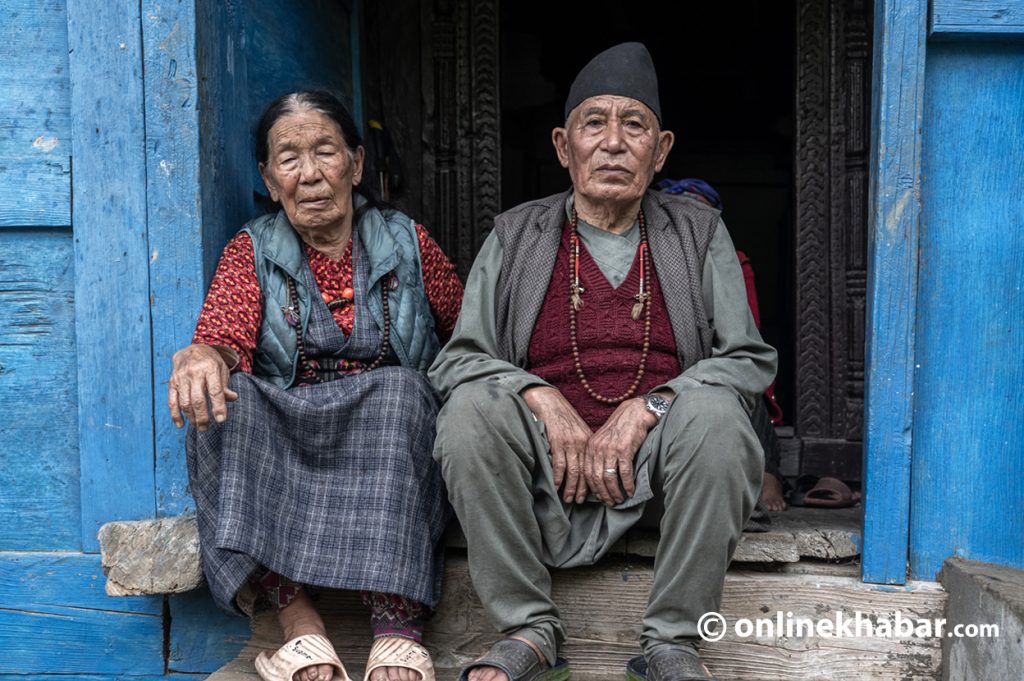
Dawa Finjo Tamang is 91 and needs support to walk. Yet since the Bhotekoshi flood swept through Syabrubesi, he has been going from house to house in his neighbourhood, trying to comfort families who have lost loved ones.
When Onlinekhabar’s team reached the small village of Bharkhu in Gosainkunda Rural Municipality-5 on Tuesday afternoon, Dawa was returning from such a visit.
“A neighbour lost his son,” he said, drawing a long breath. “His daughter-in-law keeps crying, so I went to comfort her.”
The neighbour’s 24-year-old son, a driver, disappeared when the Bhotekoshi flood swept through Syabrubesi Bazaar. He had become the family’s main breadwinner. His mother has been unable to stop crying.
Dawa keeps going to comfort them, drawing on his age and experience. But he has his own grief to carry.
Standing beside his 86-year-old wife, Chenga Yangjen, he asked: “Should I walk around comforting others, or should I be comforting myself?”
A family built around a hotel
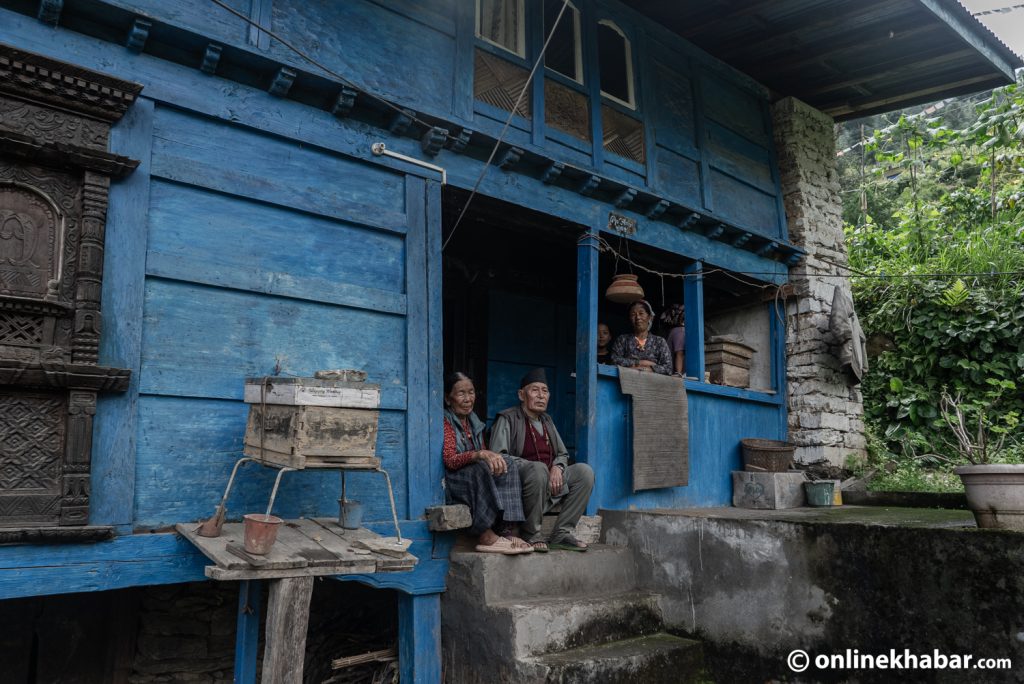
Dawa’s son, Furpasang, owned the Buddha Guest Hotel in Syabrubesi.
The hotel had grown over generations, built on ancestral property and four generations of family work. In recent years, Dawa’s grandson Tindu Chhiring had taken over its day-to-day operation.
Dawa was proud of him.
“My grandson knew so many people. Buses carrying pilgrims to Mansarovar used to fill the hotel,” he recalled. “People coming from Kathmandu would stay there by asking for my grandson by name.”
Travellers from China, India and other countries also stayed at the hotel.
Furpasang and Tindu would tell Dawa and Chenga to stay at the hotel and rest. With two great-grandchildren growing up around them, the couple enjoyed spending their later years in Syabrubesi.
“My son had the biggest hotel,” Dawa said. “Last year, my daughter-in-law was honoured as the owner of the number one hotel in all of Rasuwa.”
Dawa estimated that the hotel was worth at least Rs 25 crore.
For the couple, the journey from their ancestral home in the steep village of Bharkhu to a multimillion-rupee hotel business in Syabrubesi had been a source of immense pride.
Then age began to catch up with Dawa.
His eyesight deteriorated, and Furpasang took him to Kathmandu for treatment. After his latest treatment, Dawa and Chenga returned to Syabrubesi on August 21.
But a relative had died in Bharkhu, and instead of staying at the hotel, the couple decided to return to their ancestral home to offer their condolences. Furpasang himself accompanied his parents to Bharkhu.
Less than a week later, on August 26, the unimaginable happened.
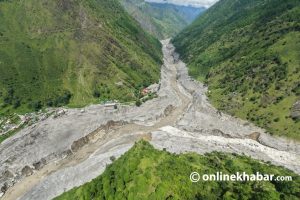
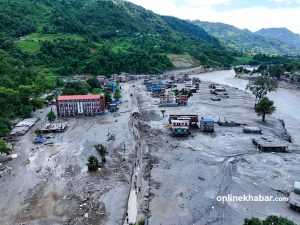
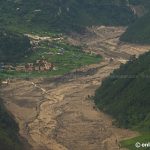
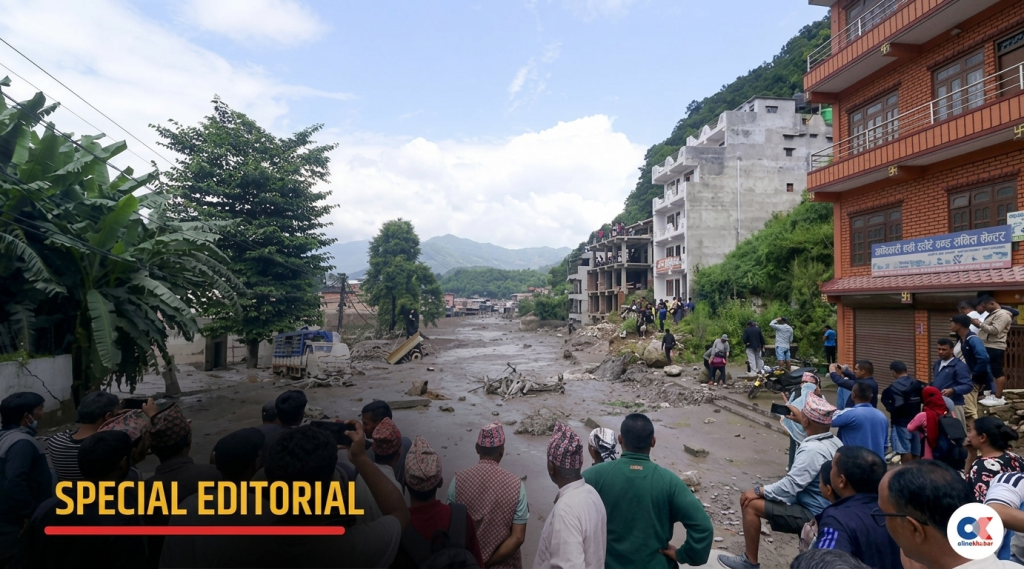
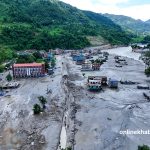
The Bhotekoshi surged. Syabrubesi Bazaar was swept away.
“It sounded like a helicopter,” Chenga recalled. “When I came outside and looked, I saw the sky filled with clouds. It had taken everything.”
By the time they saw Syabrubesi again, the market was gone.

As Chenga recalled the family they had left behind, there was little chance of holding back her tears.
Dawa listed them one by one: his son Furpasang, daughter-in-law Chetin, grandson Tintu Chhiring, granddaughter-in-law Yangji, great-grandson Kalsang and a worker.
For four or five days, the couple held on to the hope that they might have been stranded somewhere in the forest. As the days passed, that hope began to fade.
“Furpa had said he would come to get us after a week,” Chenga said.
Young people from the village later showed the couple photographs of Syabrubesi, after the flood.
“The tall hotel is not there anymore,” Chenga said, giving up hope. “How could they have survived?”
The decision to stay in Bharkhu for a week had saved Dawa and Chenga. But surviving while losing three generations of their family has brought its own unbearable grief.
Their two sons, one living in Britain and the other in Australia, are preparing to return to Nepal. The couple has not yet been able to tell their youngest great-grandchild, who studies in Kathmandu, what has happened.
‘This time, it was a ghambal’
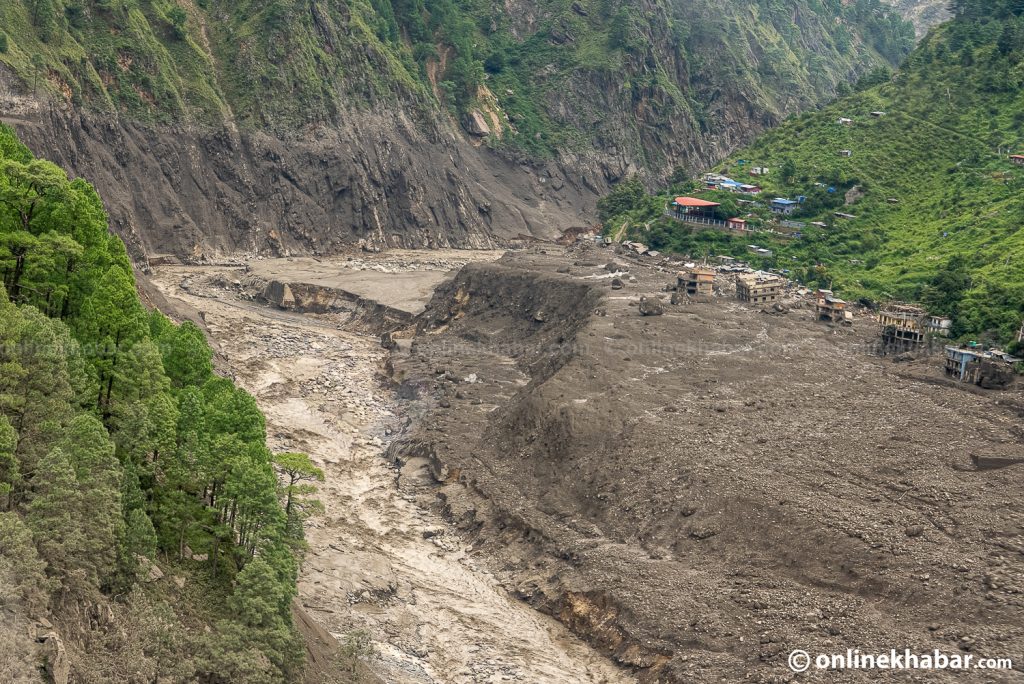
Dawa’s ancestors have lived in Bharkhu for 15 generations. He cannot remember the Bhotekoshi ever rising with such force.
“Our ancestors came here from Nuwakot 15 generations ago,” he said. “If a disaster like this had happened before, we would have left this place long ago.”
He remembers a major flood in 2018 and another last year. Neither, he said, swept away Syabrubesi.
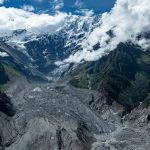
His ancestors had always warned of the possibility of a flood powerful enough to carry away bridges, villages and roads if a glacial lake burst.
“I had heard that a ghambal — a flood caused by a glacial lake outburst — can pass over bridges,” he said. “That is what happened this time.”
The flood has touched almost every family in small Bharkhu.
Dawa’s neighbours, Mewang Tamang and Gangdhram Lhamo, have also lost sons.
“In this small village of Bharke alone, 35 people are missing,” Mewang said.
The figure was compiled by members of the Tamang community in Bharkhu. Unable to go out themselves to search, they have been counting relatives who have not made contact as missing.
“Where can we go to search? How can we go?” Mewang said. “Even when we hear the Bhotekoshi roaring, people in their homes are frightened.”
When the Onlinekhabar team left Mewang’s house, the family was still staring silently towards the river.
A village divided by the flood
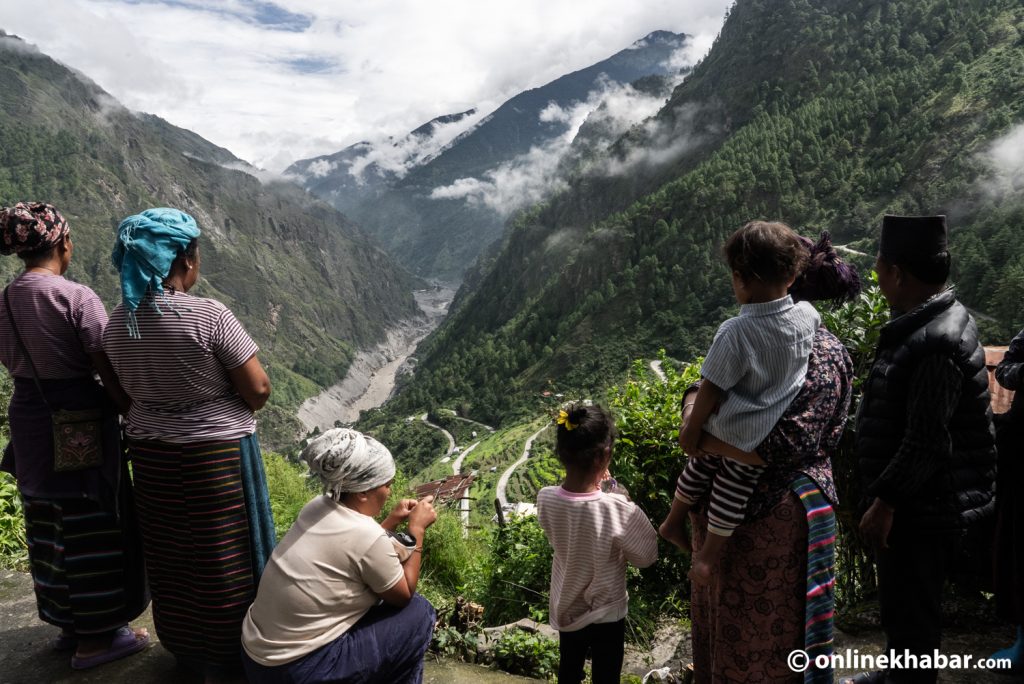
The grief of Dawa, Mewang and Gangdhram is shared across Syabrubesi.
Dawa Mingmar Tamang, the ward chairperson of Gosainkunda Rural Municipality-5, is missing. Pratima Tamang, vice-chairperson of Gosainkunda Rural Municipality and a local resident of Syabrubesi, is also missing.
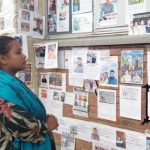
No reliable count has yet been established of how many people are missing, how many have been found alive and how many have been found dead. Families have been keeping their own lists of missing relatives.
“Thankfully, I survived, but all my relatives are missing,” Tharjen Dolmo Tamang said through tears.
An administrative assistant at the Chilime Hydropower Project, Tharjen had been preparing to leave for work when the flood struck.
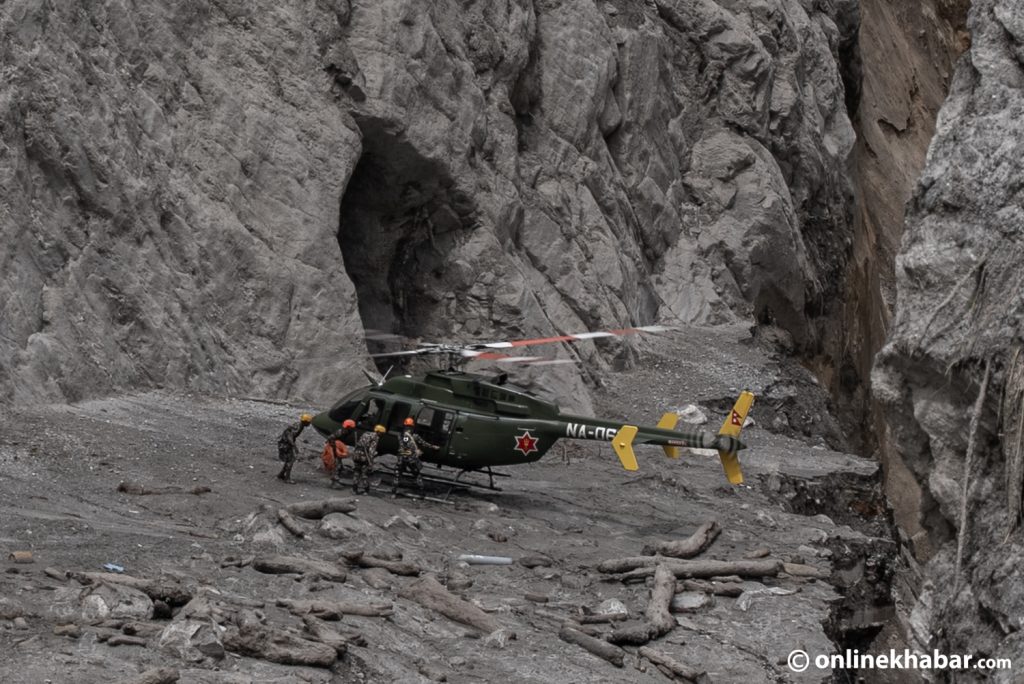
“I managed to escape. My house was buried in mud. I cannot even bear to remember that day,” she said. “Six of my colleagues are trapped inside the powerhouse.”
Despite repeated efforts by the Nepal Army and the Nepal Electricity Authority, those trapped inside the powerhouse have not yet been rescued.
“Everyone from the office and from my family is missing,” she said. “We watched our settlement and our market disappear before our eyes.”
Where the market once stood, there is now only a riverbed. Tharjen’s sister’s son, her brother-in-law and her brother-in-law’s husband are also buried in Syabrubesi.
“I have lost hope now. So many days have passed,” she said.
According to Gosainkunda Rural Municipality, Syabrubesi has a population of 2,462, including around 450 elderly people. There is still no preliminary estimate of how many of them survived. Thats not all, the flood has also physically split Syabrubesi into four sections.
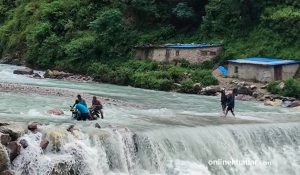
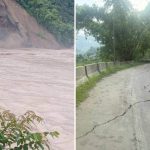
Crossing the Bhotekoshi is no longer possible. The flood also swept away the bridge over Bharkhu Khola at Dobhan, dividing the settlement further. People cannot simply walk from one part of the village to another.
Telephone networks, roads and bridges have all been severed, leaving even survivors unable to meet relatives who may still be alive.
“Even if there were a suspension bridge, a rough road or an environment where phones could connect, the survivors would at least be able to breathe a little easier,” Mewang said.
“We are in disbelief. We had never in our wildest dreams imagined that such a disaster could strike Syabrubesi”.