

Kathmandu, August 29
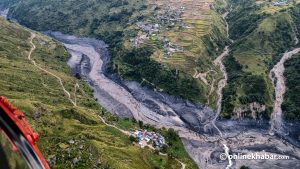
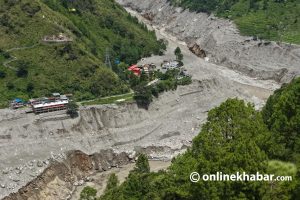
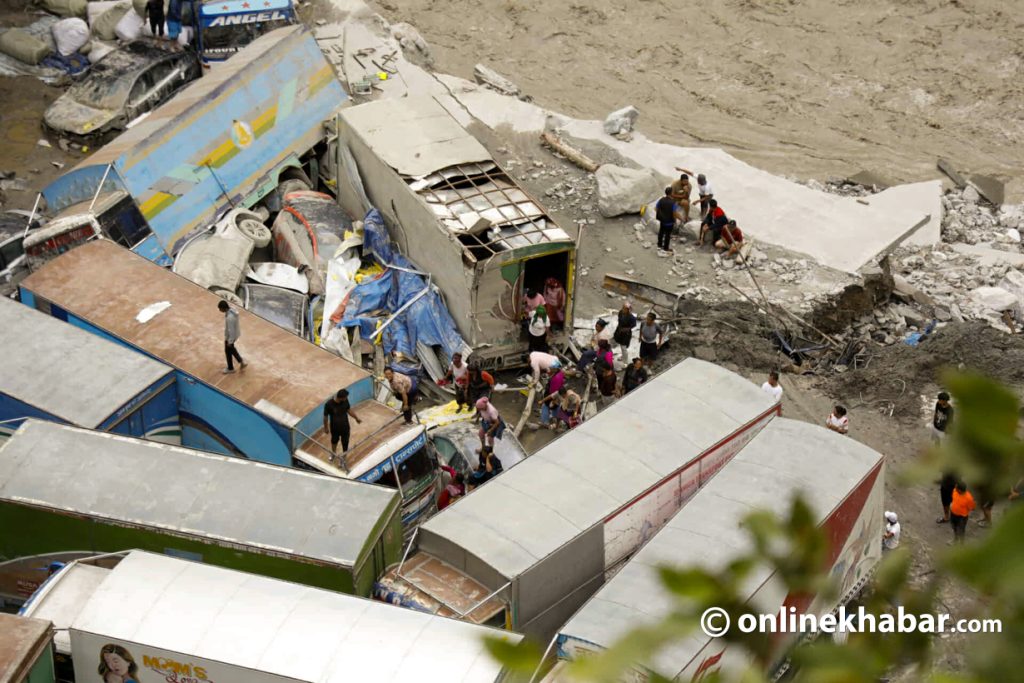
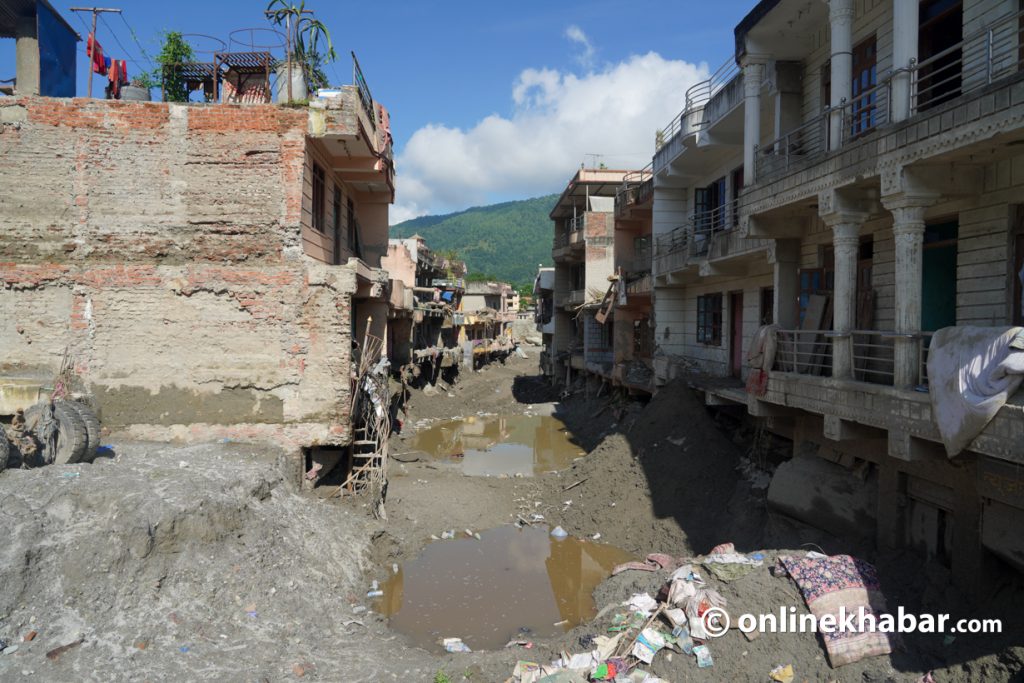
The devastating floods in Rasuwa’s Bhotekoshi River have killed more than 600 people, but most of the bodies recovered so far remain unidentified.
As bodies swept away by Wednesday’s floods continue to be recovered across several districts, authorities are facing a new challenge: there is simply not enough space to store them.
Some bodies have already begun decomposing in the heat, creating a growing risk of foul odour, infection and public-health problems. With morgues and available refrigerated storage unable to accommodate the large number of bodies, the government has decided to temporarily bury unidentified bodies until they can be identified and handed over to their families.
But why was burial chosen? How will the identities of the dead be preserved? And what happens if relatives come looking for a body later?
Here is what officials and forensic experts say.
Why are the bodies being buried?
The immediate reason is the lack of adequate facilities to store such a large number of bodies.
According to Nepal Police, bodies have so far been recovered in Rasuwa, Dhading, Gorkha, Nawalparasi East, Nuwakot, Chitwan, Tanahun and Nawalparasi West.
Chitwan has recorded the highest number, with 233 bodies recovered, followed by 158 in Nawalparasi East, 54 in Gorkha, 49 in Dhading, 47 in Nawalparasi West, 41 in Nuwakot, 31 in Tanahun and 13 in Rasuwa.
Relatives of many of the victims have also been unable to reach the recovery sites because roads have been destroyed or remain inaccessible.
The large number of bodies recovered at once has overwhelmed existing morgues and refrigerated storage facilities.
According to the Ministry of Health, government and private health institutions across Nepal have refrigerated capacity for around 600 bodies. However, much of that capacity cannot be used for the flood victims because the bodies have been recovered across geographically dispersed districts.
In Chitwan alone, health facilities have a combined capacity to store only around 50 bodies. Even that capacity has been strained, with some hospital freezers already occupied by unidentified bodies.
Authorities say there was not enough time or available infrastructure to immediately establish additional cold-storage facilities, temporary morgues or refrigerated containers.
As a result, temporary burial has been adopted as a last-resort preservation measure.
Police Inspector Anil Thapa says decomposition has already begun.
“The bodies have started decomposing. As decomposition progresses, the smell is spreading. We are burying them to prevent the risk of epidemics and infection,” Thapa said.
According to him, the smell has begun spreading up to 1.5 to two kilometres from some locations where bodies are being kept, affecting patients at nearby hospitals as well as local residents.
Why not simply keep the bodies in cold storage?
Refrigeration remains the preferred option when large numbers of bodies are recovered after a disaster.
International Committee of the Red Cross (ICRC) guidance recommends keeping bodies at around 2–4 degrees Celsius in refrigerated containers or other suitable cold-storage facilities wherever possible.
But when adequate refrigeration is unavailable, temporary burial in a safe location can be used to preserve the bodies until they can be identified and returned to their families.
Senior forensic expert Dr Gopal Chaudhary of Tribhuvan University Teaching Hospital says temporary burial is not the same as a final funeral.
“Temporary burial means documenting all the details of the deceased, taking photographs and DNA samples, and burying the body underground in a safe place until relatives come forward,” he said.
The objective, therefore, is not to dispose of unidentified bodies but to preserve them in a way that allows identification and recovery later.
Why couldn’t additional morgues or refrigerated containers be set up?
The scale and geographical spread of the disaster have made the problem more complicated.
Bodies have been recovered from several districts stretching from Rasuwa towards Chitwan and Nawalparasi. No single hospital or institution has enough capacity to store all of them for an extended period.
Hospitals normally have morgues designed for routine requirements, not for hundreds of bodies arriving simultaneously following a major disaster.
At the same time, authorities have to carry out postmortems, document bodies, photograph identifying features and collect DNA samples.
In Chitwan, Bharatpur Hospital has formed seven forensic teams to carry out postmortems and collect DNA samples, with forensic specialists from hospitals including Bheri Hospital and Lumbini also providing assistance.
With existing storage facilities overwhelmed and additional refrigerated infrastructure not immediately available, officials opted for temporary burial.

How will the bodies be buried?
Authorities say the bodies will not be dumped together in an unidentified mass grave.
Each body will be individually documented and assigned a unique identification number before burial.
The documentation includes photographs of the face, tattoos, injuries, scars and other distinguishing physical features. Clothing and other belongings found with the body will also be recorded.
A legal document will be prepared for each body, while DNA samples will be collected and preserved.
More than 100 bodies had already undergone DNA profiling by Saturday afternoon and were being prepared for burial.
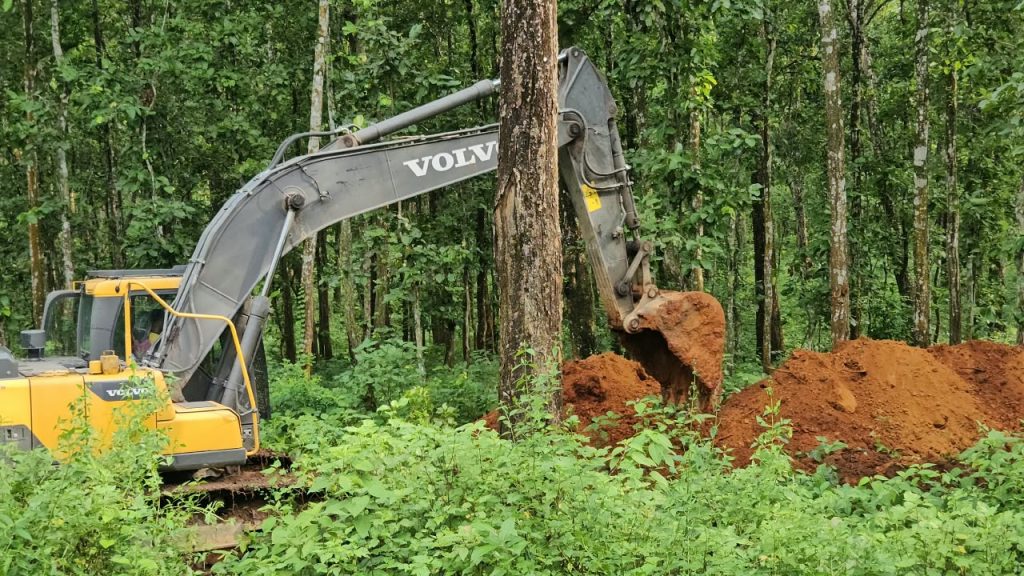
Bodies began being buried on Saturday afternoon in a forested area between Ramnagar and Devghat in Bharatpur Metropolitan City-1, according to the authorities.
The graves are being dug to a depth of around 1.5 metres while avoiding damage to the surrounding sal trees. A gap of around 40 centimetres will be maintained between individual bodies.
The body bags will carry identification numbers, and corresponding markers will be placed at the burial sites.
Authorities will also photograph and record the burial process and maintain GPS coordinates and mapping data showing the exact location of each body.
The burial area will subsequently be fenced off or otherwise secured.
What happens if a body is later identified?
Temporary burial does not close the possibility of identification or recovery.
If relatives later come forward, authorities can compare information provided by the family with the records, photographs and other evidence collected before burial.
DNA testing can then be used to confirm the identity.
If a match is established, the body can be exhumed and handed over to the family for funeral rites according to their religious and cultural practices.
Inspector Thapa said the burial system has been designed specifically to make such future recovery possible.
“If a DNA match is established in the future and the family wants to perform the final rites according to their religion and culture, the body can be exhumed and handed over to them,” he said.
Dr Chaudhary said the same procedure can be followed by comparing DNA from relatives with samples collected from the bodies.

What happens to body parts recovered separately?
The floods have severely damaged some bodies, and body parts have been recovered separately from different locations.
These will also be documented and preserved in the same manner as complete bodies.
DNA samples and identification numbers will be assigned so that individual remains can potentially be linked to a victim later.
Will the bodies decompose underground?
Yes. Burial does not stop decomposition.
However, forensic experts say decomposition can be slower underground than when a body is exposed in the open.
According to Dr Chaudhary, the rate of decomposition is comparatively slower underground, meaning a body may remain in a relatively better state for a period of time.
The purpose of burial is therefore not to prevent decomposition indefinitely. Rather, it is to slow the process, control the immediate public-health and environmental problems caused by exposed bodies, and preserve the possibility of identification and future exhumation.
Why is location and record-keeping so important?
The entire process is designed to ensure that authorities can locate an individual body even years after burial.
Each body will have a unique identification number. The same number will be recorded in official documents, on a marker associated with the burial site and in forensic records.
GPS coordinates, photographs and videos of the burial location will also be preserved.
A concrete marker indicating the identification number will be placed near each burial site so that the location of a particular body can be traced later.
Has Nepal used temporary burial before?
Yes. A similar system was used following the 2015 earthquake when unidentified bodies had to be managed after existing facilities were overwhelmed.
According to Dr Chaudhary, 32 bodies were temporarily buried on the premises of Tribhuvan University Teaching Hospital following the earthquake.
Some foreign families came searching for their missing relatives years later. DNA testing helped identify two of the bodies, which were subsequently exhumed and handed over to their families.
Dr Chaudhary says around 30 bodies buried during the earthquake still remain on the teaching hospital premises.
How long must unidentified remains be preserved?
According to Dr Chaudhary, Nepal’s legal provisions require unidentified bodies and remains to be preserved for an extended period.
He says unidentified bodies and remaining bones or other remains are required to be preserved for up to 12 years.
“If relatives come looking for them within those 12 years, the remains must also be handed over,” he said.
After that period, legal provisions allow the person to be declared dead.
So, why bury the bodies now?
The decision is essentially the result of three immediate problems coming together: the unusually high number of bodies, insufficient refrigerated storage, and rapid decomposition caused by the heat.
Burial was not chosen as a substitute for identification or as a final disposal method. It was chosen because authorities needed a way to move the bodies away from overcrowded and unsuitable storage conditions while preserving every possible means of identifying them later.
Each body is therefore being documented, photographed, assigned a unique number, sampled for DNA and mapped before being buried.
For the families still searching for their missing loved ones, the crucial point is that burial does not mean the search for identity ends. The system is intended to ensure that a body can still be traced, identified and exhumed when a family comes forward.