Chitwan, August 27
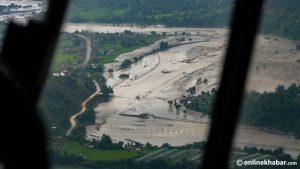
The pain of families who lost loved ones in the devastating Rasuwa flood has now reached Chitwan.
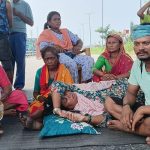
Relatives of people missing after the Bhotekoshi flood have been moving between hospitals and the mortuary in Bharatpur, searching for any sign of those they have been waiting for.
Some clutch photographs of their missing relatives. Others sit with tears in their eyes.
They share the same hope and the same fear.
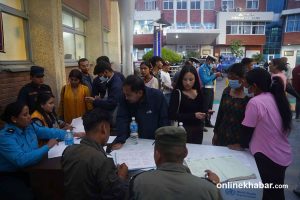
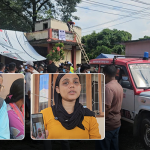
Since early Thursday morning, relatives carrying that uncertainty have gathered outside a newly established body identification centre in Bharatpur. Every time an ambulance siren is heard, they rush towards it. For a few moments, all eyes remain fixed on the ambulance carrying the bodies.
The doors open. A body is brought out. Relatives compare the face with photographs on their phones. For some, the search ends. For others, the wait begins again.
‘What do I tell my brother abroad?’
Yaman Banu, who lives in Tadi, Chitwan, arrived in Bharatpur looking for members of her family after 14 relatives went missing following the Bhotekoshi flood.
Time has become another source of pain for those waiting in Bharatpur. With every passing hour, their anxiety grows. Their eyes remain on the road and their ears tuned to the sound of ambulance sirens.
Yaman repeatedly shows a photograph of her relatives on her phone, her eyes filled with tears.
“What do I tell my brother who is abroad? Everyone from our home and my maternal family has been swept away,” she said.
She had been visiting hospitals and mortuaries in Bharatpur since early morning. After finding no information about her relatives, she was eventually forced to come to the identification centre and look for their faces among the dead.
On her phone, however, the face is still alive.
Holding on to the photograph, she continues to hope that one day she will see that face not on a dead body, but standing alive in front of her.
35 people from one village missing
Relatives who had travelled from Palungtar in Gorkha to Gosainkunda for a pilgrimage have also arrived in Chitwan.
Hari Baniya was waiting for his sister. He sat quietly until an ambulance siren suddenly broke the silence. He immediately got up and rushed towards the ambulance.
His sister was not among the bodies. Now he waits for the next ambulance.
After searching hospitals without finding any information, Hari and other relatives have been waiting for every ambulance carrying bodies from the flood.
According to Hari, 39 people from the same village who had travelled to Gosainkunda remain out of contact. Their disappearance has plunged the entire village into grief.
‘I’m at the border’ — then the call stopped
Chandra Lama is living through a similar wait.
His brother called in the morning and said he had reached the border. After that, the phone went silent.
Chandra came to Bharatpur after his uncle sent him to look for his brother.
The possibility that his brother could be among the bodies swept downstream by the flood brought him to the identification centre.
His wait now lies somewhere between two possibilities — the hope of finding his brother and the fear of finding his body.
Separate identification centre set up as mortuaries run out of space
As the number of bodies brought from Rasuwa to Chitwan increased, a separate body identification and preservation centre was established in Bharatpur.
The centre, located in the old building of the Industrial Enterprise Development Institute in Bharatpur-10, has the capacity to store around 250 bodies.
The mortuaries at Bharatpur Hospital and other hospitals can accommodate only around 50 bodies, prompting authorities to establish the additional facility.
Chitwan Chief District Officer Ganesh Aryal said arrangements had been made to preserve the bodies at controlled temperatures. Food and accommodation have also been arranged for relatives of those affected by the disaster.
Throughout the day, ambulances arrive carrying bodies. Relatives rush towards them. Then another siren sounds. And the same faces turn towards the road again.
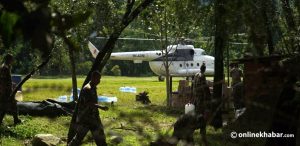
The Nepal Army, Nepal Police, Armed Police Force and municipal police have been mobilised for the search and management of the bodies.
Families identify loved ones through photographs
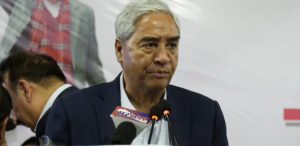
Chitwan District Police Office chief Rameshwar Paudel said special arrangements had been made both to preserve the recovered bodies and make identification easier.
“Bodies that arrive will be cleaned and preserved in dry ice. We are also preparing to photograph the bodies and display the photographs on boards,” he said.
A separate contact desk has also been established so that relatives can seek information more easily.
The arrangement is intended to reduce the need for relatives to open and inspect every body at the mortuary themselves, Paudel said.
But identifying a loved one from a photograph remains difficult.
The smiling face of someone they know from a phone screen has to be compared with a face changed by death — a process Paudel described as an extremely painful moment for families.
25 ambulances working continuously
Ambulance drivers have also been working around the clock to transport the bodies.
According to Navaraj Lamichhane, president of the Nepal Ambulance Drivers’ Association, 25 ambulances are currently on standby for transporting bodies.
The ambulances are bringing bodies to hospitals and the identification centre free of charge, he said.
The ambulances keep coming. The bodies keep arriving. And each siren sends relatives rushing towards the same place. Some are still hoping to find their loved ones alive. Others simply want the chance to see their faces one last time.
For everyone waiting, the search has narrowed to one place: the body identification centre in Bharatpur.
More than 130 bodies have been collected in Chitwan so far.
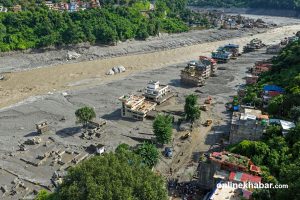
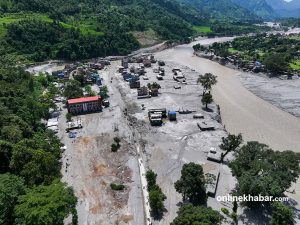
The flood has swept away homes, families and property. For hundreds of families, it has also carried away laughter, dreams and futures.
And in Bharatpur, time has become another form of suffering. Every tick of the clock brings more anxiety. Their eyes remain on the road. Their ears remain tuned to the ambulance sirens.