
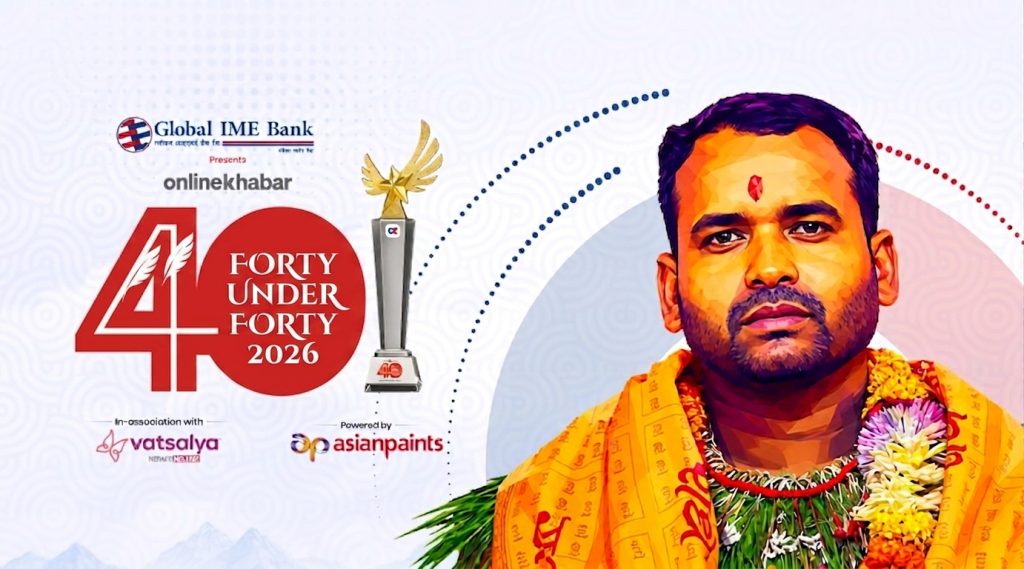
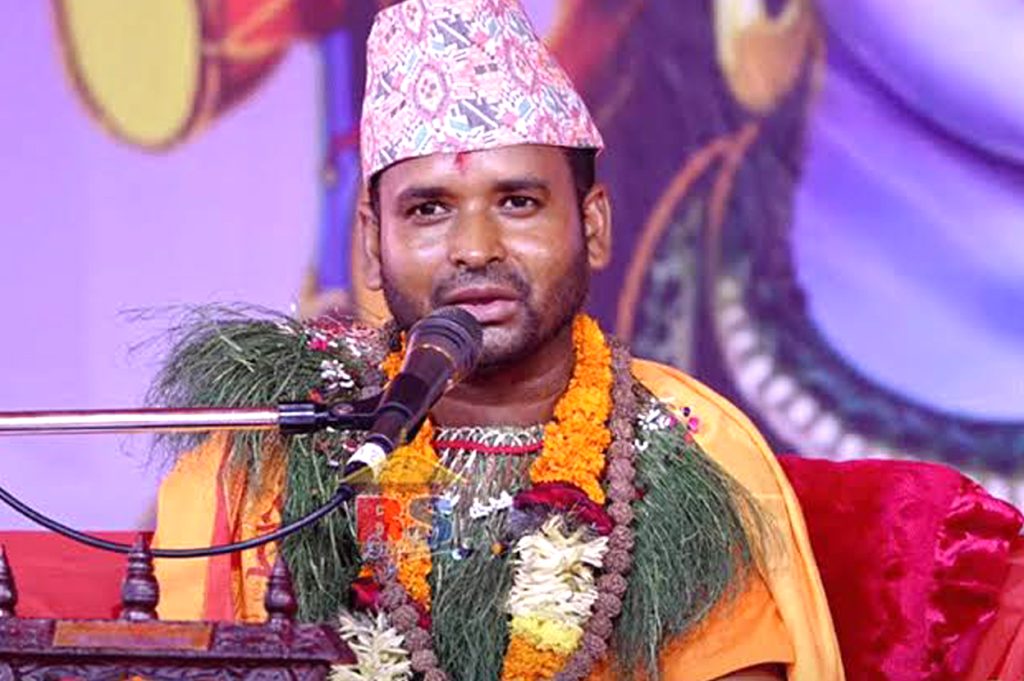
August 8, 2024, thousands of devotees gathered at the historic Kotihom Mahayagya held on the premises of Pashupatinath Temple in Kathmandu. At the centre of the stage, a young priest sat on the Vyasasan, delivering religious discourses as devotees listened attentively. The young man seated on the Vyasasan was Krishna Bahadur Damai from Kanchanpur.
For a young man from the Dalit community to pursue higher education in Sanskrit and complete an Acharya (postgraduate) degree is remarkable. Once denied a tika at a temple because he was considered to be from a so-called lower caste, he was now sitting on the Vyasasan at the Pashupatinath premises, interpreting scriptures before the very society that had discriminated against him.
Determination born from temple humiliation
Born on October 7, 1991, in Tilakpur, Bhimdatta-3, Kanchanpur, Krishna spent his childhood in extreme poverty and deprivation. He is the third of nine children—four sons and five daughters—of Ran Bahadur and Kamala. Growing up in a low-income Dalit family, he faced both financial hardship and social discrimination from an early age. New school uniforms and adequate educational materials were almost a luxury for him. But an incident when he was in Grade 10 changed the course of his life.
While studying at the local Baijnath Secondary School, he once participated in a cleaning programme at a local Bishnu temple. All the students happily cleaned the temple together. After the cleaning was completed, the priest applied tika to the foreheads of all the students. But when it was Krishna’s turn, the priest refused after hearing his name and surname. The priest’s rebuke, accompanied by a caste-based remark telling him to “go over there,” deeply disturbed the young Krishna. That day, he silently resolved, “The priest who refused to put tika on me because I am a Dalit—I will not be inferior to him.”
Turning point of his life
After passing the SLC (School Leaving Certificate, now SEE) examination in 2064 BS, Krishna wanted to study science. But his family’s financial circumstances made that impossible. His old determination, however, remained alive.
The village had not only priests who practised caste discrimination but also teachers such as Ishwardutta Bhatt, who encouraged the oppressed. He not only encouraged Krishna but also provided him with Rs 500 in financial assistance. That money became the means through which Krishna began his journey into Sanskrit studies.
He began studying Sanskrit at Sharda Vidyapeeth at the Uttar Madhyama (plus-two) level. But he also had to bear the cost of his education and the responsibility of helping support his family. To look after six of his siblings, apart from two elder sisters, while continuing his studies, he began selling Janakranti Dainik, a newspaper published from Mahendranagar, in 2066 BS.
His daily routine involved reaching the market early in the morning carrying newspapers, finding customers, marketing the papers and spending the remaining time studying. “I covered my food, accommodation and education expenses with the money I earned from selling newspapers,” he recalls.
What some might consider an ordinary job of selling newspapers taught him discipline, self-reliance and the art of building relationships with people.
Social rebellion through priesthood
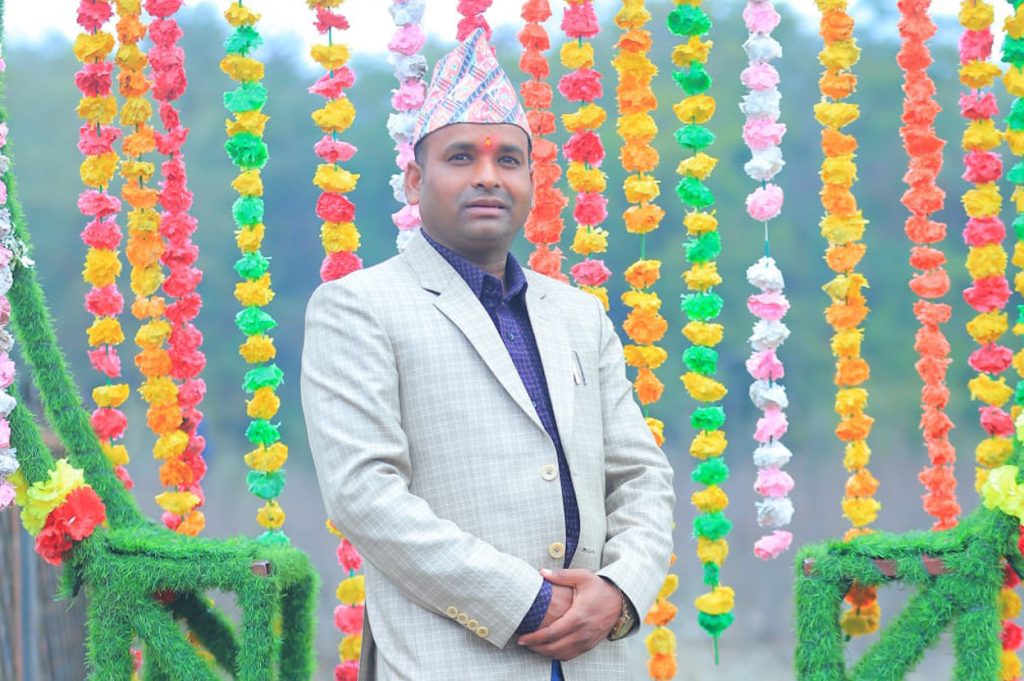
Overcoming numerous hardships, he completed his Shastri degree in literature from Nepal Sanskrit University and an Acharya degree from the university’s campus in Dang. By then, he had gained an in-depth knowledge of Sanskrit verses, the Vedas, the Upanishads and religious scriptures.
But society was still more concerned about his caste than his knowledge. “Can a Dalit know the scriptures?” he was repeatedly asked. Some people tried to discourage him. But Krishna wanted to prove himself through his knowledge and actions. Whenever he found an opportunity, he continued reciting the Vedas. Many people began to be impressed by his style and pronunciation.
Krishna proved his competence in various religious rituals, including weddings, Bratabandha, Nwaran and puja. Through his religious ceremonies, he promotes the message that all people are equal and seeks to challenge caste discrimination. For him, this is not merely a means of personal fulfilment but also a campaign to convey the message that all people are equal and that, if God exists, God loves everyone without discrimination. He wants to use religious rituals not merely as religious traditions but also as a means of campaigning against discrimination.
Impressed by his message and graceful style, members of the community now actively seek him out and invite him to conduct religious ceremonies.
Government service and social campaign
Krishna Bahadur Damai is no longer limited to performing religious rituals. This is part of his knowledge and social campaign. His main profession is government service. He works as a sixth-level officer as an inclusive education facilitator in the Education Section of Dhangadhi Sub-Metropolitan City.
The sub-metropolitan city assigned him the responsibility after assessing his educational qualifications and social struggles. Having gained confidence through education himself, Krishna Bahadur considers education the most powerful tool for transforming society. He believes higher education should be made accessible, particularly to children from Dalit, disadvantaged and marginalised communities.
Dream for the future
While pursuing his government career alongside his religious work, Krishna Bahadur wants young people from the Dalit community to study not only science, technology and economics but also Sanskrit and religious rituals. He dreams of establishing a “Dalit Karmakanda School” in his village.
Speaking about his plans, he says, “Society will not change just because I put tika on people at a temple. I want to create thousands of Krishnas who will ensure that the doors of temples remain open to everyone forever.”
Krishna Bahadur’s knowledge and dedication have challenged the centuries-old tradition of determining who can become a priest based on caste. His rebellion is not against any individual but against the social practice that creates divisions between people.
Today, Krishna Bahadur Damai is no longer simply an individual. He has emerged as a cultural activist working to end caste discrimination in Nepali society.