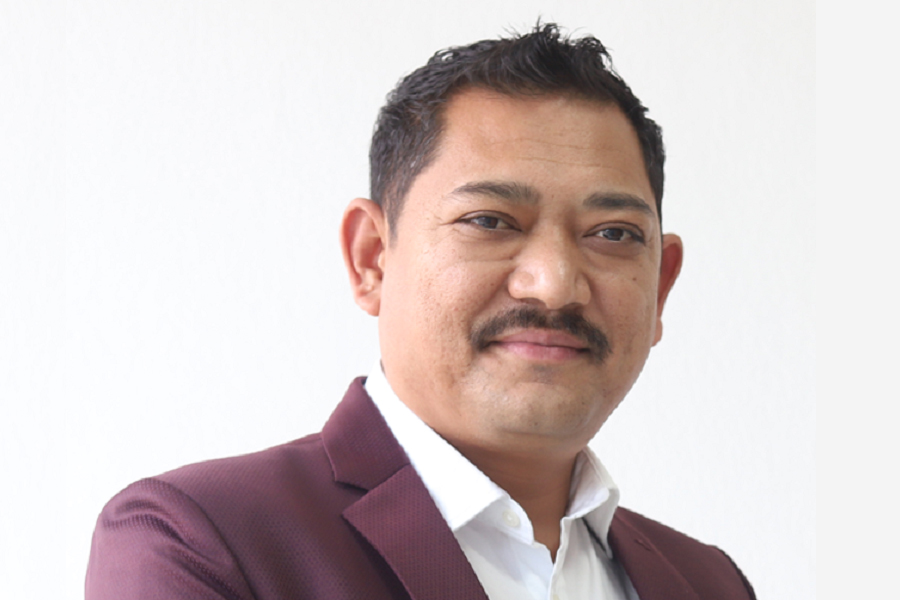


Companies owned by fugitive GB Rai have continued operating for the past five years with the apparent support of the state mechanism.
Although the Nepal Police tracked Rai—accused of embezzling more than Rs 21 billion from depositors through over a dozen cooperatives—to Malaysia, he has yet to be arrested.
Meanwhile, personal companies established by Rai using cooperative savings, including networking and herbal businesses, are still reportedly operating without interruption.
Since Rai’s involvement in cooperative fraud was confirmed, Nepal has already seen four prime ministers. Cases against him have been filed in courts across the country. Yet, the government has failed to arrest and bring back Rai, who is accused of massive financial embezzlement.
The Ministry of Land Management, Cooperatives and Poverty Alleviation, the Department of Cooperatives, the Cooperative Authority, the police, the courts, and provincial and local governments have merely shifted responsibility from one office to another. Rai is accused of misappropriating savings from nine cooperatives.
Suman Khanal, coordinator of the Swarnalakshmi Cooperative Victims’ Struggle Committee, said it was shocking that the entire state mechanism appeared helpless before Rai, who allegedly embezzled nearly Rs 21 billion in savings.
“Can a government really fail to even know where one of its own citizens is or what he is doing? This is clearly because the state itself has protected him. Otherwise, he would have already been arrested and brought back,” Khanal said.
According to Khanal, Rai invested cooperative savings into his and his group’s private companies, including Nature Herbs and Gorkha Ayurveda Pvt Ltd. All these companies are still in operation, but the government has not informed depositors about their status.
An audit report of Swarnalakshmi Cooperative, operating in Kathmandu and Lalitpur, showed deposits worth Rs 3.71 billion as of mid-July 2022. Of that, Rs 3.10 billion was allegedly misappropriated under the guise of loan investments.
Police said Rai invested Rs 102.79 million of cooperative funds into Herbo International Pvt Ltd.
Likewise, police investigations found that Rs 16.9 million was invested in GB Group of Companies Pvt Ltd, Rs 18.2 million in Gorkha Herbal Production Pvt Ltd, and Rs 4 million in Gorkha Group of Companies. The investigation report has already been submitted to the government attorney’s office.
Companies associated with Rai include Gorkha Herbal, Galaxy 4K TV (Gorkha Media Pvt Ltd), Nature Herbs, and GB Group, among seven affiliated companies. Khanal said depositors, who have not received their savings for years, have approached the Bagmati Province Ministry of Land Management, Cooperatives and Poverty Alleviation, demanding that the cooperatives be declared “problematic institutions.”
However, cooperatives linked to Rai have not yet been officially declared problematic.
“When we ask why it is taking so long, they don’t even answer properly. They say the official file has not yet arrived from Hetauda,” Khanal said. “We have already submitted a memorandum to the Provincial Cooperative Registrar’s Office in Sanepa, and they only said they would inform us later.”
He added that if Rai, as chairperson of the institutions, were brought into contact, it would greatly help depositors because it would clarify where the money went, who mobilised it, and where the assets were transferred, making recovery easier.
“Government officials say the institutions cannot be declared problematic because court cases are already underway,” Khanal said. “It has been four years since complaints were filed with cooperative regulatory bodies. We have been endlessly shuffled from one office to another. Wherever GB Rai may be, the government must return the depositors’ money. We don’t need GB Rai—we need our money back.”
Khanal also accused the government of failing to hold other directors in Nepal accountable for refunding depositors.
“People like Kavita Lama, Ishan Lama, and manager Nabin Achhami are openly moving around,” he said.
A victim from Hamro Krishi Cooperative said depositors no longer had any basis to believe whether the government had intentionally allowed Rai to flee or was simply unable to arrest him.
“It should not be impossible for an institution like Nepal Police,” the depositor said. “Even while his other businesses continue operating, depositors cannot do anything. We are not even allowed to demand that the offices be shut down, because then we could face public offence charges ourselves.”
The victim also alleged that despite police control over the servers of all cooperatives linked to Rai, including Swarnalakshmi, no serious investigation had been carried out.
Shiv Kumar Shrestha, spokesperson for the Central Investigation Bureau (CIB), said Nepal Police had received no new information regarding Rai, and there had been no new decision to intensify the search.
Meanwhile, the government has begun returning savings to small depositors of problematic cooperatives. The refund process started on Monday, May 18.
For this, the government has established a revolving fund with Rs 250 million and plans to add another Rs 250 million. Around Rs 46 billion must be returned to 76,000 depositors of problematic cooperatives.
“We are not only focused on GB Rai but on resolving the entire cooperative crisis,” says Minister Rawal.
Minister for Land Management, Cooperatives and Poverty Alleviation, Pratibha Rawal, said the government was working towards resolving the broader cooperative crisis rather than focusing solely on one individual.
“Some cooperatives linked to GB Rai have become problematic, and many others are also facing difficulties,” she said.
She added that the government was discussing mechanisms with relevant agencies to quickly settle transactions in institutions facing problems, but not officially declared problematic.
“In the first phase, we are focusing on resolving the savings of problematic cooperatives,” she said. “Then we will move on to other troubled institutions. We are also planning to strengthen regulation and oversight, not just savings refunds.”
She stated that recovery procedures would also extend to companies where misappropriated cooperative funds had been invested.
“Efforts to trace fugitive individuals will also continue,” Minister Rawal said. “The government will leave no legal step undone in returning depositors’ money.”
She added that the ministry was coordinating with agencies, including the CIB, to reach conclusions regarding those involved in embezzlement.
“In the case of GB Rai as well, the search operation will continue since he remains on the fugitive list,” she said. “An agreement has been reached to assign officials from Nepal Rastra Bank to the National Cooperative Regulatory Authority to strengthen cooperative regulation, and the Institute of Chartered Accountants of Nepal has also pledged necessary facilitation.”
She stressed that there would be no compromise on refunding depositors’ savings.
“Declaring institutions problematic alone does not solve the issue,” she said. “Declaring them problematic essentially means they are bankrupt. Therefore, efforts must be made to settle issues before reaching that stage, and work is moving accordingly.”
The government formed after the Gen Z movement had decided to withdraw money laundering and organised crime cases against individuals involved in cooperative fund embezzlement, including Rabi Lamichhane and GB Rai. Following that decision, the Office of the Attorney General instructed government attorneys in relevant districts to withdraw the two charges.
Among the districts where cases against Rabi and GB had progressed, the Kaski District Court has already ordered the withdrawal of those charges after hearings.
It is estimated that more than Rs 21 billion was embezzled from multiple cooperatives, including Swarnalakshmi Multipurpose Cooperative in Kathmandu (Rs 3.53 billion), Suryadarshan Savings and Credit Cooperative in Pokhara (Rs 1.55 billion), Supreme Savings and Credit Cooperative in Butwal (Rs 1.51 billion), Samata Savings and Credit Cooperative in Nepalgunj (Rs 200 million), Sahara Chitwan Multipurpose Cooperative (Rs 870 million), Hamro Naya Krishi Cooperative (Rs 450 million), Kalyan Upakar Savings and Credit in Lalitpur (Rs 2.47 billion), Laligurans Savings and Credit Cooperative (Rs 4.47 billion), Sano Paila Savings and Credit Cooperative in Birgunj (Rs 1.2 billion), and Gorkha Savings and Credit Cooperative (around Rs 4 billion). Some institutions, including Gorkha Savings and Credit, Hamro Naya Krishi, and Laligurans, have already been declared problematic.