
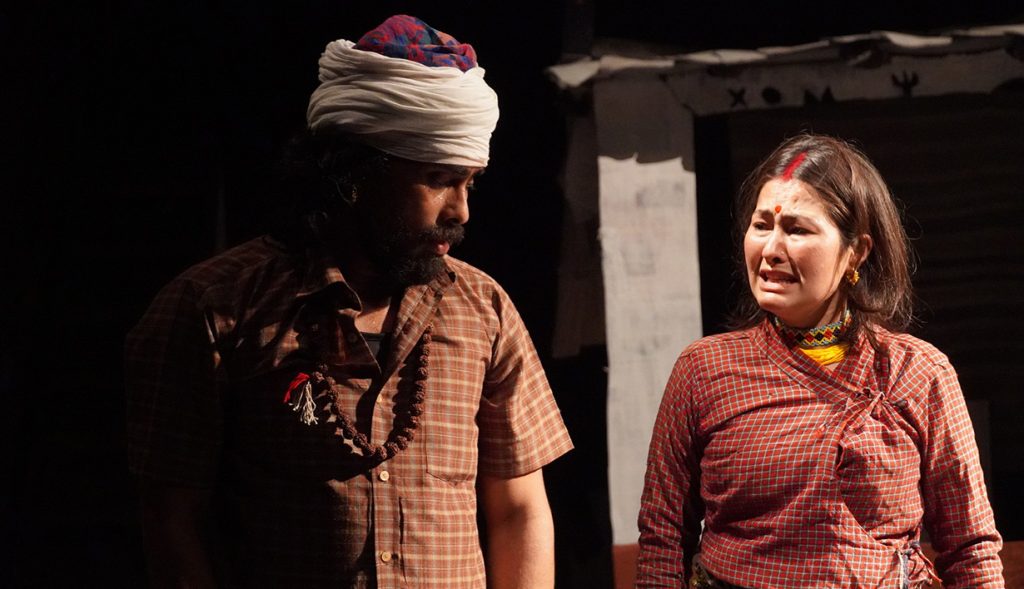
A newborn baby boy is burning with fever. The family has no money to take him to the hospital. The district headquarters is far from their home, and even if they somehow manage to reach the hospital, there are no doctors there — they have all gone to Kathmandu.
Unable to take her son for treatment, Gita grows increasingly restless. She repeatedly tells her husband, Dal Bahadur Kami, “Take our son to the hospital somehow, otherwise I will go myself.”
Dal Bahadur runs around the village trying to arrange money. He has just finished making a statue for the ward chairperson and hopes to receive payment for it. But the ward chairperson takes the statue without paying him.
While Dal Bahadur is still struggling to gather money, their son dies.
000
Dal Bahadur is a Dalit character. He is somewhat conservative because he lacks education. He believes more in shamans and traditional healers than in modern medical treatment.
Whenever a problem arises at home, the first place he goes is to the village shaman. He never questions the shaman’s words. He is hardworking and capable of supporting his family through labour. He deeply loves his wife, Gita.
The couple had already lost two children earlier due to a lack of proper treatment.
Gita, on the other hand, is portrayed as a progressive character. She does not believe in shamans or witch doctors. The pain of losing two children still haunts her. The birth of another child brings new hope into their lives. Yet her husband remains trapped in blind faith, and she constantly questions his beliefs.
This Dalit family forms the centre of the play. They are forced to endure social oppression and caste discrimination, but there is no one to speak against it. They remain helpless victims.
Dal Bahadur’s labour is accepted by society. The statue he makes is welcomed into the temple, but if he accidentally enters the place of worship himself, he is humiliated.
Even the title of the play, “Acheta,” is used symbolically to portray discrimination.
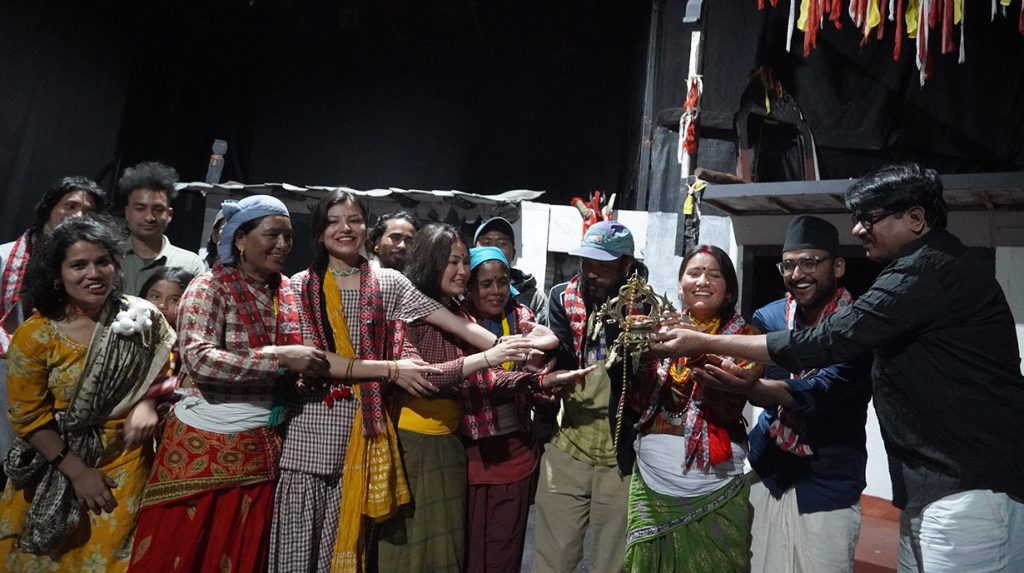
In one scene, the shaman hands Dal Bahadur acheta in a separate and degrading manner, while upper-caste individuals receive it respectfully in their caps.
Similarly, the play presents Acheta as a witness to both blessings and sorrow. Literally, acheta is simply a grain of rice, but in the drama, it becomes a powerful metaphor.
If a Dalit offers acheta at the temple, it is not considered acceptable. But when the same acheta is offered by an upper-caste person, it becomes sacred. After ritual healing ceremonies, shamans also distribute acheta, which many people regard as a symbol of faith. Yet it takes little time for that faith to turn into a curse.
Alongside Karnali’s hardships, the play vividly portrays the region’s culture and traditions.
One of its strongest aspects is the dialogue. The local dialect, folk tunes, and songs transport the audience directly to Karnali. Though some viewers may find the language challenging, it ultimately does not become a barrier.
The play features original traditions such as “Magal” songs sung after childbirth and the “Balo Nachaune” ritual performed for babies. It also incorporates the “Khalo” tradition, in which Dalit communities receive a share of grain after the harvest season in return for their labour.
The play also highlights how people still depend on shamans and deities due to the lack of hospitals. Local melodies and traditional dances further enrich the performance and help reveal the psychology of the society.
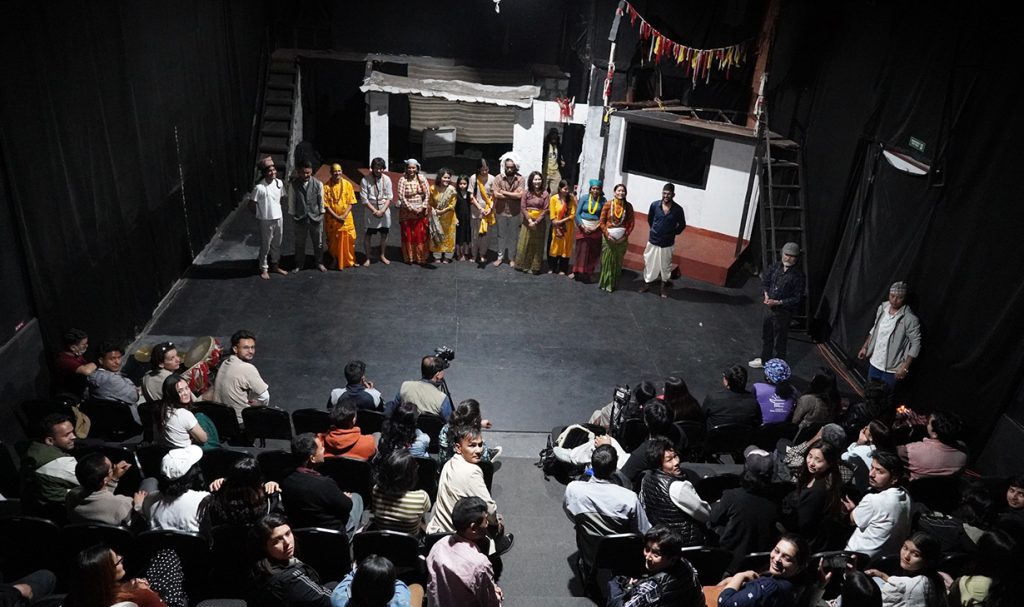
All the characters belong to a rural setting, and the play successfully captures the existing social structure there. Director Govinda Sunar says many of the actors are performing on stage for the first time.
Perhaps that is why the dialogues and accents sound so natural, and the acting never feels artificial.
000
“Acheta” was staged during the three-day Tri-Nation Theatre Festival organised by the Nepal Academy of Music and Drama at Kantipur Theatre. The play will also be staged at Shilpee Theatre from May 14.
Directed by Govinda Sunar, the play is based on an original story from Karnali. Through its characters, social structures, and harsh realities, the play brings Karnali to the stage.
Everyone knows that Karnali has long suffered from state neglect. The region lacks the basic foundations necessary for development. There are no hospitals, no quality education, no roads, and no employment opportunities. What exists instead are poverty, superstition, caste-based untouchability, and discrimination. These very issues of western Nepal form the core narrative of “Acheta.”
Overall, “Acheta” succeeds in becoming a social, economic, and cultural mirror of Karnali. It is both a question directed at the state and a warning to those in power. On one hand, it portrays the region’s beautiful culture, while on the other, it exposes the bitter reality of caste discrimination and the deprived lives that remain far beyond the reach of the state.