

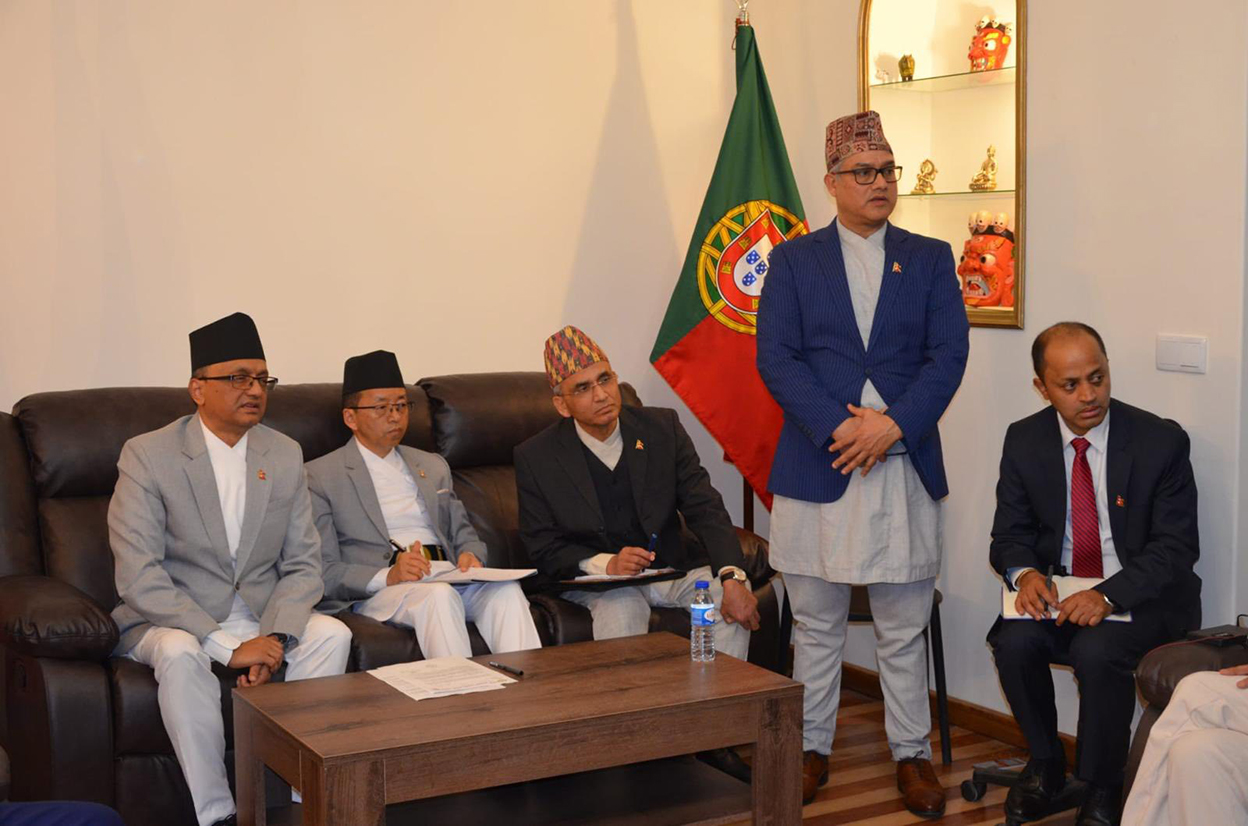
Lisbon, February 22
More than 2,000 Nepalis in Portugal have filed complaints after discovering that stamps and signatures used on police clearance certificates issued by Nepal Police were forged.
The complaints have been lodged at the Nepali Embassy in Lisbon, where affected individuals have reported that although their police clearance certificates are genuine, the stamps and signatures of the Portuguese and Nepali embassies used for authentication are fake.
Some complainants have even named the individuals they had assigned to get their documents authenticated. The forged stamps and signatures were reportedly those of the Portuguese and Nepali embassies in New Delhi, India.
According to Nepali Ambassador to Portugal, Prakash Mani Paudel, the number of complaints—both by email and in person—is increasing daily. “It feels as though the embassy’s main task now is to receive these complaints. Hundreds of genuine police reports appear to have been authenticated with fake stamps and signatures,” he said, adding that around 1,000 written complaints have been formally registered, while even more have been received via email.
The embassy is currently compiling details of the complainants. Although the police reports themselves are genuine, their authentication was found to be fraudulent, particularly during the period when there was no Nepali embassy in Portugal, and applicants had to send documents to New Delhi for verification.
The embassy has informed Portuguese authorities that the victims were defrauded by intermediaries and that the original police reports issued by Nepal Police are authentic. “Even though the stamps and signatures of the two embassies were forged, the reports issued by Nepal Police are genuine. We have officially notified the concerned authorities here,” Ambassador Paudel said.
Portugal’s immigration agency, Agency for Integration, Migration and Asylum (AIMA), uncovered the forgery while verifying documents submitted by Nepalis applying for Temporary Residence Cards (TRC). The agency has warned applicants found with forged authentication that they may face expulsion.
Victims say that submitting police reports bearing fake stamps and signatures has led to accusations of document misuse and forgery. Hundreds have reportedly received emails from immigration authorities accusing them of falsifying official documents.
One victim claimed that more than 3,000 Nepalis could be facing legal trouble due to the fake stamp scandal. Deepak Nepal of Sindhupalchok, currently in Lisbon, said his temporary residence process has been halted and that he fears deportation or imprisonment. “More than 1,500 people are in contact with me. We have formed a WhatsApp group to collectively seek solutions,” he said, urging support from the Nepali government, the embassy and community organisations.
Many affected individuals have been visiting the Nepali Embassy in Lisbon, asserting that they are victims of fraud and requesting facilitation and humanitarian consideration from both the embassy and the government of Nepal.
How the fake reports were produced
Investigations so far indicate that genuine police clearance certificates issued by Nepal Police were authenticated with forged stamps and signatures of the Portuguese and Nepali embassies in New Delhi. Under a Portuguese government policy, individuals residing and working in Portugal until June 3, 2024, are eligible to apply for Temporary Residence Cards.
Applicants were required to have their police reports authenticated by both embassies. After the closure of the honorary consulate in Lisbon on April 30, 2024, by a decision of Nepal’s Council of Ministers, and before the establishment of the Nepali Embassy in Lisbon, applicants were compelled to travel to Paris or New Delhi for document authentication.
During this 10-month gap, brokers reportedly exploited the situation. Due to heavy demand, intermediaries allegedly produced forged documents in Portugal itself by stamping fake seals of both embassies. Two Nepalis allegedly involved in the racket were arrested a few months ago.
Sources say that even documents sent to New Delhi were sometimes not submitted to the embassy but instead forged in hotels in India. What initially circulated as rumours was later confirmed through investigations by Portuguese police and immigration authorities. The perpetrators reportedly charged at least €200 per person for the forged authentication.
Complaints against community organisations

During an interaction programme organised by the Nepali Embassy in Lisbon on February 19, members of the Nepali community expressed anger over the issue. Binod Sunar from Pyuthan questioned the silence of Non-Resident Nepali (NRN) organisations. “Are these organisations formed only to celebrate festivals? More than 2,000 Nepalis are facing deportation over forged documents, yet no one speaks up,” he said.
He alleged that individuals linked to community organisations were involved in the forgery racket and that he had received threats after raising the issue.
Call for immediate investigation
Nepal’s Foreign Secretary, Amrit Bahadur Rai, who is currently on an official visit to Portugal, has directed the Nepali Embassy in Lisbon to immediately prepare a detailed report on the matter.
He has instructed the embassy to investigate complaints that Nepalis were involved in forgery and fraud and to bring those responsible under the law. “Do not spare anyone involved in this serious crime. Many facts have already come to light. Prepare a report immediately and proceed legally,” he said at a programme held at the embassy on Thursday.
Rai also urged that the issue not be treated lightly, noting that more than 2,000 Nepalis are reportedly affected by the same problem.