

When Jamil Salmi first began advising governments on higher education reform more than three decades ago, few developing countries spoke confidently about building “world-class universities.” Today, the phrase has become a global ambition, even in nations still struggling to finance their public institutions.
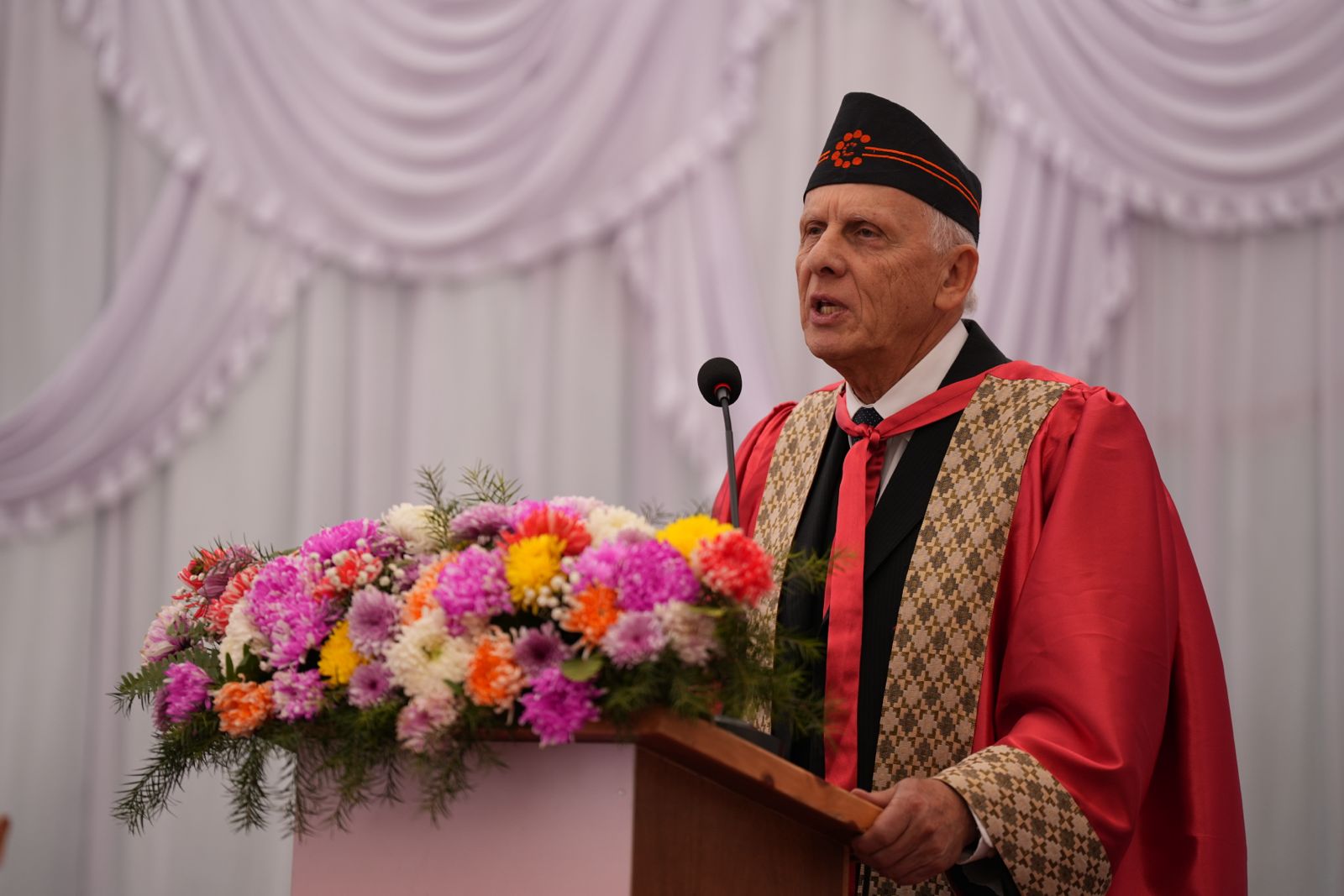
Salmi, a global expert who has counselled governments and university leaders in more than 90 countries, was in Nepal this week to attend the first graduation ceremony of Madan Bhandari University of Science and Technology (MBUST).
In this conversation with Onlinekhabar, Salmi reflects on what worries him most about global higher education, why governance and autonomy matter more than slogans, and whether a country like Nepal can realistically aspire to world-class institutions. He also discusses financing models, the power of diaspora engagement, and why artificial intelligence is not a distant concern but an immediate test of whether nations are prepared to compete in a rapidly reshaping world.
You have advised governments and universities in more than 90 countries. When you look at global higher education today, what worries you the most—and what gives you hope?
I think that not enough countries have a vision of the importance of higher education for their development. And not enough countries invest sufficiently to improve and develop their higher education systems. I’ve been working in Nepal since the early 2000 and I wish Nepal had worked more on higher education. I haven’t seen much change and it’s a shame because it’s so important for the development of your country.
The aspects that give me hope are well. If you look at the world over the past 30 years, you see tremendous progress in some countries.
China is the most obvious example, but if you go to South Korea or Vietnam now, it is moving fast. European countries like Finland, Denmark, Switzerland and the Netherlands have countries which have very much improved their higher education system. Singapore is another example of an excellent country.
What is the most common mistake governments make when trying to build universities?
The government’s initial mistake is not having the right governance in place from the start. A university needs autonomy and a leadership team with a clear, ambitious vision. By autonomy, I mean freedom from political interference, as well as access to sufficient resources.
I hope the government has taken the first step by passing an act for MBUST and granting it this autonomy. The university has a remarkable board of trustees, combining well-respected Nepali figures with international experts who bring extensive experience. While it has received some initial funding, this is hopefully just the beginning.
The government should recognise that this university has the potential to become a source of national pride, and it will require increased support and funding to reach that goal.
Many countries want “world-class universities.” Is this ambition realistic for developing countries like Nepal?
Well, it’s up to you whether you know what you know. As individuals, parents everywhere want the best for their children. We are willing to make sacrifices to ensure they receive a good education, especially at the university level. I wish countries would approach their citizens with the same mindset—treating their people as their children and striving to educate them as well as possible.
Take South Korea as an example. Until 1945, when it was under Japanese colonial rule, only 5 percent of the population had attended university. Today, South Korea boasts one of the highest rates of higher education attainment in the world, with roughly 70 percent of young people pursuing tertiary education.
I hope Nepal, too, will embrace this vision. I was heartened to see the Nepali government’s recent initiative allowing the new university, MBUST, to operate with the ambition of becoming a world-class institution. This kind of commitment could transform the country’s educational landscape, much like it has in other nations that have prioritised learning for all.
Public universities across the world are facing financial stress. What sustainable financing models have you seen work best?
So, first of all, it depends.
Many countries either do not provide enough funding for universities or are actually reducing their budgets. On the other hand, some countries are increasing their investment in higher education. I was reading yesterday that Luxembourg, for example, is raising its university budget by 20 percent, with a government commitment not just for next year but for the next four years.
Realistically, however, governments cannot finance everything. World-class universities typically rely on a mix of public and private funding. They raise money from companies, philanthropists, and other sources. As these universities strengthen their research capabilities, they also compete for research grants, both nationally and internationally.
These diverse funding streams give universities the resources they need to attract talented professors and conduct high-quality research, both essential ingredients for achieving world-class status.
As per your experience, what have you found to be the most important ingredients for a world-class university?
In my work on world-class universities, I’ve identified three essential factors that must come together. The first is talent; you need both outstanding professors and high-achieving students. The second is abundant resources, and the third is favourable governance. Take France, for example. The central government exerts too much control over universities, limiting their autonomy. Without the right balance of talent, resources, and governance, it is extremely difficult for any university to achieve world-class status.
Based on your experience, what kind of higher education system best supports national development, not just economic growth?
I believe countries need a diversified higher education system. They may have one or two world-class universities, depending on the size and wealth of the country, but they also need institutions focused primarily on teaching. Shorter-duration colleges, like the junior colleges in Japan and Korea, are also essential. These two-year institutions are closely tied to the labour market, providing practical skills for those who may not pursue research careers.
This kind of diversification is not only important for meeting different educational needs, but also for financing. World-class universities are extremely expensive to run, and a country cannot afford to focus solely on them. A mix of institutions, research-intensive universities, teaching-focused colleges, and shorter vocational programs ensures a more sustainable and inclusive system.
Online education is increasingly playing a role in this diversification as well. For example, India has the Indira Gandhi National Open University, and Thailand has two open universities that together account for half of the country’s higher education enrollment.
How will digital learning, AI, and cross-border education reshape universities in the next decade?
The future isn’t a decade away; it’s today. Nepal cannot afford to say, “We’re too poor now; we’ll think about artificial intelligence in five years.” If it does, the country risks being left behind.
I was particularly impressed to see that MBUST has identified five key research clusters, and one of them is artificial intelligence. The department is led by an internationally renowned expert with extensive experience in the UK, which is critical for building credibility and capacity.
Investing in AI is not just about hardware; it’s about training the mind. Young Nepalis, students, and professors have the potential to compete on equal footing with peers in Japan, the U.S., and the U.K., because intellect knows no borders. Preparing for AI today will shape how universities are managed, how research is conducted, and ultimately, how society adapts to the technologies that are already reshaping every aspect of our lives.
Each day, hundreds of Nepalis leave the country, many of them to pursue education abroad. At the same time, Nepal has struggled to attract foreign students to its universities. So how can Nepali universities become more appealing to international students?
Today, Nepal’s national universities are not widely known internationally. If MBUST succeeds, however, it could attract students from other countries. Equally important is engaging the Nepali diaspora. It’s valuable for students to gain experience abroad in countries like the U.S., China, or elsewhere.
But sending remittances alone is not enough. When members of the diaspora return—or even collaborate with government agencies, companies, or universities from abroad—they can make significant contributions. I was particularly impressed to see that two professors from MBUST had international careers before returning: one in England and another in Japan. Their return is very encouraging, because they bring experience that can accelerate the country’s progress.