Kathmandu, December 29
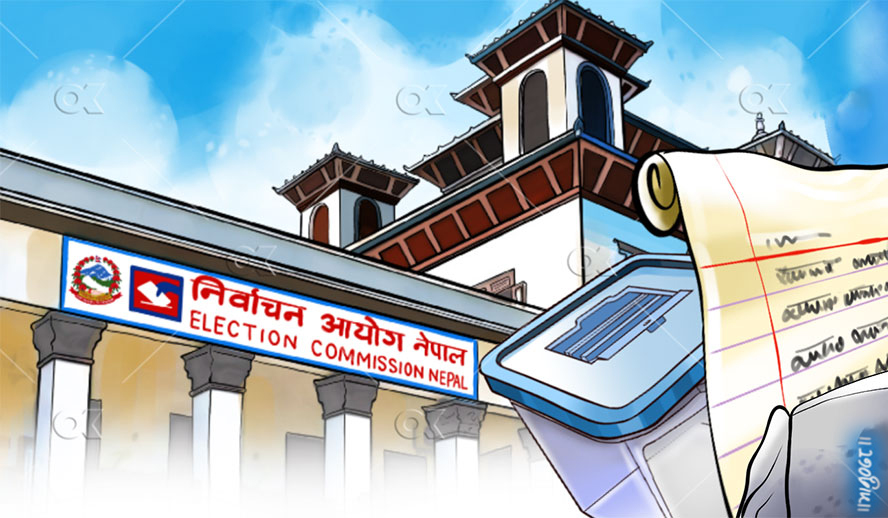
According to the election schedule made public by the Election Commission, political parties must submit their closed lists of proportional representation candidates by Monday.
Of the 275 members of the House of Representatives, 110 will be elected through the proportional representation system based on the total votes received by parties nationwide. As the system requires balancing the proportion of women and men as well as representation from various groups and clusters, candidate selection under the proportional system is considered more complex than under the direct election system.
To facilitate this process, the Election Commission organised a workshop for representatives of political parties in Kathmandu last week. Although two days are generally allocated for submissions, the final day often sees a large crowd of party representatives at the Election Commission. In previous elections, commission staff worked overnight to verify and register proportional lists.
Before finalising candidates, parties must have the Election Commission verify that the individual is listed on the voter roll. For this purpose, parties submit a list of potential candidates to the commission. Commission staff then check whether the individuals are registered voters and informs the parties in writing. Only after this verification can parties formally register their closed lists with the commission.
According to Election Commission Assistant Spokesperson Kul Bahadur GC, the commission has set up more than a dozen desks to facilitate the process. “We have already started verifying the details submitted by parties and sending back the confirmations,” Assistant Spokesperson GC told Onlinekhabar. “Some parties have completed the verification, while others are in the process.”
Representation by cluster
According to the House of Representatives Proportional Election Directive, 2082, approved by the Election Commission, there will be seven clusters in the proportional list.
When selecting candidates from Indigenous Nationalities, Khas Arya, Tharu, Dalit, Madheshi, Muslim, and backward regions, at least 50 per cent must be women.
Under the latest directive, 28.72 per cent of candidates must be selected from Indigenous Nationalities, 30.28 per cent from Khas Arya, 6.52 per cent from Tharu, and 13.44 per cent from Dalit communities.
Similarly, the Election Commission has mandated that 16.15 per cent of candidates must be from the Madheshi community, 4.89 per cent from the Muslim community, and at least 4.02 per cent from backward regions. Political parties may submit closed lists containing a minimum of 11 and a maximum of 110 candidates.
Parties must submit candidate lists that have been presented to and approved by their central committees, along with certified copies of the central committee’s decision. If two or more parties merge and submit a single list, the directive requires submission of separate or joint central committee decisions from each party, clearly specifying which candidate belongs to which party.
Each candidate included in the closed list must also submit photocopies of their citizenship certificate and voter ID card, along with a signed consent letter agreeing to contest the election.
The Election Commission has also requested political parties to email a soft copy of the proportional candidate list along with the hard copy.
How are seats allocated?
After voting on 21 Falgun, votes from both the direct and proportional systems will be counted. Based on the total votes received by each party, a weighting system will be applied, and the names of elected lawmakers will be finalised according to cluster-wise allocation.
Parties that fail to cross the threshold will be excluded from proportional representation. In the previous election, the CPN (Unified Socialist), despite winning 10 seats through direct elections, failed to cross the threshold in the proportional system.
Several aspects of finalising proportional lawmakers depend on the results of the direct elections. For instance, if an insufficient number of women are elected through the direct system, the selection of women representatives from the proportional list becomes mandatory.
However, if a sufficient number of women are elected directly, male candidates listed under the proportional system may also be selected. The Election Commission begins the process of allocating proportional seats only after the direct election results are finalised.