
Kathmandu, September 9
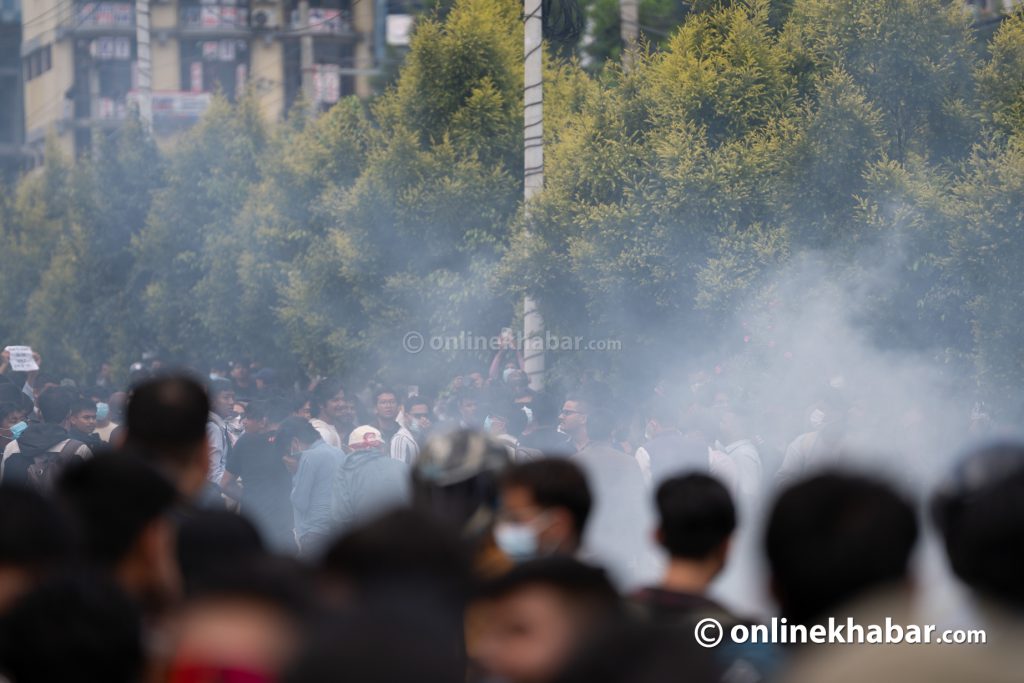
A year after the Gen Z protests, the damage is still visible in some of Nepal’s most important government buildings.
The main building of the Prime Minister’s Office at Singha Durbar remains in ruins. Work on the Birendra International Convention Centre at New Baneshwor has yet to begin, while reconstruction of other government offices, police buildings and public infrastructure damaged during the two-day unrest is still underway.
The destruction was widespread. Government data puts the total physical damage caused during the protests at Rs 84.46 billion — equivalent to 1.38 percent of Nepal’s gross domestic product and 4.30 percent of the annual budget for fiscal year 2025/26.
The damage was not limited to government offices.
Political party offices, businesses, private homes, vehicles and community structures were also affected. In all, 2,671 buildings were damaged during the protests of September 8 and 9, 2025.
The government formed a committee under then National Planning Commission Secretary Rabilal Panth to assess the damage to public and private property and prepare a reconstruction plan.
The assessment showed that the government and public sector bore the largest share of the loss, accounting for 53 percent of the total damage. Private property accounted for 40 percent, while community and other property made up the remaining 7 percent.
Of the 2,671 damaged buildings, 79.8 percent were public buildings.
Some buildings still waiting for reconstruction
The government has carried out technical assessments of the damaged structures. Buildings that could still be used were repaired and repainted, while others were identified for reconstruction.
In fiscal year 2025/26, repair work had begun on 904 buildings, of which 494 had been completed and reopened.
But some of the most prominent structures remain unfinished.
The Parliament building at New Baneshwor, which was heavily damaged, is among them. According to Prakash Aryal, deputy director general at the Department of Urban Development and Building Construction, a decision has yet to be made on whether the building should be reconstructed or replaced.
The building is already around 30 to 35 years old, and the fire severely damaged its internal structure. Officials have therefore been considering whether constructing a new building would be more practical than rebuilding the existing one.
As a result, reconstruction work has not yet started.
At Bhaisipati, reconstruction of the ministers’ residence is underway. The former Home Ministry building in Singha Durbar is also being assessed, with a detailed project report being prepared.
Elsewhere, the design for the Godavari conference hall has been completed, while retrofitting work has started at the Kathmandu District Court. The design for the Kathmandu District Administration Office is also ready.
The Damak View Tower, which was heavily damaged, is being reconstructed.
Some reconstruction programmes were left out during the merger of ministries and now require Cabinet approval and fresh budget arrangements.
Damage went far beyond buildings
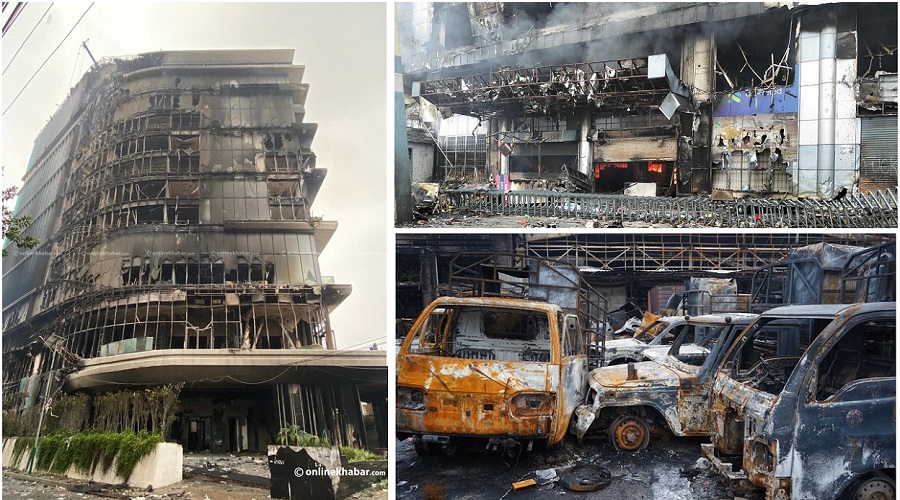
The destruction was not measured only in burnt walls and damaged offices.
Government figures put the damage to buildings at Rs 39.31 billion. Vehicles accounted for another Rs 13 billion, while damage to other physical assets stood at Rs 20.36 billion.
A further Rs 2.81 billion was recorded in losses involving cash and valuables.
Temporary and private property losses amounted to Rs 9.02 billion.
Within the private sector, businesses suffered Rs 27.49 billion in damage, while households suffered Rs 6.05 billion. Political parties and community organisations recorded another Rs 5.97 billion in damage.
The protests also disrupted the production of goods and services, resulting in an estimated Rs 13.87 billion in production losses.
The employment impact was also significant. A total of 2,999 jobs were affected, with 2,353 people losing their jobs entirely.
Many of the damaged buildings were relatively new
One of the striking findings of the government assessment is the age of the buildings that were damaged.
Nearly half — 46 percent — had been built within the previous 10 years. Another 48 percent were between 10 and 49 years old, while only 6 percent were more than 50 years old.
The assessment also identified 57 structures valued at more than Rs 100 million among the damaged buildings.
Of the total 2,671 buildings, 921 were valued between Rs 100,000 and Rs 1 million, 1,114 between Rs 1 million and Rs 10 million, and 312 between Rs 10 million and Rs 100 million.
The damage came only years after Nepal had spent billions rebuilding and repairing infrastructure following the 2015 earthquake, adding another layer to the cost of the destruction.
Insurance covered little of the loss

Insurance has done little to cushion the losses.
Of the 2,671 damaged buildings, only 130 were insured — 19 government buildings and 111 private buildings.
The government initially allocated money for essential repairs. Reconstruction has now been included in the current fiscal year’s budget, with plans to award contracts for a larger number of projects.
The National Planning Commission’s reconstruction and reorganisation action plan estimates that Rs 36.30 billion will be required for the reconstruction of public buildings, vehicles and other physical assets.
The government has adopted a three-year reconstruction strategy for damaged structures and physical assets. The plan, published by the National Planning Commission in March, aims to complete reconstruction over the previous, current and next fiscal years.
Projects are to be incorporated into the National Project Bank, the Medium-Term Expenditure Framework and the respective ministries’ budget systems.
Under the plan, the federal government is to allocate Rs 10 billion each in the current and next fiscal years, while provincial governments are expected to allocate Rs 1.5 billion annually and local governments Rs 3.25 billion annually.
Finance Minister Swarnim Wagle has also announced that the government will prioritise the retrofitting and reconstruction of government buildings damaged during the protests. The Ministry of Physical Infrastructure and Transport has allocated Rs 6 billion for reconstruction in the current fiscal year.
A year later, the numbers show how much was lost in just two days. But in places such as Singha Durbar and New Baneshwor, the damage is still easier to see than to count.