
Nuwakot, August 27
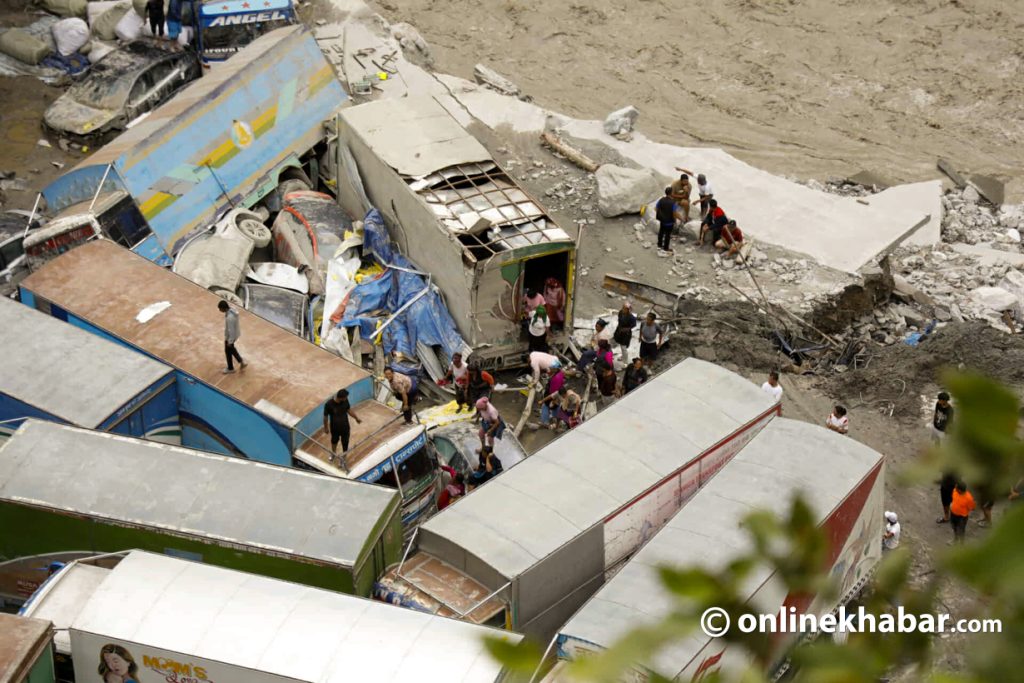
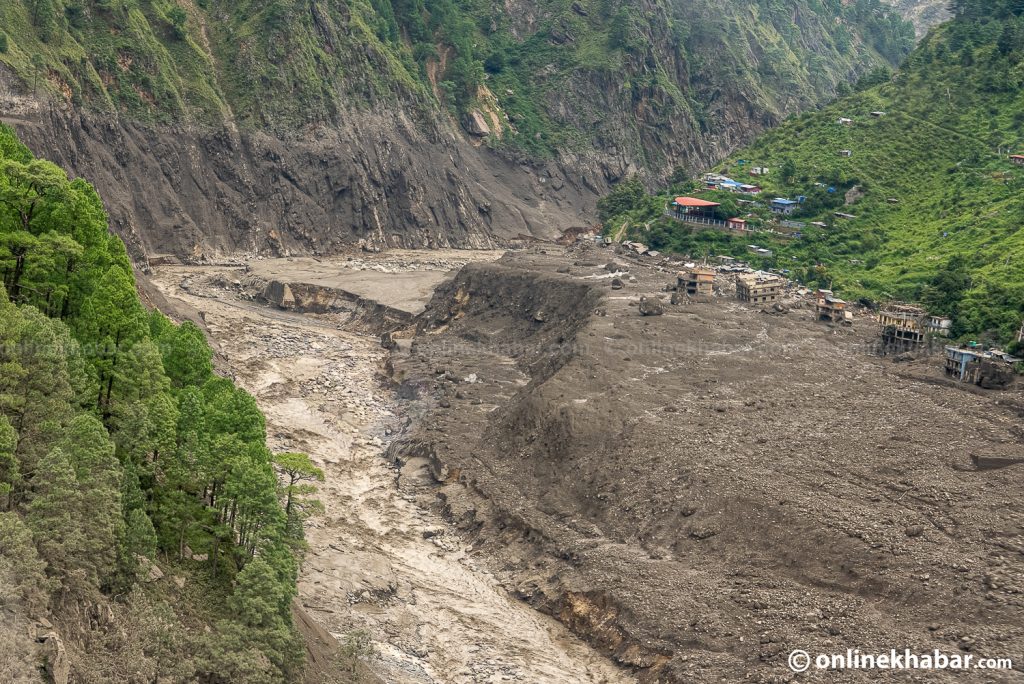
The wall of water slammed into the mountainside at Timure in Rasuwa before surging down towards the market.
Houses collapsed before people’s eyes. People ran in every direction. Some made it to safety. Others disappeared. No one knew who had survived and who had been swept away.
Among those caught in the chaos was Deepak Tamang of Sindhupalchok.
On Wednesday morning, the ground suddenly seemed to shake. At first, Tamang thought an earthquake had struck.
Then he saw it — a terrifying surge of mud, rocks and water racing towards the market.
“By the time I came out of the house, it had already arrived,” he recalled. “The wave of water hit the houses in front of us and they collapsed.”
There was no time to think. A mountain wall stood ahead of him. The flood was behind him.
He climbed. He climbed fast.
It became a race between life and death.
Tamang repeatedly fell as he tried to climb the slope. He grabbed at nettles and thorny bushes to pull himself higher while the flood roared below and people fled around him.
“When I fell, I thought this was it. This was the end for us,” he said.
He eventually made it to higher ground and survived. But what he saw from there continues to haunt him.
“I saw people being swept away right in front of my eyes. Some were reaching out their hands and shouting for help,” he said. “But there was no way to think about saving others at that moment. All we could do was watch our friends being swept away.”
At the time, Timure was crowded with foreign tourists, drivers, traders, police personnel, Armed Police Force personnel and Nepali Army staff. Many were caught in the flood. Even the police post was swept away, Tamang said.
But surviving the initial surge was only the beginning.
Those who escaped ran into the forest and eventually reached an old shed used for storing timber. Around 100 to 200 people crowded into the structure.
There was barely room to stand, let alone sleep.
“We stood in a line like that through the day and night,” Tamang recalled.
Then it started raining again.
People were crammed into the narrow tin-roofed shed. Some became dizzy. Others felt nauseous. But no one could go outside.
As they stood there, everyone thought if help would come the next day.
“We were waiting for morning and wondering when the rescue would come,” Tamang said.
They were finally rescued after around 24 to 25 hours, when a Nepali Army helicopter arrived and flew them to Bidur.
But even after reaching safety, Tamang had no answers about the people left behind in Timure.
“There is no way to count the deaths there,” he said, his voice heavy with grief. “It is not even possible to search for everyone right now.”
‘There is almost nothing left in Timure’
Nischal Tripathi, from Kathmandu, had been in Timure for around 20 days for business.
He was at work yesterday morning when everything suddenly began shaking. He too thought it was an earthquake. He stepped outside and saw a massive wave of water mixed with mud approaching.
Tripathi was on the fifth floor. There was only one way out — the stairs.
He ran down and jumped from around the second floor before reaching the side of the mountain.
“Those who were on the side of the mountain managed to survive to some extent,” he said. “For those on the road side, it was very difficult to survive.”
After the flood, Tripathi and others also fled into the forest.
They spent the night there, surviving on noodles and biscuits they managed to find. Later, they moved to a goat shed.
Around 150 to 200 people gathered there, along with Nepali Army personnel.
But Tripathi was not thinking about his own safety. His brother was missing. So were five or six members of his team and seven truck drivers.
“My brother and five, six, seven truck drivers who worked with me are out of contact,” he said.
When he remembers the scene around Timure market, his voice grows heavy.
“Only one or two houses appear to have survived. Otherwise, there is not a single house left in Timure.”
The flood had erased the distinction between the customs yard, the road and the river, he said.
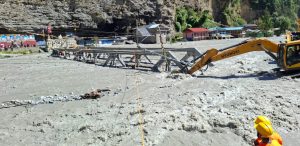
Where there had once been roads, shops and crowds of people, there was now only a riverbed.
‘If the current had hit us, none of us would have survived’
Rasuwa Customs Office accountant Hridayesh Neupane also escaped death. Neupane, originally from Dailekh, had reached the office at around 7:30am that morning.
The office stood beside the river. He was working on the lowest floor when he felt a slight tremor.
The buildings began shaking. Like others, he too suspected an earthquake. Then he heard a strange sound — almost like a siren.
“It was a very faint but very sharp sound,” he recalled.
Realising that something was wrong, he ran out of the office. When he reached the gate and looked north, he saw something far beyond what he had imagined a flood could look like.
Mud, dust and water were being thrown into the air, rising an estimated 100 metres. He knew immediately that he had to climb. And so he did and ran uphill.
After that, he remembers little.
“I only remember walking across the sheet of a roof,” he said. “After that, I don’t remember anything.”
When he regained consciousness, he was already higher up the mountain.
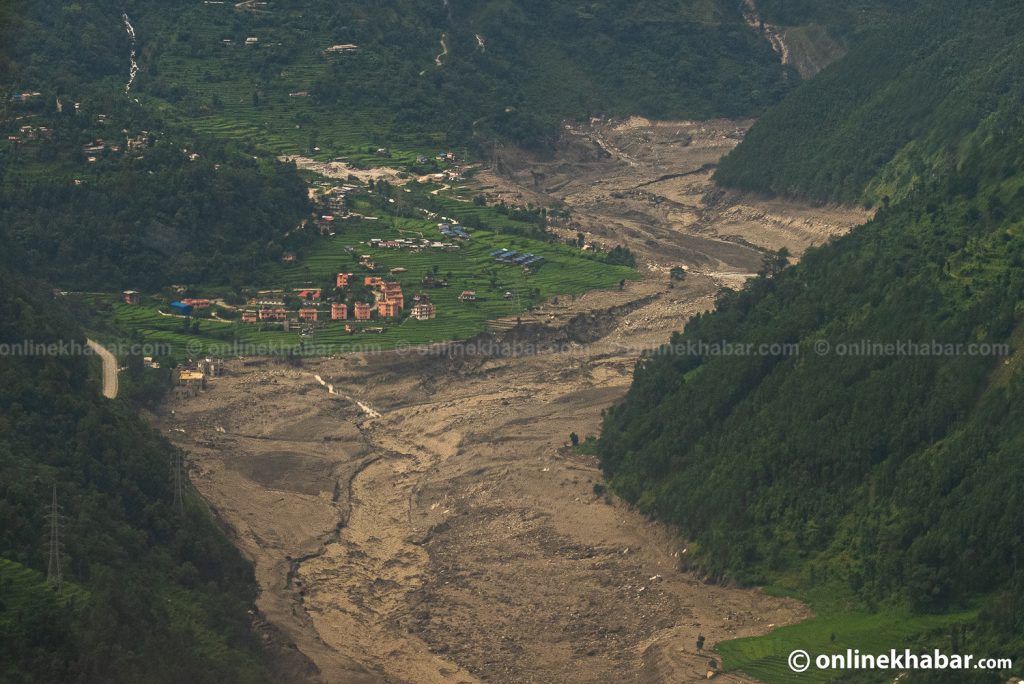
Looking down, he saw that Timure had been transformed into a barren riverbed.
“It cannot be described,” he said. “It was an unimaginable scene.”
Neupane believes they survived largely by chance.
The main force of the flood did not hit the side where they were standing. Instead, it slammed into the mountain wall opposite them.
“If the current had hit the side where we were, none of us would have survived,” he said.
Mud had been deposited 50 to 60 metres up the opposite slope. Large pine trees that had stood there had disappeared.
The situation in Ghattekhola market, further upstream, was even worse.
“Not a single person survived there,” Neupane said.
The survivors climbed higher as rescue operations began below. Then the weather deteriorated. Rain returned and the helicopter rescue operation had to stop. All the could do now was wait and hope.
They spent the night in a makeshift structure covered with sheets in an open pasture-like area. Around 50 to 60 people took shelter there.
At around 6:30am the next morning, helicopters began arriving again — including Nepali Army and private helicopters.
Neupane said they were among the last people to be rescued.
But several people were still waiting below.
Around two to two and a half hours after the flood, he said, a Nepali Army helicopter rescued eight to 10 people who had been partially buried in the Timure market and were still struggling to survive.
Rescue operation launched from Trishuli
The flood struck on August 26, turning settlements and markets along rivers in Rasuwa and Nuwakot into wastelands.
People living along the riverbanks in Rasuwa had barely seconds to escape.
Those who happened to be on upper floors or higher ground managed to scramble towards the forest and survive. But immediate rescue was difficult. Helicopters could not land safely in the affected areas. Communications were also disrupted.
After helicopter rescue was deemed impossible on Wednesday, a larger rescue operation began at around 6am on Thursday.
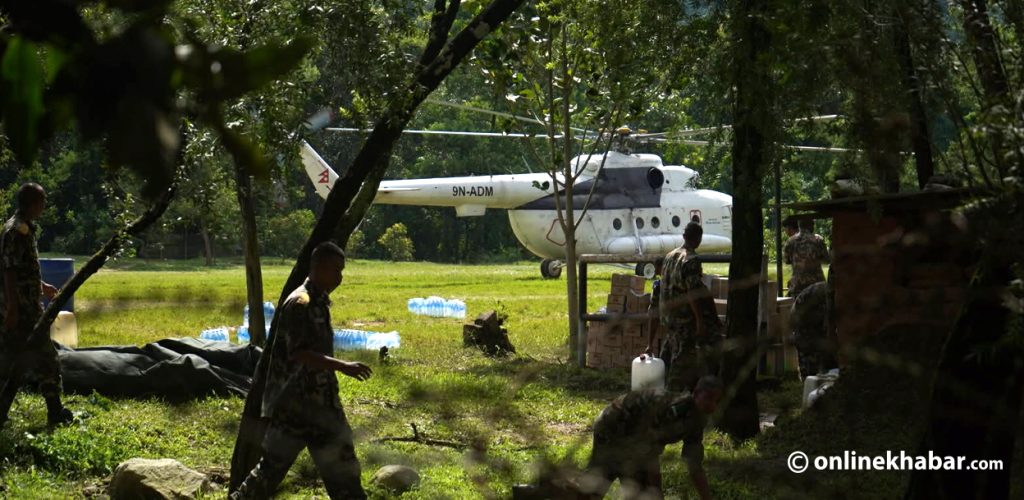
The Nepali Army and private helicopters were deployed at the No. 1 Military Training Centre in Trishuli, Nuwakot. From there, rescue flights carrying stranded and injured people were accelerated.
The same military training centre also became a gathering point for relatives of people missing in the flood. Every time a helicopter landed, families rushed towards it, hoping that the person they had been searching for was among those brought back to safety.
For the survivors, the flood was a matter of seconds. For those left behind, the waiting continues.