
Kathmandu, September 18
A week has passed since the Fund for Responding to Loss and Damage, established under the UN climate change framework, pledged to make the “earliest possible and meaningful response” to the devastation caused by the Rasuwa floods.
Nepal had written to the fund on September 1, arguing that climate change was a contributing factor behind the disaster, which killed 1,410 people and left 5,130 missing.
In its response 10 days later, the fund said it had recommended that its board consider various options within the limits of its existing mandate, structure, policies and procedures.
The response has renewed an important question for Nepal. If climate change is contributing to increasingly severe disasters in a country that contributes very little to global emissions, what should Nepal be entitled to under the principle of climate justice?
International research has strengthened Nepal’s argument that climate change played a role in creating the conditions for the Rasuwa disaster.
A group of international researchers who conducted a disaster analysis for World Weather Attribution, an initiative that studies the role of climate change in extreme weather events, said climate change could have contributed to the Rasuwa flood.
Climate scientist Dr Friederike Otto, one of the researchers involved in the study, told the BBC that there was no doubt human-induced climate change had played a role in creating the background conditions for the disaster.
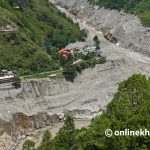
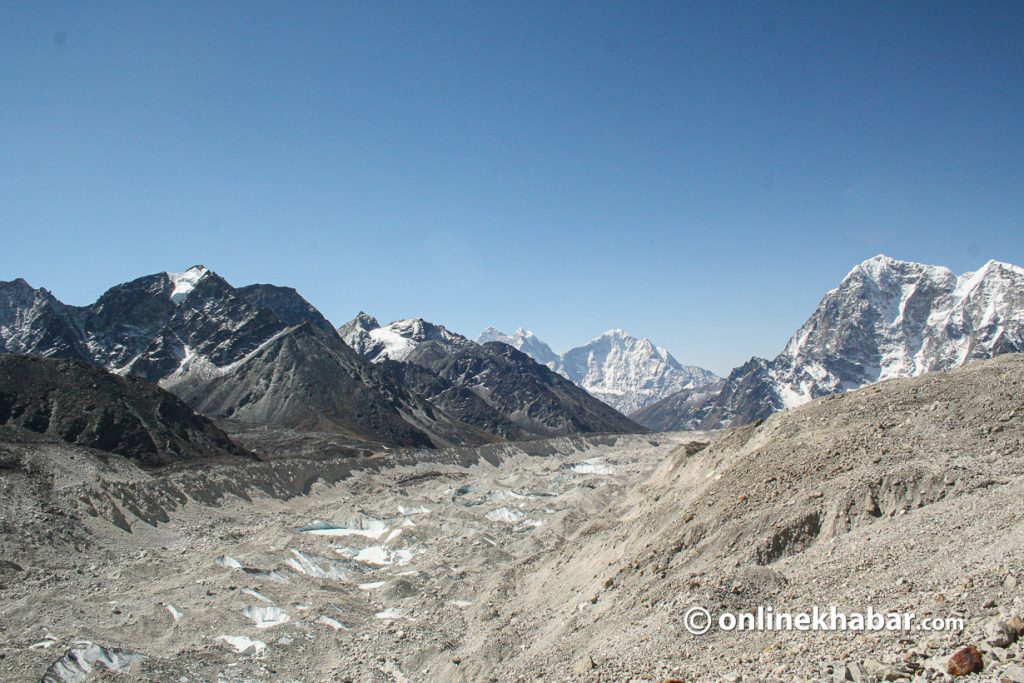
National Geographic reported that a huge mass of glacier ice and rock covering around two square kilometres fell from the Langtang Lirung mountain area in Rasuwa into the valley below.
The report said climate change had been weakening the slope in the days, weeks, months and years before the collapse, leaving it vulnerable to landslides.
For Nepali officials, the scale of the disaster is particularly significant because the country’s contribution to global climate change remains extremely small.
But there is another side to the story.
Nepal’s emissions have increased sixfold
There is little dispute that Nepal’s contribution to global greenhouse gas emissions is negligible. Its per capita emissions are not only far below those of the world’s biggest emitters but also substantially below the global average.
The global average annual carbon emissions per person stand at 4.67 tonnes. Nepal’s figure is just 0.54 tonnes.
That, however, does not mean Nepal can simply sit back because its emissions are low, experts say.
Nepal became a party to the United Nations Framework Convention on Climate Change in 1994. Over the three decades since then, the country has sought to reduce emissions and strengthen its ability to adapt to climate change.
But World Bank data show that per capita emissions have actually increased.
In 1994, Nepal’s annual per capita emissions stood at 0.0873 tonnes. By 2024, the figure had risen nearly sixfold to 0.5360 tonnes.
The increase has continued in recent years. Per capita emissions stood at 0.5063 tonnes in 2022 and 0.5197 tonnes in 2023.
Compared with 1970, Nepal’s per capita emissions have increased roughly 20-fold. In 1970, the figure was only 0.02683 tonnes per person per year.
These figures, however, do not mean that Nepal has done nothing to reduce emissions or adapt to climate change.
Forests and climate adaptation
Nepal signed the Convention on Biological Diversity during the 1992 Earth Summit in Rio de Janeiro. The convention covers the conservation of biodiversity, sustainable use of its components and the fair and equitable sharing of benefits arising from genetic resources.
Nepal says its forest coverage has also increased significantly. Forests covered around 40 percent of the country in 2000, while the figure has now reached 46 percent.
Government officials attribute part of this increase to community forestry and the implementation of the national REDD strategy, arguing that the expansion of forest cover has also contributed to reducing greenhouse gas emissions.
Nepal says it has been working on climate management and balance since becoming a party to the UN climate convention in 1994.
Even before climate change became a central policy issue, the country’s Millennium Development Goals and Sustainable Development Goals indirectly addressed several climate-related concerns, officials say.
Nepal began its National Adaptation Programme in 2008 with the aim of strengthening climate adaptation capacity and reducing risks faced by vulnerable households and communities. Reducing the risk of floods caused by glacial lake outbursts was identified as one of its priority areas.
A year later, the government established the Climate Change Council under the prime minister, with experts included, as well as a Climate Change Coordination Committee involving various stakeholders to coordinate climate-related plans and programmes.
The Climate Change Division at the Ministry of Forests and Environment was designated as the focal point for coordinating climate-related issues.
Hydrologist Madhukar Upadhya says Nepal has repeatedly told international climate forums that it is suffering the consequences of a problem it did little to create.
According to Upadhya, Nepal has prioritised climate concerns not only through the Millennium Development Goals and Sustainable Development Goals but also through the national budget.
He says 81 budget headings are related to activities that contribute to climate balance, with Nepal beginning to track such spending from the 2012 budget.
“Annual spending itself shows how Nepal can address the issue of climate change,” Upadhya says.
From policy to Paris
The government formulated a climate policy in 2010. The same year, a framework for Local Adaptation Plans of Action was prepared to integrate climate concerns into local development planning.
The plans were subsequently developed in areas considered vulnerable to climate-related risks, according to government officials.
Nepal signed the Paris Agreement in 2016 and subsequently made commitments through its Nationally Determined Contribution.
A new National Climate Change Policy was introduced in 2019.
In November 2021, the Cabinet approved the 30-year National Adaptation Plan for 2021–2050. The same meeting also approved the Long-Term Net-Zero Emission Strategy and the National Framework on Climate Change-Induced Loss and Damage.
The international loss and damage mechanism itself was established by the Conference of the Parties to the UN climate convention and the meeting of parties to the Paris Agreement.
Its purpose is to support developing countries that are particularly vulnerable to the adverse effects of climate change. Its mandate covers support for developing countries dealing with both economic and non-economic losses and damages associated with climate change.
Nepal wants climate leadership, but faces a growing risk
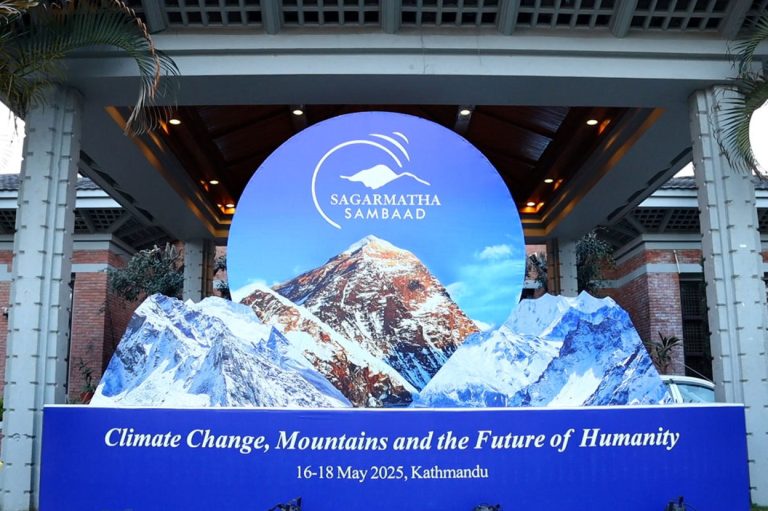
Last year, Nepal organised the Sagarmatha Sambaad under the theme “Climate Change, Mountains and the Future of Humanity”.
The conference concluded in May 2025 with the adoption of a 25-point “Sagarmatha Call for Action”, outlining measures aimed at maintaining the 1.5-degree Celsius temperature limit.
Through the Sagarmatha Sambaad, Nepal also sought to position itself as a leading voice on climate issues on the international stage.
But climate change is no longer simply an international environmental issue for Nepal.
Experts say it has increasingly become intertwined with development, energy, forests, agriculture, infrastructure, the economy and, most directly, disasters.
Arjun Dhakal, who works as a consultant in environmental economics and policy, says Nepal initially failed to take climate change seriously enough.
“Climate change was at times treated as an issue for NGOs or a foreign agenda,” he says. “Initially, we said it was an environmental issue. Later, we considered it a development issue. But we did not look at it as an economic issue that could create a major crisis like the one now seen in Bhotekoshi.”
Dhakal says he had been warning about the potential risks to hydropower projects for years.
“I have been saying this, but nobody seemed to care. There are no measures to reduce risks in major projects like Melamchi,” he says.
At the very least, he argues, Nepal now needs to recognise that climate change can affect the country’s infrastructure and livelihoods on a much larger scale.
That may be the central challenge behind Nepal’s demand for climate justice.
The country remains a very small contributor to global emissions, yet its emissions have risen over the decades. At the same time, it has expanded forest cover, introduced climate policies, invested in adaptation and sought a stronger role in international climate diplomacy.
The Rasuwa disaster has brought these two realities into sharp focus: Nepal is asking those responsible for the bulk of global emissions to help bear the cost of climate-related losses, while it must also confront the growing climate risks — and its own rising emissions — at home.