

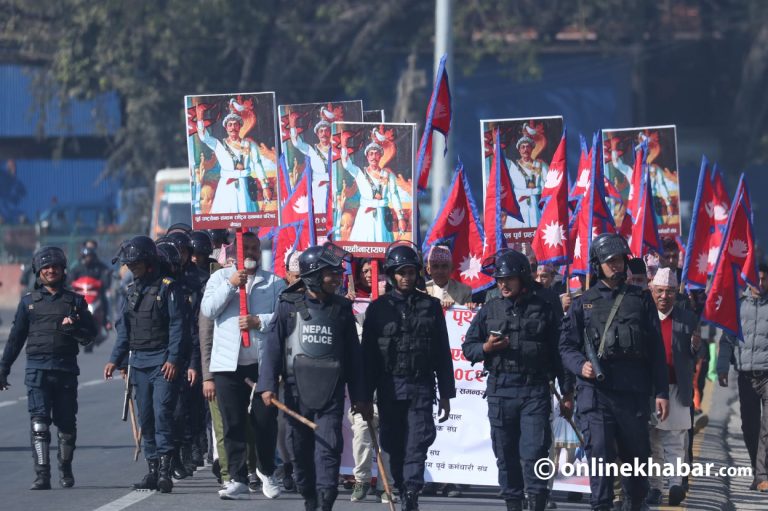
Remembering Prithvi Narayan Shah conveys a powerful message to the world about navigating geopolitical complexities with foresight to address contemporary challenges in Nepal. Without formal exposure to world literature, he initiated the expansion of his state by integrating multiple fragmented principalities into a single, larger political entity, a process now referred to as unification.
At a time when Nepal was divided into many small states, the King of Gorkha led the effort to unify them into Greater Nepal while pursuing a balanced foreign policy. His famous characterisation of Nepal as a “yam between two boulders” remains relevant today, particularly in the context of Nepal’s role as a bridge between powerful neighbours.
His ambitious and courageous nature played a crucial role in shaping the unification process and in the creation of a strong and sovereign state. The unification campaign was not merely a territorial expansion; it was a strategic effort focused on consolidation, internal stability, and protection from external powers. Through military strength, strategic manoeuvring, advanced weaponry, diplomatic skill, and long-term vision, he laid the foundation of modern Nepal.
Without explicitly referencing Sun Tzu’s The Art of War, Chanakya’s Arthashastra, or Thucydides’ History of the Peloponnesian War, Prithvi Narayan Shah followed indigenous wisdom, including the counsel of Bise Nagarchi. Many of his strategies resonate with later theoretical perspectives on the nation-state and nation-building, particularly those of Francis Fukuyama and Michel Foucault.
Fukuyama emphasises political order, strong institutions, and governance mechanisms as the foundation of a stable state, while Foucault focuses on power and governance, examining how authority and social control shape societies. Together, these perspectives provide valuable insights into understanding the processes and challenges of building a unified and resilient nation.
In Nepal, the core task of state-building was largely accomplished in the past through unification, which laid the foundation for a sovereign and culturally integrated nation. However, subsequent efforts needed to focus on strengthening institutions, governance mechanisms, and political stability to ensure the effective functioning of the state.
Political upheavals over the past eight decades have raised serious questions about the sustainability of Nepal’s nation-building achievements. Frequent changes in governance and prolonged instability suggest that even past gains are under threat. Structures established to maintain unity have been repeatedly challenged, from the mass movements of 1950, 1990, and 2006 to more recent Gen-Z-led movements. These developments highlight the fragility of political order and raise doubts about whether state-building can firmly take root in Nepal.
From the Rana regime to the introduction of democracy
The 1950s marked a transformative period in Nepal’s history. The end of the 104-year Rana autocracy ushered in a democratic era. Following the establishment of democracy in 1950, successive governments initiated policy changes aimed at reshaping various sectors of society. During this period, Nepal signed the 1950 Peace and Friendship Treaty with India, establishing a foundational framework for bilateral relations that continues to influence ties today.
However, this era remained one of political transition. The limitations of the 1950 treaty have become increasingly apparent in the context of changing security architecture and border tensions. India’s refusal to accept the Eminent Persons Group (EPG) proposal to revise the treaty has further strained relations, suggesting potentially rougher waters ahead.
From absolute to semi-constitutional monarchy
In 1960, executive and emergency powers were centralised, and the elected Congress government was dissolved amid allegations of corruption, poor governance, and threats to national unity. Popular discontent within the Panchayat system grew, culminating in the 1990 movement, when a left-democratic alliance launched mass demonstrations and strikes to restore multiparty democracy.
Although democracy was restored, nation-building once again faced setbacks due to political instability. The shift from an absolute to a constitutional monarchy aimed to promote inclusive governance but was soon followed by the Maoist insurgency in 1996 and renewed political fragmentation, compounded by monarchical interference.
This phase ended with the Comprehensive Peace Accord (CPA) in 2006 and the declaration of Nepal as a Federal Democratic Republic, followed by the promulgation of a new constitution in 2015. The constitution established inclusive democracy, secularism, and a development vision oriented towards socialism with economic growth. However, persistent carousel leadership within political parties has weakened policy continuity, accountability, and public trust. Frequent leadership changes and the recycling of political elites have discouraged long-term planning, domestic confidence, and foreign investment, undermining nation-building efforts.
Key challenges to nation-building
Political Instability:
Frequent government changes, ageing political leadership, internal party power struggles, and a lack of visionary leadership remain major obstacles. Without stability, long-term governance and development plans cannot be effectively implemented.
Weak Institutions:
Strong institutions are essential for governance, the rule of law, security, and public service delivery. In Nepal, politically influenced and underdeveloped institutions have emerged as a critical challenge to sustaining nation-building progress.
Social Fragmentation:
Deepening divisions along ethnic, linguistic, cultural, religious, and economic lines have intensified social tensions. Growing inequality, unemployment, and distrust undermine social cohesion and a shared national identity, particularly in the digital era.
Corruption and Governance:
Corruption—deeply embedded in practices of bribery and patronage—has eroded public trust in political parties, leaders, and institutions. It diverts resources from essential services, fuels inequality, and weakens the social contract between the state and its citizens. Unemployed youth, frustrated by corruption and exclusion, have become a volatile force against the established political order.
Geopolitical, Geo-economic, and Security Dynamics:
Chronic political instability undermines coherent policymaking, while weak security structures threaten state capacity. Nation-building today requires comprehensive security, encompassing health, education, environmental safety, cybersecurity, food security, and political stability.
If these challenges remain unaddressed and carousel leadership persists, even the achievements of past nation-building efforts risk being lost. Upholding Prithvi Narayan Shah’s vision, ensuring public trust in institutions, equality in society, and security in all dimensions of life, is essential. Without this, Nepal’s pursuit of a strong, sovereign, and resilient state may remain incomplete amid ongoing instability.