
Kathmandu, October 11
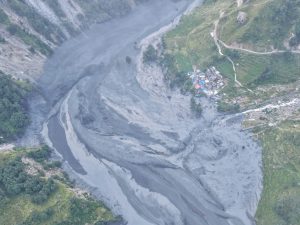
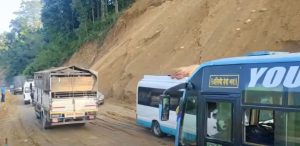
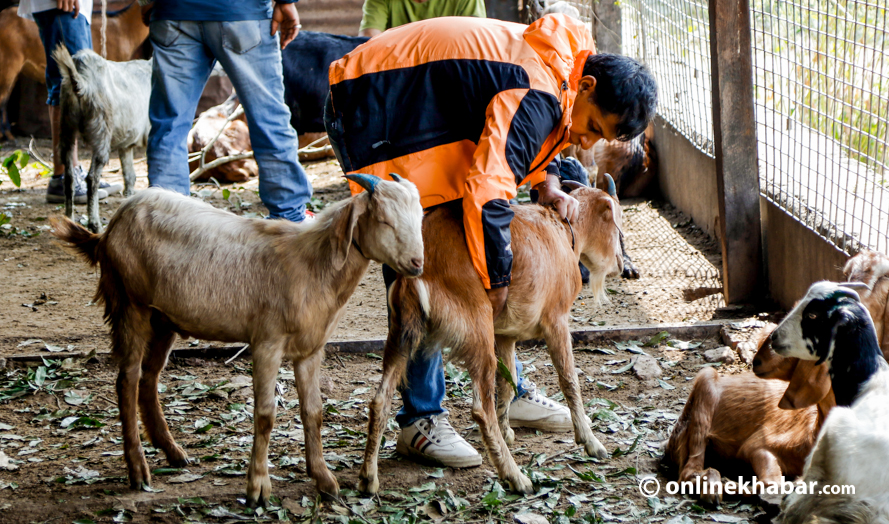
Floods and landslides triggered by incessant rainfall have disrupted Dashain meat supplies in Kathmandu Valley, raising concerns that prices of goats and sheep could rise further as major highways remain blocked.
Traders say the closure of key routes used to transport goats and Himalayan sheep, known as chyangra, has severely affected the festive meat market. With supplies falling short of demand, goat consumption in the Valley is expected to decline to 38,000–40,000 this year, down from 45,000–50,000 last year.
Babu Kaji Shahi, general secretary of the National Meat Traders Association, said the market was in disarray because livestock shipments had been unable to reach Kathmandu on time.
“The market is in a chaotic state. The goats that should have arrived have not reached the Valley because of road blockages,” Shahi told Onlinekhabar. “It is uncertain whether more will arrive. Everything now depends on the government.”
He said supplies would improve only if the government reopened roads quickly. Livestock brought from villages near Kathmandu would not be enough to meet the Valley’s substantial demand, he warned.
Shahi said prices could rise further if supply failed to meet demand, although the extent of any increase would depend on road conditions and market trends over the next two to three days.
Government supplier’s absence adds pressure on private traders

The government-owned Food Management and Trading Company has traditionally helped stabilise the Dashain livestock market by bringing in goats for sale at subsidised or controlled prices.
Kathmandu Valley typically needs 45,000–60,000 goats during Dashain. In previous years, the state-owned company supplied around 20,000–25,000, helping ease pressure on private traders and consumers.
The company will not bring goats this year, leaving private businesses to meet a larger share of demand.
“When the company does not bring goats, the entire demand shifts to the private market, creating unusual pressure,” Shahi said. “The market needs around 40,000–50,000 goats, and the company’s supply used to help balance it. Its absence will add to the pressure and contribute to higher prices.”
With the government stepping back from direct market intervention, consumers face the prospect of paying more for meat during the festival.
Markets in Kathmandu Valley would normally be filling up with goats and chyangra by this stage of Dashain. This year, however, traders say supplies remain limited.
Chyangra have traditionally entered Nepal through the Tatopani and Rasuwa border points. But the severe disaster in Rasuwa has left the route closed, making shipments through that corridor unlikely.
Shahi said the disruption of major roads used by freight vehicles, including routes through Narayangadh, Gajuri and the Kali Gandaki corridor, had further complicated transportation.
“With routes including Rasuwagadhi closed, it is uncertain whether chyangra will arrive,” he said. “The only alternative at present is the Korala border point in Mustang, but road conditions there are also causing serious problems. The situation for chyangra is therefore highly uncertain.”
Only small quantities of goats are arriving from areas near the Valley, Shahi said. He added that shortages and price increases would be difficult to control unless the government restored road access, even if only through temporary or unpaved routes.
Transport delays push up livestock prices

The Kalanki livestock market is the main entry point for goats brought into Kathmandu Valley for Dashain.
Livestock supplies for the festival usually come from around 35–40 districts, including Makwanpur, Dhading, Rolpa, Rukum, Jajarkot, Salyan and Pyuthan in the western hills, as well as Sindhuli, Nuwakot and Tehrathum in the east.
Jeevan Raj Khatiwada, chairperson of the Livestock Buying and Selling Association in Kalanki, said road blockages had made it increasingly difficult to bring goats into the Valley.
“The market situation is poor. Supplies have not been arriving since the past couple of days,” Khatiwada said. “Vehicles are moving at a snail’s pace, and it now takes 10–12 hours to reach Kathmandu from Hetauda.”
He said the lack of alternative routes to the Prithvi Highway and severe traffic congestion had caused major transportation delays. Although traders continued placing orders with farmers, shipments could not all arrive at once because of road conditions.
Khatiwada estimated that around 24,000–25,000 goats would reach the Kalanki market this Dashain.
Supply disruptions have already pushed up the price of live goats. According to Khatiwada, live goats are currently selling at Rs 850–860 per kilogram in Kathmandu, up from Rs 750 last year.
The price has risen by more than Rs 100 per kilogram even before the peak of the festival.
Goat meat, which sold for Rs 1,300–1,400 per kilogram last year, now costs Rs 1,600–1,700, he said. Prices could climb further if traders are unable to bring in enough livestock to meet demand.
Purchase prices paid to farmers vary depending on location and local conditions.
“Prices differ from place to place. Some traders have bought goats at Rs 700 per kilogram, while others have purchased them without weighing them properly. Prices depend on the farmers’ circumstances and the location,” Khatiwada said.
Farmers mobilised to maintain supply
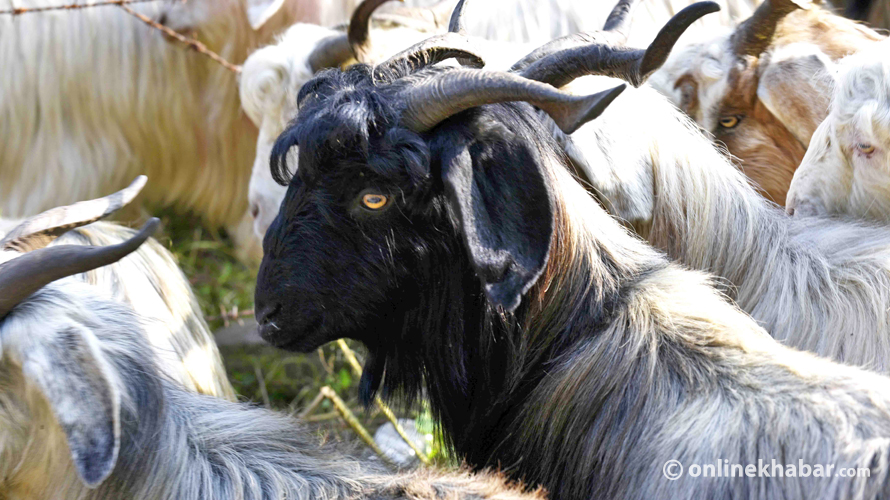
Govinda Prasad Subedi, chairperson of the Nepal Commercial Goat Farmers Federation, said efforts were under way to transport goats to Kathmandu from both eastern and western Nepal.
“Goats are being loaded and sent from across the country, but we cannot yet say exactly how many will arrive. We will know only once they reach here,” Subedi said. “Floods have blocked routes in many places. The Budhi Gandaki flood has halted movement in parts of Gorkha. We are urging farmers across the country to send livestock so that we can meet demand as much as possible.”
Subedi said a meeting of stakeholders was scheduled at the Department of Livestock Services on Tuesday to discuss the Dashain meat market, supply chains and other logistical challenges.
Representatives of the meat traders’ association and goat farmers are also expected to attend.
The government’s response to road blockages and efforts to manage livestock supplies will be crucial to easing the disruption. Without improvements, consumers in Kathmandu Valley are likely to face further price increases as Dashain approaches.