Bharatpur, September 30
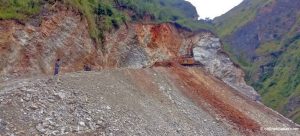
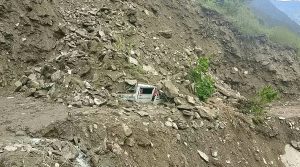
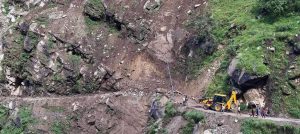
There was a time when residents of Chandisthan in Ichchhakamana Rural Municipality-7, Chitwan, would become fearful whenever they saw clouds gathering in the sky. Landslides, both small and large, were frequent.
Soil and rocks would wash downhill, forming gullies and exposing farms and settlements below to risk. Whenever clouds gathered in the sky, residents would routinely check the lake formed by water being blocked uphill.
The situation has now changed. The soil has stabilised, while grass and other vegetation have begun to grow.
Amrit Gurung, chairperson of Chandisthan Community Forest, says soil erosion has been reduced by around 95 per cent in an approximately 80-metre-long landslide-prone area where soil had continuously been washed away until three years ago.
Before discussing the measures taken to control the landslide, it is important to look at what happened in Chandisthan three decades ago.
A devastating flood in Ashwin 2054 BS caused extensive damage in Chandisthan. Water became blocked in the Ghade Khola area, forming a large lake and creating fear among settlements downstream. Locals remained awake throughout the night.
Had the lake burst at the time, nearby settlements, houses and agricultural land would almost certainly have been swept away. Tek Bahadur Chepang, then a ward member of Ichchhakamana-7, informed ward chairperson Bhaktaman Gurung about the situation. The matter was subsequently reported to the District Coordination Committee.
A team of around 300 soldiers from Bharatpur Barracks was deployed to safely drain the lake. However, the problem was not resolved.
After no solution was found, 194 households were relocated to a safer area. But relocation did not completely resolve the problem, as landslides continued. Various attempts to control the landslides failed.
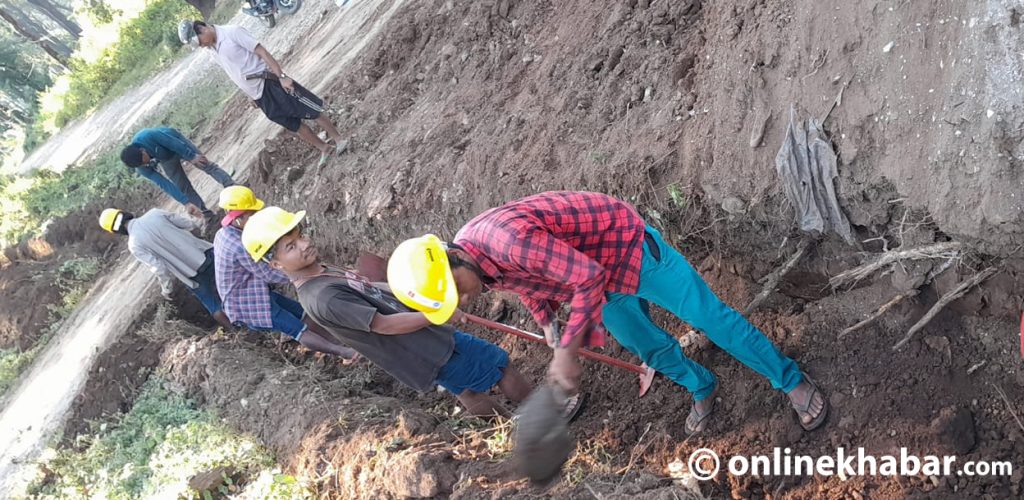
The community then began looking for a long-term solution together with locals, according to Community Forest Chairperson Gurung. Instead of relying solely on external technology, discussions were held with the local community. Particular importance was given to the practical knowledge the Chepang community had developed over generations on landslides and soil conservation.
Discussions focused on which plants could hold the soil, how water flow could be reduced and how locally available bamboo, stones and other materials could be used. The work was then taken forward through consultations with engineers and technical experts, says Shiva Subedi, programme coordinator of the Nature-based Solutions Programme. He says landslide control was carried out using bio-engineering methods that combined local knowledge with modern technology.
According to Subedi, the team learned that the local Chepang community had been effective in controlling landslides. The possibility of using their knowledge and skills along with technology to control landslides was tested, and the trial proved successful.
The Chepang community, which lives in landslide-prone settlements, has long been working to prevent floods and landslides by using local resources and traditional knowledge.
Bhim Bahadur Chepang of Thulo Syangdi worked for two months on prevention efforts in the area. According to him, Chepang people have been levelling soil and working to control landslides since they were young.
“Because our houses are located in landslide-prone areas, landslides have always caused us problems,” Chepang said. “If plants survive, landslides can also be stopped, and it becomes easier to graze buffaloes and goats. That is why we plant broom grass, Datiwan and other plants.”
Chepang said locals use bamboo in areas affected by large landslides. He said bamboo and broom grass help hold the soil and prevent landslides from expanding.
“In a landslide-prone slope, we tie three bamboo poles together, cover them with soil from above, and let them sprout from below. After planting broom grass above them, it holds the soil,” he said.
Chepang said he had never received formal training in landslide-control techniques. Instead, different methods were developed through generations of experience dealing with landslides and flash floods.
“No one taught us. Landslides had occurred here before, and later there was a major landslide. When a landslide occurs, there is no place to graze goats. So we plant vegetation immediately,” Chepang said.
At the time, 36 Chepang people from Thulo Syangdi worked for around one and a half months to control the landslide. Landslides and flash floods are not new problems for them.
“We grew up dealing with landslides and flash floods. We have succeeded by doing what we know,” he said.
The Chepang community, which has long faced natural disasters, has been practising landslide control by using locally available resources and knowledge passed down through generations. Their practices demonstrate the role that traditional knowledge and local technology can play in disaster prevention.
What is bio-engineering?
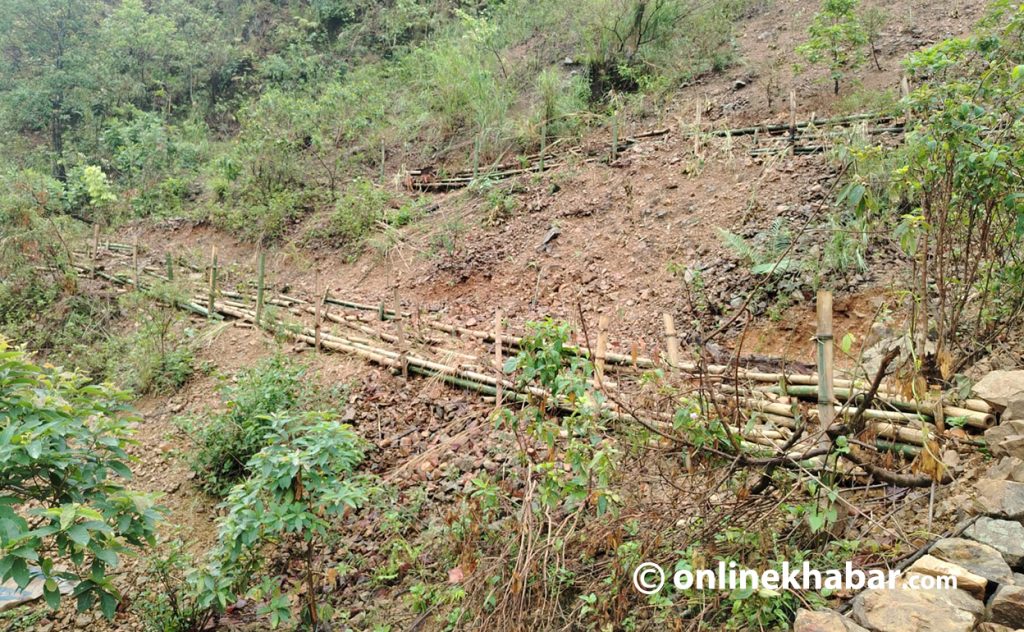
One of the key approaches used in Chandisthan is bio-engineering. The method combines vegetation and natural materials with engineering structures to control soil erosion, landslides and rapid water flow, and it has proved effective.
Bamboo, grass, shrubs, plants and other locally available biological materials have been used to control landslides. Stones, gabions and other structures have also been built where necessary, according to Programme Coordinator Subedi.
The objective is not to stop water completely but to reduce its speed, prevent soil from being washed away and create an environment in which vegetation can grow, says Bishnu Acharya, chief of the Division Forest Office, Chitwan. As plant roots spread through the soil, they help hold it together, while landslide-affected areas gradually become green, he said.
Therefore, he said, bio-engineering structures can be understood not simply as physical structures but as a combination of nature and engineering.
Work has been carried out in different phases on a landslide-affected hill in Chandisthan measuring around 380 metres in length and 180 metres in width.
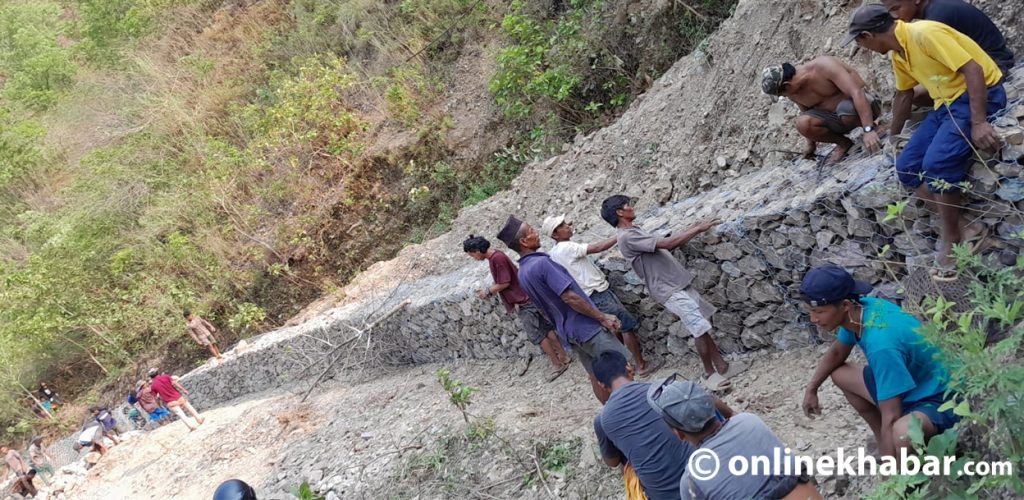
“Locally available bamboo and stones have been used to control the landslide,” said Community Forest Chairperson Gurung. “Bamboo crib walls have been constructed, along with stone pitching and walls. Gabion walls have also been installed at the bottom of the stream to prevent water flow from eroding and carrying away the ground.”
These structures have helped control water flow and reduce the speed of soil erosion. Grass and other vegetation have now begun to grow in the area. Soil has stabilised in places where soil and rocks previously washed downhill.
Locals have been able to see the impact of the landslide-control measures themselves.
“Previously, soil would wash downhill from the landslide during the monsoon,” said resident Maya Tamang. “The landslide had created gullies. Now the soil has stabilised, and plants have started growing in those areas. Perhaps there will be no more landslides.”
The experience of Chandisthan shows that disaster-related problems can be addressed by understanding nature, respecting local knowledge and working together with communities.