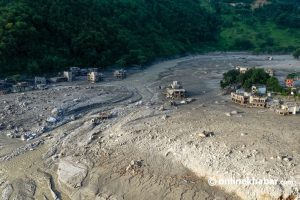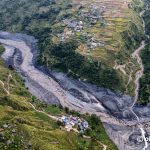



No home to live in. No contact with family members. Only a faint hope that they might return. Locals of Betrawati are still searching, hoping to find a relative. Their bodies are caked in sand and mud. They have no clothes to change into.
When we arrived in the evening of August 27, those displaced by the Betrawati flood in Nuwakot were still searching for shelter.
“Yesterday we went and stayed at Keraghari. Today too, we’ll go there again,” says Indra Maya Dangol.
As evening fell, a group of 15–20 people set out for Keraghari, three hours away from Betrawati.
The Dangol family alone had more than 100 households in Betrawati. The flood swept away some; some are still reachable, and there’s no confirmed count. But on the day the flood hit, on August 26, around 50 people went to stay overnight at Keraghari. On the second day, about 30 stayed.
“Some left, saying they wouldn’t stay here and headed toward Kathmandu. Some have gone toward Bidur. We’re staying here because we have nowhere else to go,” Dangol says. “We’re sleeping under the open sky.”
More than shelter, she is worried about her son. Her son, seriously injured in the flood, was rescued and taken to Kathmandu.
“It’s been three days. I heard he’s being treated at the trauma centre. I haven’t been able to talk to him; the phone doesn’t connect,” she says, praying for his recovery.
Everyone who survived by fleeing has lost someone or something. Some are injured.
“We had more than 100 households. Whoever you see here now, that’s all that’s left. There’s no one else,” says Narayan Lal Dangol. “Some are said to be still in the jungle, but we haven’t been able to reach them. Most have been swept away.”
Betrawati had been preparing to celebrate Gai Jatra and Janai Purnima grandly today. But the flood left them homeless instead.
“We had prepared for a big festival procession. But now this place looks like a cremation ghat. We’re taking shelter in a villager’s house,” said Yogesh Dangol. “Just look at the state we’ve had to live in today.”
Even those who found shelter in a villager’s home remain haunted by memories of the flood.
“I can’t sleep. The moment I close my eyes, that’s all I remember. I couldn’t sleep last night either. How I escaped, how I got here, I don’t know. I can barely even walk,” Dangol says.

Resident Suna Tamang has been feeding the displaced morning and evening.
“On the first day there were 50–60 people. The gas ran out. I’ve been cooking over an open fire to feed them,” she said. “Everyone’s eyes are full of tears. Those who survived such suffering had to be fed.”
Since the flood buried everything, the displaced don’t even have food supplies of their own.
“There’s no house at all. Where would food supplies be? We don’t know how we’ll survive. For those who lived, it’s one hardship piled on another,” says Narayan Lal Dangol. “Relief is urgently needed here.”
The displaced are forced to spend the night in the courtyard of Suna Tamang’s house. They urgently need temporary shelter.
“We don’t know where to go tomorrow, where to stay. Will the government even look after us now that we’re homeless? The government hasn’t come here yet,” Indramaya says.