
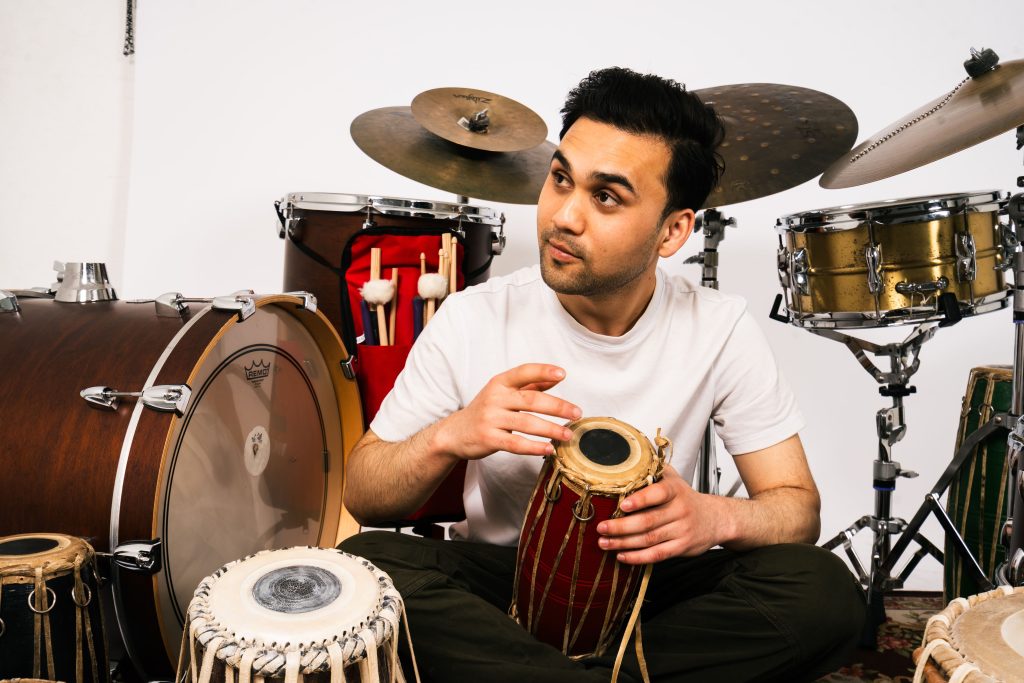
From winning the UK Young Drummer of the Year title to graduating from London’s prestigious Guildhall School of Music & Drama and releasing a critically acclaimed debut album, musician Anmol Mohara has already achieved what many artists aspire to in an entire career.
A native of Dharan, Eastern Nepal, and currently based in the UK, Mohara is an exceptional musician whose primary instrument is the drums. His recently released debut album, Across the Sea, is a sixteen-track collection that showcases not merely his musical versatility but also his enduring connection to his homeland.
“Once you leave your country, it makes you love your country more. You observe Nepal from a different perspective,” says Mohara. “I have included my love and observations about my country in the album.”
Bridging musical worlds
The album moves between personal reflection and cultural remembrance. In tracks such as Sakhiye Ho, Shilu, and Sorathi, Mohara pays tribute to Nepal’s rich musical traditions, blending reverence with contemporary expression. Migrant captures the emotional complexities of living far from home, exploring themes of displacement and belonging. Meanwhile, Momo in My Mind expresses his craving for momo of Kathmandu.
The album is largely a fusion of Eastern and Western musical traditions. In tracks such as Sakhiye Ho, a traditional song of the Tharu community, and Sorathi, a traditional song of the Magar community, Mohara blends indigenous melodies with jazz-inspired compositions. According to him, the purpose of this fusion is to make Nepali music more accessible to global audiences.
“At university, I studied different musical traditions and began exploring ways to fuse them with Nepali music,” says Mohara. I have always wanted our music to reach a global audience,” he adds.
The songs in the album are accompanied by traditional instruments like tabla, madal, and nagarah, which are all played by Mohara himself.
While working on the album with musicians from different countries, Mohara noticed that many of them were excited by the opportunity to engage with Nepali music. For the international artists featured on the album, it was an entirely new experience, a chance to explore the music of a country they had never visited.
To make collaboration easier, Mohara arranged the songs with a contemporary sensibility, leaving ample room for improvisation. This approach allowed the foreign musicians to contribute their own interpretations while engaging with the essence of the original Nepali melodies.
Roots of rhythm
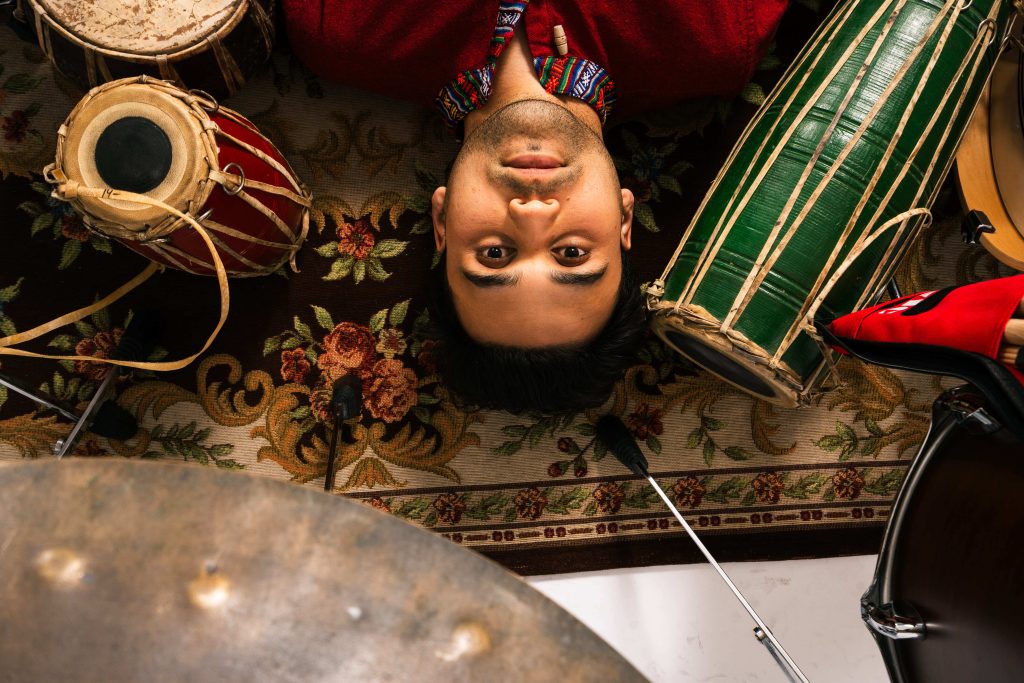
Since his early days at the Nepal Music Centre (NMC), where he began his formal musical education, Mohara has been involved in fusion music. Even then, he would perform on drums, fusioning with traditional instruments such as the tabla, flute, and sarangi, playing songs drawn from various Nepali communities and musical traditions.
Mohara got into music at a very young age; he was just nine when he joined NMC. His interest was sparked by his uncles, who were passionate about music and loved to sing. Dharan frequently hosted various musical events, and during one of these gatherings, Mohara discovered the congo drums. His uncles encouraged him to give them a try.
“The time when I played congo, it was so natural and fascinating,” Mohara recalls.
This experience sparked a growing passion for music. Knowing about NMC, his parents enrolled him in the academy. Since NMC didn’t offer specific classes for the congo, Mohara began learning the drums instead, later expanding his skills to the tabla and madal.
While in Nepal, Anmol Mohara had the opportunity to learn and perform with talented musicians, helping him build a strong musical foundation. Later, he moved to the UK. Drawing on the drumming skills he had developed in Nepal, he won the title of UK Young Drummer of the Year in 2017 during his early years there.
To further hone his craft, he enrolled at the Guildhall School of Music & Drama, where he specialised in jazz drums. He chose jazz because he found many of its skills transferable across musical genres, particularly improvisation.
“I love improvising and want to bring that spirit into any form of music I play,” says Mohara.
In the final year of his undergraduate studies, he performed an original composition as part of his examination, and the piece was well received by his teachers. The positive response encouraged him to create more original works, eventually leading to the album.
Becoming a musician
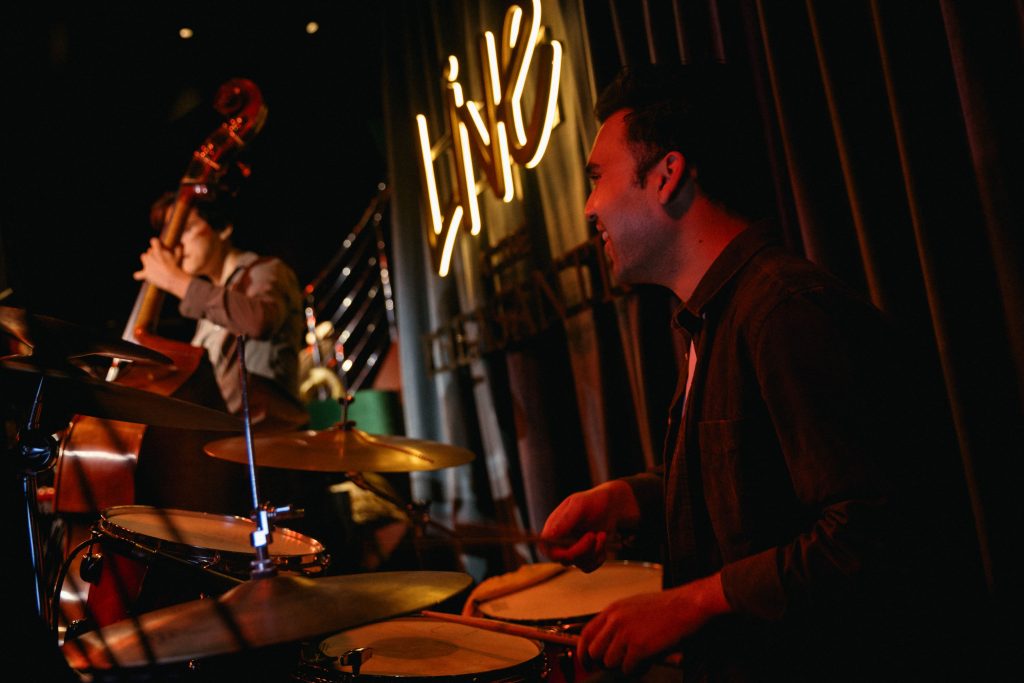
During his time in the UK, Mohara realised that musicians there generally have easier access to music education, advanced equipment, and performance platforms. As a result, many are relatively well-versed in both the theoretical and practical aspects of music.
Anmol Mohara believes that his education in the UK helped him unlock a broader range of musical abilities.
“Before, I was only a drummer. Now, I am recognised as a musician because I write songs, compose them, arrange them, and produce them,” he says to Onlinekhabar.
As he has transitioned into a full-fledged musician, Mohara shares his creative process.
Mohara handles the entire arrangement in Logic Pro, a music production software. Once the arrangement is complete, he holds band rehearsals.
“While playing with the band, things become clearer — what needs to be changed in the song,” says Mohara.
As part of his album launch, Mohara is performing at South Asian Sounds at the Soundbank Centre, one of the UK’s largest arts and cultural complexes, on July 1.
Currently, besides making music, Mohara is planning a tour of Nepal and Europe. Only after completing the tour does he intend to begin work on another album.
“A single album won’t achieve everything. I want to keep making more music,” says Mohara.