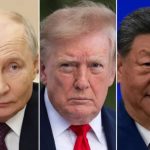


US President Donald Trump’s meeting with Russian President Vladimir Putin and Chinese President Xi Jinping in Shenzhen raises important questions about the kind of world order he hopes to shape in the final years of his presidency.
Is Trump genuinely interested in promoting a safer, rules-based international order? Does he want to build trust with China and Russia, or is the meeting another example of his unpredictable foreign policy, one that creates more anxiety among allies than adversaries?
Trump has said that nuclear weapons will be a central focus of the trilateral meeting. The discussions may also cover the wars in Ukraine and Iran, while trade is expected to feature prominently on the agenda.
The meeting comes on the final day of the Asia-Pacific Economic Cooperation (APEC) summit, hosted in Shenzhen under the theme “Building an Asia-Pacific Community to Prosper Together”.
For the first time, the leaders of the world’s three most powerful military and technological powers are meeting in one room. They have come together at a moment when wars are raging in Europe and the Middle East, trust between capitals is diminishing, and the arms-control framework that helped maintain nuclear stability for decades is unravelling.
Why hold this summit?
Nobody should mistake the Shenzhen meeting for reconciliation. Held on the sidelines of the APEC leaders’ meeting, the summit followed an idea Putin reportedly floated to Trump on October 26. Trump accepted the proposal, while Xi, as host, helped shape the diplomatic setting. He welcomed Trump at the airport and held talks with Putin a day before the trilateral meeting.
The three leaders have different objectives.
Trump has made nuclear arms reduction a headline priority. He also wants to demonstrate that he can shape the global agenda by engaging directly with two major geopolitical rivals.
Putin, meanwhile, wants to reduce Russia’s international isolation, gain diplomatic legitimacy, prevent further sanctions and secure a say in how the war in Ukraine ends. He also seeks recognition of Russia as a major power with its own sphere of influence, alongside opportunities for cooperation on global stability.
Xi wants to reinforce China’s position as an indispensable global power and a convener of great-power diplomacy, without accepting commitments that could constrain his country’s military expansion. He also wants to strengthen China’s role in shaping a multipolar world order, stabilising trade and economic relations while demonstrating its technological capabilities.
Observers in major capitals do not expect significant breakthroughs. The meeting may produce more symbolism than concrete agreements. But that does not make it irrelevant. In an increasingly unstable international environment, simply keeping channels of communication open between major powers can itself be a form of risk management.
The nuclear problem and the need for a new rulebook
Nuclear weapons are among the most important issues the three leaders must address. The central difficulty is the imbalance in their arsenals and their differing approaches to arms control.
The United States and Russia possess nuclear arsenals numbering in the thousands of warheads. For decades, the two countries negotiated bilateral agreements to limit these stockpiles. However, much of that framework has now lapsed. The last major treaty between them expired on February 5, 2026, leaving no legally binding agreement in place to cap the nuclear arsenals of the world’s two largest nuclear powers.
China has a considerably smaller arsenal, estimated at around 600 warheads, but its stockpile is expanding rapidly. Beijing has consistently resisted joining trilateral arms-control negotiations while its nuclear arsenal remains far smaller than those of Washington and Moscow.
Other nuclear-armed states would also need to be considered in any broader international framework.
From China’s perspective, an arms-control agreement that freezes the existing imbalance could place it at a disadvantage. From the American and Russian perspectives, however, an expanding Chinese arsenal without sufficient transparency presents a strategic concern.
There is no easy way to bridge these positions. A realistic outcome in Shenzhen may therefore be a political understanding rather than a formal treaty. The three leaders could agree to continue discussions, exchange information and reaffirm the principle that a nuclear war cannot be won and must never be fought.
One important consequence of the summit is that Trump has chosen to engage with the Russian and Chinese presidents as equals in discussions about global security. This raises broader questions about whether the three leaders can contribute to improving international governance and addressing challenges that extend beyond their own countries.
However, their ability to influence global affairs also comes with a responsibility to recognise the interests of countries that are not represented at the table. The future of international governance cannot be determined by three leaders alone.
Where is military development heading?
Whatever is discussed in Shenzhen, the direction of military development is already clear. Weapons are becoming faster, smarter and increasingly difficult to monitor and verify.
All three powers are modernising their nuclear forces. They are investing in hypersonic missiles that shorten warning times, missile defence systems and space-based technologies that could undermine the logic of mutual vulnerability. They are also expanding their use of drones and uncrewed systems, whose relatively low costs and battlefield effectiveness have been demonstrated in Ukraine and the Middle East.
These developments are weakening the foundations of traditional strategic stability.
Arms control was once easier because weapons were relatively few in number, large enough to detect and slow enough to give political leaders time to respond. Hypersonic weapons, cyber capabilities, anti-satellite systems and mass-produced drones are changing those conditions.
The next phase of military competition will be harder to monitor, regulate and explain to the public. How countries can establish effective mechanisms to track these developments remains a major challenge.
Artificial intelligence: A weapon and an arms-control challenge
Artificial intelligence could become one of the most consequential issues discussed in Shenzhen, even if it does not receive the greatest public attention.
AI is entering military operations on several fronts. It is accelerating intelligence analysis and target identification, powering increasingly autonomous drones and weapons systems, and being considered for roles in command, control and early-warning systems — areas closely connected to nuclear decision-making.
The risks are significant. Systems that process sensor data within seconds could push political and military leaders towards faster, less considered decisions. A false alarm generated or amplified by an algorithm during a crisis between nuclear-armed states could have catastrophic consequences.
There is already a precedent for addressing this concern. On November 16, 2024, US President Joe Biden and Chinese President Xi Jinping affirmed that decisions on the use of nuclear weapons should remain under human control rather than artificial intelligence.
Reports ahead of the Shenzhen summit suggest that the three powers may explore a similar commitment covering AI in nuclear arsenals as part of a broader discussion on global governance. If the meeting extends the principle of human control from two powers to three, it would represent one of the few practical outcomes available.
However, the wider competition over AI cannot be resolved through a single sentence in a joint statement. The race for advanced semiconductors, large AI models and military applications is also a competition for economic and strategic power. Each side suspects the others of seeking a decisive advantage.
Export controls, rare earth minerals and restrictions on technology are now as much a part of this rivalry as nuclear warheads. A world in which AI is governed by three competing blocs, each operating under its own standards and secrecy, would be more dangerous than one in which countries agree on minimum international rules.
The summit also cannot be separated from the conflicts surrounding it. The war in Ukraine and the conflict involving Iran are on the agenda, although officials have played down expectations of major breakthroughs.
Smaller countries and people living in conflict zones will be watching for signs that powerful states are deciding the future of others without their participation.
The memory of the 1945 Yalta Conference, where major powers negotiated the post-war order and divided spheres of influence, hangs over such gatherings. Commentators have already drawn comparisons. Any attempt to settle the future of Ukraine without Ukraine, or the Middle East without the countries and people directly affected, could create further instability.
However, the geopolitical landscape today is very different from that of 1945. More countries now possess advanced technologies, significant military capabilities and, in some cases, nuclear arsenals. Global power is no longer concentrated in the same way.
What smaller countries should want
For countries such as Nepal, which are situated between major powers and depend on a stable, rules-based international order, the Shenzhen summit is neither a reason to panic nor simply a spectacle to observe from the sidelines.
The interests of the Global South are straightforward: fewer weapons, safer technologies, open trade and a multilateral system that remains meaningful.
Small and middle-sized states can take three important steps.
First, they should use the United Nations and regional forums to advocate for human control over lethal and nuclear decisions, as well as a transparent international framework governing military AI. The rules should not be left exclusively to the countries with the greatest military and technological power.
Second, they should insist that peace agreements involve the countries and communities that will bear their consequences. Settlements imposed without the participation of those directly affected are unlikely to deliver lasting stability.
Third, they should maintain the principle of non-alignment in practice. Countries such as Nepal should seek constructive relations with all three powers while resisting pressure to choose sides in their strategic competition.
The final assessment of Shenzhen
History will judge the summit not only by the photograph of the three leaders but also by what follows it.
If they leave with warm words but no mechanism for continued engagement, the world will have lost an opportunity. If they agree on even a modest set of commitments — including regular strategic dialogue, crisis hotlines, human control over nuclear decisions and a willingness to begin negotiations on AI in weapons systems — Shenzhen could be remembered as a moment when major powers chose to reduce the risk of catastrophe.
The instability of the current international environment demands more than symbolism. It requires the countries possessing the world’s most dangerous weapons and powerful technologies to agree on some basic principles.
No machine, miscalculation or uncontrolled military system should be allowed to determine the fate of humanity.